
Question 765 marksMedium
With the use of Archimedes' principle, state how you will find relative density of a solid denser than water and insoluble in it. How will you modify your experiment if the solid is soluble in water ?
Confirming your payment
Sign up now and get 250 free tokens.
Upthrust in Fluids, Archimedes' Principle and Floatation · Question 76 of 143
With the use of Archimedes' principle, state how you will find relative density of a solid denser than water and insoluble in it. How will you modify your experiment if the solid is soluble in water ?
Solution:
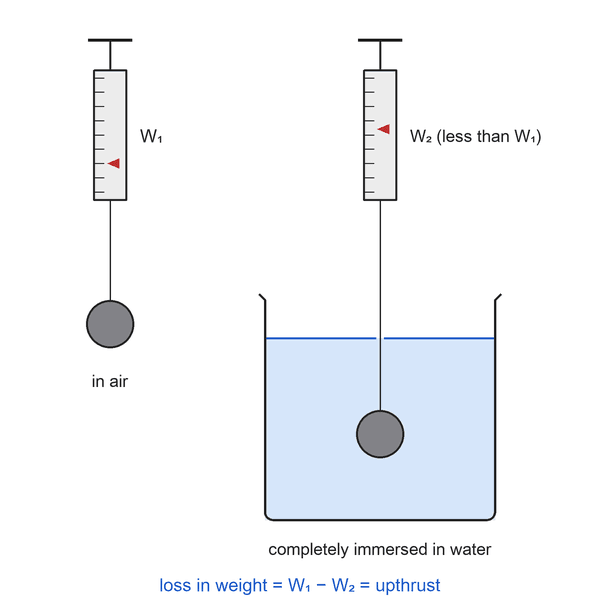
Concept: To find the R.D. of a solid, weigh it in air () and completely immersed in water (). The loss in weight is the weight of water of the same volume as the solid (Archimedes' principle), so R.D. = .
Solid denser than water and insoluble in it
Step 1 — Weigh in air.
Hang the solid from the hook of a spring balance with a fine thread and find its weight in air, gf.
Step 2 — Weigh in water.
Lower it until it is completely immersed in water in a beaker, without touching the sides or the bottom. Note its weight in water, gf.
Step 3 — Use Archimedes' principle.
The loss in weight is the weight of water displaced, which is the weight of water of the same volume as the solid.
Solid soluble in water
Step 4 — Choose another liquid.
Water cannot be used, because the solid would dissolve. Use a liquid in which the solid does not dissolve and does sink (for example kerosene), whose relative density is known.
Step 5 — Weigh in that liquid.
Weigh the solid in air, , and then completely immersed in the liquid, . Now is the weight of an equal volume of the liquid, so compares the solid with the liquid.
Step 6 — Convert to water.
Multiplying by the R.D. of the liquid changes 'compared with the liquid' into 'compared with water'.
Watch out: The solid must be completely immersed and must not touch the beaker, or the loss in weight will be wrong.
Therefore, for an insoluble solid R.D. is W₁ ÷ (W₁ − W₂) using water, and for a soluble solid the same weighing is done in a liquid in which it does not dissolve, and the result is multiplied by the R.D. of that liquid.