
Opening your dashboard
Class 9 Physics Chapter 4: Pressure in Fluids and Atmospheric Pressure Solutions
117 textbook questions with step-by-step answers, free to read, for ICSE 2026-27.
Get talked through Ch 4, not just shown the answer
Reading a finished solution is not the same as being able to do it. The AI tutor takes one question at a time and works it with you, in your own words, until you can.
- Ask it out loud, in your own words
- It gives you the next step, not the answer
- Stuck on part (ii)? Start there
117 questions with solutions
1–5 marks · Mixed difficulty
The first 54 solutions are on this page. This chapter is a long one, so the rest open on their own page to keep this one quick to load.
- 11 mark
Question 1
The force acting normally on a surface is called :
Solve with AIAnswer
(A) pressure
(B) friction
- Correct
(C) thrust
(D) none of these
Answer: (C) thrust
Concept: Thrust is the force that acts normally (at right angles) on a surface. It is a force, so it is a vector, and its S.I. unit is the newton (N).
Step 1 — Read what the stem describes.
The stem describes a force that acts normally, that is at right angles, on a surface.
Step 2 — Match it with the definition.
By definition, the force acting normally on a surface is called thrust. For example, a book lying on a table presses straight down on it; that push is a thrust.
Watch out: Thrust is a force, pressure is a force per unit area; do not mix up the two names.
Why the other options are wrong:
- (A) pressure: Pressure is the thrust acting on unit area, so it is force per unit area, not the normal force itself.
- (B) friction: Friction acts along (parallel to) the surface and opposes sliding, so it is not a normal force.
- (D) none of these: This cannot be right, because the normal force on a surface does have a name: thrust.
Therefore, the force acting normally on a surface is called thrust, option (C).
- 21 mark
Question 2
The thrust exerted by a body placed on a surface is :
Solve with AIAnswer
(A) less than the weight of the body
(B) more than the weight of the body
- Correct
(C) equal to the weight of the body
(D) independent of the weight of the body
Answer: (C) equal to the weight of the body
Concept: Thrust is the force that acts normally (at right angles) on a surface. It is a force, so it is a vector, and its S.I. unit is the newton (N).
Step 1 — Find the force the body exerts.
A body resting on a horizontal surface is pulled down by its weight, and it presses on the surface with this force, at right angles to the surface.
Step 2 — Name it.
A force acting normally on a surface is a thrust, so the thrust exerted by the body is equal to its weight.
Watch out: This holds for a body resting freely on a horizontal surface; on a slope, or if someone pushes on the body, the normal force is different.
Why the other options are wrong:
- (A) less than the weight of the body: The surface supports the whole weight, so the thrust is not less than the weight.
- (B) more than the weight of the body: Nothing else pushes the body down, so the thrust is not more than the weight.
- (D) independent of the weight of the body: The thrust is the weight itself, so a heavier body exerts a larger thrust; it is not independent of the weight.
Therefore, the thrust exerted by a body placed on a surface is equal to its weight, option (C).
- 31 mark
Question 3
The S.I. unit of thrust is :
Solve with AIAnswer
(A) dyne
(B)
- Correct
(C) Newton
(D)
Answer: (C) Newton
Concept: Thrust is the force that acts normally (at right angles) on a surface. It is a force, so it is a vector, and its S.I. unit is the newton (N).
Step 1 — Recall what thrust is.
Thrust is a force (the normal force on a surface).
Step 2 — Give its S.I. unit.
Every force is measured in the S.I. unit newton (N), so the S.I. unit of thrust is the newton.
Why the other options are wrong:
- (A) dyne: The dyne is the C.G.S. unit of force, not the S.I. unit.
- (B) : m s is the unit of speed or velocity, not of force.
- (D) : N m is force per unit length (for example, the unit of surface tension), not a unit of force.
Therefore, the S.I. unit of thrust is the newton, option (C).
- 41 mark
Question 4
The effect of a given thrust is :
Solve with AIAnswer
- Correct
(A) less on large area, more on small area
(B) more on large area, small on small area
(C) does not depend on area
(D) maximum when it is inclined at with the area
Answer: (A) less on large area, more on small area
Concept: Pressure is the thrust acting on unit area of a surface: pressure is thrust ÷ area. For the same thrust, a smaller area gives a larger pressure and a larger area gives a smaller pressure. Its S.I. unit is N m, called the pascal (Pa).
Step 1 — Decide how the effect is measured.
The effect of a thrust (how deep it presses in, how easily it cuts) is measured by the pressure it produces, which is thrust ÷ area.
Step 2 — Keep the thrust fixed and change the area.
Dividing the same thrust by a larger area gives a smaller pressure, so the effect is less on a large area; dividing by a smaller area gives a larger pressure, so the effect is more on a small area. This is why a sharp knife cuts better than a blunt one.
Why the other options are wrong:
- (B) more on large area, small on small area: This is the reverse of the truth: a larger area gives a smaller pressure.
- (C) does not depend on area: The effect does depend on the area, because the pressure is thrust divided by area.
- (D) maximum when it is inclined at with the area: Thrust is the normal force; only the part of a force acting normally presses on the surface, so the effect is greatest when the force is perpendicular to the surface, not at 45°.
Therefore, the effect of a given thrust is less on a large area and more on a small area, option (A).
- 51 mark
Question 5
The pressure exerted on a surface depends on :
Solve with AIAnswer
(A) the nature of the surface on which the thrust is applied
(B) the area on which the thrust is applied
(C) the magnitude of the thrust applied
- Correct
(D) both (b) and (c)
Answer: (D) both of options (B) and (C)
Concept: Pressure is the thrust acting on unit area of a surface: pressure is thrust ÷ area. For the same thrust, a smaller area gives a larger pressure and a larger area gives a smaller pressure. Its S.I. unit is N m, called the pascal (Pa).
Step 1 — Write the definition.
Pressure is thrust divided by area.
Step 2 — Read off what it depends on.
The pressure becomes larger when the thrust is larger, and smaller when the area is larger. So it depends on both the magnitude of the thrust (option C) and the area on which it acts (option B). Option (D) names exactly these two.
Why the other options are wrong:
- (A) the nature of the surface on which the thrust is applied: The nature of the surface (wood, iron, rough or smooth) does not appear in thrust ÷ area, so the pressure does not depend on it.
- (B) the area on which the thrust is applied: The area is only one of the two factors; the thrust matters too.
- (C) the magnitude of the thrust applied: The thrust is only one of the two factors; the area matters too.
Therefore, the pressure depends on both the area and the magnitude of the thrust, option (D).
- 61 mark
Question 6
Pressure and thrust are :
Solve with AIAnswer
(A) vector quantities
(B) scalar quantities
- Correct
(C) scalar and vector quantities respectively
(D) vector and scalar quantities respectively
Answer: (C) scalar and vector quantities respectively
Concept: Thrust is the force that acts normally (at right angles) on a surface. It is a force, so it is a vector, and its S.I. unit is the newton (N). Pressure at a point in a fluid acts equally in all directions, so it has no particular direction.
Step 1 — Look at pressure.
Pressure at a point acts equally in all directions, so it cannot be given one direction. It has magnitude only, so pressure is a scalar.
Step 2 — Look at thrust.
Thrust is a force acting in a definite direction (normal to the surface), so thrust is a vector.
Step 3 — Put them in the order asked.
The stem asks about pressure first and thrust second, so the answer is "scalar and vector respectively".
Watch out: The word "respectively" means in the same order as the stem names them: pressure first, then thrust.
Why the other options are wrong:
- (A) vector quantities: Pressure is not a vector, because it has no single direction.
- (B) scalar quantities: Thrust is not a scalar, because it is a force with a direction.
- (D) vector and scalar quantities respectively: This gives the two the wrong way round: pressure is the scalar and thrust is the vector.
Therefore, pressure and thrust are scalar and vector quantities respectively, option (C).
- 71 mark
Question 7
The S.I. unit of pressure is :
Solve with AIAnswer
(A)
- Correct
(B) Pa
(C) N
(D)
Answer: (B) Pa
Concept: Units of pressure: the S.I. unit is the pascal, where 1 Pa is 1 N m. The C.G.S. unit is dyne cm. Larger units used for air pressure are the bar (1 bar is Pa), the atmosphere (1 atm is about Pa, the pressure of a 76 cm column of mercury) and the torr (1 torr is the pressure of a 1 mm column of mercury).
Step 1 — Build the unit from the definition.
Pressure is thrust ÷ area. In S.I. units the thrust is in newtons and the area in square metres, so the unit is N m.
Step 2 — Give its name.
The unit N m has a special name, the pascal (Pa).
Why the other options are wrong:
- (A) : N cm is a unit of pressure, but not the S.I. unit, because the area is in cm, not m.
- (C) N: The newton is the unit of force (thrust), not of pressure.
- (D) : N m multiplies force by area, but pressure is force divided by area, so this is not a unit of pressure at all.
Therefore, the S.I. unit of pressure is the pascal (Pa), option (B).
- 81 mark
Question 8
The C.G.S. unit of pressure is :
Solve with AIAnswer
(A) Pa
(B)
- Correct
(C)
(D)
Answer: (C)
Concept: Units of pressure: the S.I. unit is the pascal, where 1 Pa is 1 N m. The C.G.S. unit is dyne cm. Larger units used for air pressure are the bar (1 bar is Pa), the atmosphere (1 atm is about Pa, the pressure of a 76 cm column of mercury) and the torr (1 torr is the pressure of a 1 mm column of mercury).
Step 1 — Use C.G.S. units in the definition.
In the C.G.S. system force is measured in dyne and area in cm.
Step 2 — Divide.
Pressure is force ÷ area, so its C.G.S. unit is dyne cm.
Why the other options are wrong:
- (A) Pa: The pascal is the S.I. unit, not the C.G.S. unit.
- (B) : N m is the pascal itself, the S.I. unit.
- (D) : dyne cm multiplies force by area instead of dividing by it, so it is not a unit of pressure.
Therefore, the C.G.S. unit of pressure is dyne cm, option (C).
- 91 mark
Question 9
One bar is equal to :
Solve with AIAnswer
(A)
(B)
- Correct
(C)
(D)
Answer: (C)
Concept: Units of pressure: the S.I. unit is the pascal, where 1 Pa is 1 N m. The C.G.S. unit is dyne cm. Larger units used for air pressure are the bar (1 bar is Pa), the atmosphere (1 atm is about Pa, the pressure of a 76 cm column of mercury) and the torr (1 torr is the pressure of a 1 mm column of mercury).
Step 1 — Recall the size of a bar.
The bar is a large unit of pressure used for air pressure in weather reports. By definition, 1 bar is pascal.
Step 2 — Write it in N m.
Since 1 Pa is 1 N m, 1 bar is N m. This is close to normal atmospheric pressure ( Pa).
Why the other options are wrong:
- (A) : N m is a hundred times too small.
- (B) : N m is ten times too small.
- (D) : Both the power and the unit are wrong: N m is not a unit of pressure.
Therefore, one bar is equal to N m, option (C).
- 101 mark
Question 10
1 atm of pressure is equal to :
Solve with AIAnswer
(A) 0.076 m of Hg
- Correct
(B) 760 torr
(C) 76 torr
(D) 7.6 mm of Hg
Answer: (B) 760 torr
Concept: Units of pressure: the S.I. unit is the pascal, where 1 Pa is 1 N m. The C.G.S. unit is dyne cm. Larger units used for air pressure are the bar (1 bar is Pa), the atmosphere (1 atm is about Pa, the pressure of a 76 cm column of mercury) and the torr (1 torr is the pressure of a 1 mm column of mercury).
Step 1 — Write 1 atm as a mercury column.
1 atm is normal atmospheric pressure, which holds up a mercury column 76 cm high. In millimetres this is 760 mm of Hg.
Step 2 — Change to torr.
One torr is the pressure of a 1 mm column of mercury, so 760 mm of Hg is 760 torr.
Watch out: 76 cm is 0.76 m, not 0.076 m; count the decimal places carefully.
Why the other options are wrong:
- (A) 0.076 m of Hg: 0.076 m of Hg is only 7.6 cm, ten times too small; 1 atm is 0.76 m of Hg.
- (C) 76 torr: 76 torr is only 76 mm of Hg, ten times too small.
- (D) 7.6 mm of Hg: 7.6 mm of Hg is a hundred times too small.
Therefore, 1 atm is equal to 760 torr, option (B).
- 111 mark
Question 11
The pressure on a surface is reduced by :
Solve with AIAnswer
(A) using high thrust
- Correct
(B) increasing the area of surface
(C) decreasing the area of surface
(D) none of these
Answer: (B) increasing the area of surface
Concept: Pressure is the thrust acting on unit area of a surface: pressure is thrust ÷ area. For the same thrust, a smaller area gives a larger pressure and a larger area gives a smaller pressure. Its S.I. unit is N m, called the pascal (Pa).
Step 1 — Use pressure is thrust ÷ area.
To make the pressure smaller we must either reduce the thrust or increase the area.
Step 2 — Pick the option that does this.
Increasing the area of the surface spreads the same thrust over more area, so the pressure falls. That is why sleepers are laid under rails and heavy vehicles have broad tyres.
Why the other options are wrong:
- (A) using high thrust: A higher thrust increases the pressure.
- (C) decreasing the area of surface: A smaller area increases the pressure.
- (D) none of these: This cannot be right, because increasing the area does reduce the pressure.
Therefore, the pressure on a surface is reduced by increasing the area of the surface, option (B).
- 121 mark
Question 12
Cutting tools have either sharp or pointed edges so that a ............ thrust may cause a ......... pressure at the edges and cutting can be done with less effort.
Solve with AIAnswer
(A) high, high
(B) small, small
(C) high, small
- Correct
(D) small, high
Answer: (D) small, high
Concept: Pressure is the thrust acting on unit area of a surface: pressure is thrust ÷ area. For the same thrust, a smaller area gives a larger pressure and a larger area gives a smaller pressure. Its S.I. unit is N m, called the pascal (Pa).
Step 1 — See what a sharp edge does.
A sharp or pointed edge has a very small area of contact.
Step 2 — Apply pressure is thrust ÷ area.
Dividing even a small thrust by this very small area gives a high pressure at the edge, and this high pressure cuts the material. So the blanks read "small, high".
Why the other options are wrong:
- (A) high, high: The whole point of a sharp edge is to cut with less effort, so a high thrust is not needed.
- (B) small, small: A small pressure would not cut the material.
- (C) high, small: A high thrust giving only a small pressure would need a large area, the opposite of a sharp edge.
Therefore, a small thrust causes a high pressure at the edges, option (D).
- 131 mark
Question 13
The pressure inside a liquid of density at a depth is :
Solve with AIAnswer
- Correct
(A)
(B)
(C)
(D)
Answer: (A)
Concept: The pressure due to a liquid at a depth below its free surface is , where is the density of the liquid and is the acceleration due to gravity. It comes from the weight of the liquid column standing on unit area, so it does not depend on the shape of the vessel or the area of the surface.
Step 1 — Find the weight of the liquid above unit area.
A liquid column of height standing on area has volume , mass and weight .
Step 2 — Divide by the area.
Pressure is weight ÷ area, so the area cancels and the pressure at depth is .
Why the other options are wrong:
- (B) : The pressure increases with and , so they multiply ; they are not divided into it.
- (C) : multiplies the other two; dividing by would make the pressure smaller on a planet with stronger gravity, which is false.
- (D) : has no ; its unit is kg m, which is not a unit of pressure.
Therefore, the pressure inside a liquid at depth is , option (A).
- 141 mark
Question 14
Out of the following, which one is correct about the law of liquid pressure ?
Solve with AIAnswer
(A) Pressure is different in all directions about a point inside the liquid.
(B) In a stationary liquid, pressure is different at all points on a horizontal plane.
(C) Inside the liquid, pressure decreases with an increase in depth from its free surface.
- Correct
(D) It increases with an increase in the density of the liquid.
Answer: (D) It increases with an increase in the density of the liquid
Concept: Laws of liquid pressure: inside a liquid the pressure increases with depth; in a still liquid it is the same at all points on the same horizontal level; at a point it is the same in all directions; at the same depth it is greater in a denser liquid; and a liquid seeks its own level.
Step 1 — Check each statement against the laws.
We compare each option with the laws of liquid pressure listed above.
Step 2 — Find the true one.
Since the pressure at depth is , a denser liquid (larger ) gives a greater pressure at the same depth. So option (D) is a correct law.
Why the other options are wrong:
- (A) Pressure is different in all directions about a point inside the liquid: At a point inside a liquid the pressure is the same in all directions, not different.
- (B) In a stationary liquid, pressure is different at all points on a horizontal plane: In a still liquid the pressure is the same at all points on a horizontal plane.
- (C) Inside the liquid, pressure decreases with an increase in depth from its free surface: The pressure increases with depth, it does not decrease.
Therefore, the correct law is that liquid pressure increases with the density of the liquid, option (D).
- 151 mark
Question 15
The pressure at a certain depth in river water and at the same depth in sea water are related as :
Solve with AIAnswer
(A)
(B)
- Correct
(C)
(D) atmospheric pressure
Answer: (C)
Concept: The pressure due to a liquid at a depth below its free surface is , where is the density of the liquid and is the acceleration due to gravity. It comes from the weight of the liquid column standing on unit area, so it does not depend on the shape of the vessel or the area of the surface.
Step 1 — Compare the densities.
Sea water has salts dissolved in it, so its density is greater than that of river water.
Step 2 — Compare the pressures.
At the same depth the pressure is larger for the larger , so the pressure in sea water is greater than in river water: .
Why the other options are wrong:
- (A) greater than : This is the reverse: the denser sea water gives the larger pressure.
- (B) the two equal: The pressures would be equal only if the two waters had the same density.
- (D) difference equal to atmospheric pressure: Both surfaces are open to the same air, so atmospheric pressure is added to both and cancels in the difference; the difference comes only from the densities.
Therefore, , option (C).
- 161 mark
Question 16
The pressure at the top of a dam and at a depth from the top inside water (density ) are related as :
Solve with AIAnswer
(A)
(B)
(C)
- Correct
(D)
Answer: (D) minus is
Concept: The pressure due to a liquid at a depth below its free surface is , where is the density of the liquid and is the acceleration due to gravity. It comes from the weight of the liquid column standing on unit area, so it does not depend on the shape of the vessel or the area of the surface.
Step 1 — See what is added on going down.
Going down a depth in water adds the weight of a water column of height on each unit area, that is an extra pressure .
Step 2 — Write the relation.
So the pressure at depth is the pressure at the top plus :
Step 3 — Rearrange.
Taking to the other side gives the form used in the options:
Watch out: The deeper point has the larger pressure, so subtract the top pressure from the deeper one.
Why the other options are wrong:
- (A) greater than : The pressure at the top is not greater; pressure increases with depth.
- (B) the two equal: The pressures are not equal, because the deeper point has a water column above it.
- (C) minus form: This would make the larger one, but the pressure at the top is the smaller one.
Therefore, , option (D).
- 171 mark
Question 17
The wall of a dam is made thicker at the bottom because :
Solve with AIAnswer
(A) the pressure exerted by a liquid remains the same with its depth.
(B) the pressure exerted by a liquid decreases with its depth.
- Correct
(C) the pressure exerted by a liquid increases with its depth.
(D) of safety from outer forces.
Answer: (C) the pressure exerted by a liquid increases with its depth
Concept: Laws of liquid pressure: inside a liquid the pressure increases with depth; in a still liquid it is the same at all points on the same horizontal level; at a point it is the same in all directions; at the same depth it is greater in a denser liquid; and a liquid seeks its own level.
Step 1 — Compare the top and the bottom of the wall.
Near the top of the dam the water is shallow, so its pressure on the wall is small. Near the bottom the depth is large, so the pressure () is much greater.
Step 2 — Explain the shape.
The lower part of the wall must withstand this greater pressure, so it is made thicker (stronger) at the bottom.
Why the other options are wrong:
- (A) the pressure exerted by a liquid remains the same with its depth: The pressure does not stay the same; it increases with depth.
- (B) the pressure exerted by a liquid decreases with its depth: The pressure does not decrease with depth; it increases.
- (D) of safety from outer forces: The wall is shaped to resist the water pressure, which grows with depth, not some outside force.
Therefore, the wall of a dam is thicker at the bottom because liquid pressure increases with depth, option (C).
- 181 mark
Question 18
Hydraulic machines work on the principle of :
Solve with AIAnswer
(A) Newton's first law
(B) Newton's third law
- Correct
(C) Pascal's law
(D) both (a) and (b)
Answer: (C) Pascal's law
Concept: Pascal's law: the pressure exerted anywhere in a confined liquid is transmitted equally and undiminished in all directions throughout the liquid.
Step 1 — See how a hydraulic machine works.
A force on a small piston creates a pressure in the enclosed liquid, and this pressure reaches the large piston.
Step 2 — Name the principle.
The pressure is passed on equally and undiminished through the confined liquid; this is Pascal's law of transmission of pressure.
Why the other options are wrong:
- (A) Newton's first law: Newton's first law (inertia) is not the principle that makes the force larger.
- (B) Newton's third law: Newton's third law (action and reaction) does not explain why the output force is larger.
- (D) both (a) and (b): Neither of Newton's laws named is the working principle, so their combination is not either.
Therefore, hydraulic machines work on Pascal's law, option (C).
- 191 mark
Question 19
Hydraulic machines act like a :
Solve with AIAnswer
(A) force subtractor
(B) force reducer
- Correct
(C) force multiplier
(D) both (a) and (c)
Answer: (C) force multiplier
Concept: In a hydraulic machine a small piston (area ) and a large piston (area ) are joined by an enclosed liquid. By Pascal's law both feel the same pressure, so . A small force on the small piston therefore gives a large force on the large piston: the machine is a force multiplier.
Step 1 — Compare the forces on the two pistons.
The same pressure acts on both pistons, so the force on each is pressure × area.
Step 2 — See which force is larger.
The larger piston has the larger area, so it receives the larger force. A small effort gives a large output force, so the machine acts as a force multiplier.
Why the other options are wrong:
- (A) force subtractor: A hydraulic machine does not subtract from the force; the output force is larger.
- (B) force reducer: The output force is larger than the input force, so it is not a force reducer.
- (D) both of options (A) and (C): Option (A), a force subtractor, is wrong, so this combination is wrong too.
Therefore, hydraulic machines act like a force multiplier, option (C).
- 202 marks
Question 20
Define the term thrust. State its S.I. unit.
Solve with AIWritten solution
Solution:
Concept: Thrust is the force that acts normally (at right angles) on a surface. It is a force, so it is a vector, and its S.I. unit is the newton (N).
Step 1 — Define thrust.
Thrust is the force acting normally (perpendicularly) on a surface.
Step 2 — Give an example.
A book lying on a table presses straight down on it with a force equal to its weight; this force is the thrust on the table.
Step 3 — State the S.I. unit.
Thrust is a force, so its S.I. unit is the newton (N).
Therefore, thrust is the force acting normally on a surface, and its S.I. unit is the newton (N).
- 212 marks
Question 21
(a) What physical quantity is measured in bar ?
(b) How is the unit bar related to the S.I. unit pascal?
Solve with AIWritten solution
Solution:
Concept: Units of pressure: the S.I. unit is the pascal, where 1 Pa is 1 N m. The C.G.S. unit is dyne cm. Larger units used for air pressure are the bar (1 bar is Pa), the atmosphere (1 atm is about Pa, the pressure of a 76 cm column of mercury) and the torr (1 torr is the pressure of a 1 mm column of mercury).
Step 1 — Part (a): name the quantity.
The bar is a unit of pressure. It is used mainly to express atmospheric pressure, for example in weather reports (often as millibar).
Step 2 — Part (b): relate it to the pascal.
The pascal is the S.I. unit of pressure, and the bar is a much bigger unit:
Therefore, (a) the bar measures pressure, and (b) 1 bar is pascal.
- 221 mark
Question 22
Define one pascal (Pa), the S.I. unit of pressure.
Solve with AIWritten solution
Solution:
Concept: Pressure is the thrust acting on unit area of a surface: pressure is thrust ÷ area. For the same thrust, a smaller area gives a larger pressure and a larger area gives a smaller pressure. Its S.I. unit is N m, called the pascal (Pa).
Step 1 — Start from the definition of pressure.
Pressure is the thrust acting on unit area, so its S.I. unit is newton per square metre.
Step 2 — Define one pascal.
One pascal is the pressure exerted on a surface of area 1 m by a thrust of 1 N acting normally on it:
Therefore, one pascal is the pressure exerted by a thrust of 1 N acting normally on an area of 1 m.
- 231 mark
Question 23
State whether thrust is a scalar or vector ?
Solve with AIWritten solution
Solution:
Concept: Thrust is the force that acts normally (at right angles) on a surface. It is a force, so it is a vector, and its S.I. unit is the newton (N).
Step 1 — Ask whether thrust needs a direction.
Thrust is a force, and a force always acts in a definite direction; for thrust that direction is normal to the surface.
Step 2 — Decide.
A quantity with both magnitude and direction is a vector.
Therefore, thrust is a vector quantity.
- 241 mark
Question 24
State whether pressure is a scalar or vector ?
Solve with AIWritten solution
Solution:
Concept: A scalar has magnitude only; a vector has both magnitude and a definite direction.
Step 1 — Ask whether pressure has one direction.
At a point in a fluid the pressure acts equally in all directions, so it cannot be given any one direction.
Step 2 — Decide.
Pressure has magnitude only, so it is a scalar. (The thrust it produces on a surface is a vector, acting normal to that surface.)
Therefore, pressure is a scalar quantity.
- 251 mark
Question 25
What is a fluid ?
Solve with AIWritten solution
Solution:
Concept: A fluid is a substance that can flow: all liquids and gases. Because a fluid has weight and can flow, it presses on the bottom and on the walls of its container, and on anything placed in it, at every point and in every direction.
Step 1 — Give the meaning.
The word "fluid" means "able to flow". A fluid is a substance which can flow.
Step 2 — Give examples.
All liquids and all gases are fluids, for example water, oil, air and steam. Solids are not fluids, because they keep their shape and do not flow.
Therefore, a fluid is a substance which can flow; all liquids and gases are fluids.
- 262 marks
Question 26
Pressure at free surface of a water lake is , while at a point at depth below its free surface is . (a) How are and related ? (b) Which is more or ?
Solve with AIWritten solution
Solution:
Concept: The pressure due to a liquid at a depth below its free surface is , where is the density of the liquid and is the acceleration due to gravity. It comes from the weight of the liquid column standing on unit area, so it does not depend on the shape of the vessel or the area of the surface.
Step 1 — Part (a): see what is added on going down.
The pressure at depth is the pressure at the surface plus the pressure of the water column of height above the point:
Here is the density of water and is the acceleration due to gravity.
Step 2 — Part (b): compare them.
The extra term is positive, so is more than .
Watch out: at the free surface is the atmospheric pressure, not zero.
Therefore, (a) , and (b) is more than .
- 272 marks
Question 27
How does the liquid pressure on a diver change if :
(i) the diver moves to the greater depth, and
(ii) the diver moves horizontally ?
Solve with AIWritten solution
Solution:
Concept: Laws of liquid pressure: inside a liquid the pressure increases with depth; in a still liquid it is the same at all points on the same horizontal level; at a point it is the same in all directions; at the same depth it is greater in a denser liquid; and a liquid seeks its own level.
Step 1 — Part (i): the diver goes deeper.
Liquid pressure increases with depth ( grows with ), so the pressure on the diver increases.
Step 2 — Part (ii): the diver moves horizontally.
Moving horizontally keeps the depth the same, and in a still liquid the pressure is the same at all points on a horizontal level. So the pressure remains the same.
Therefore, (i) the pressure increases, and (ii) the pressure remains unchanged.
- 281 mark
Question 28
State Pascal's law of transmission of pressure.
Solve with AIWritten solution
Solution:
Concept: A liquid is almost incompressible, so a push on it at one place is passed on through the whole liquid.
Step 1 — State the law.
Pascal's law: the pressure exerted anywhere in a confined liquid is transmitted equally and undiminished in all directions throughout the liquid.
Step 2 — Say what it means.
If we press a piston on an enclosed liquid and raise its pressure by some amount, the pressure at every other point of the liquid, and on every wall, rises by exactly the same amount.
Therefore, pressure applied to a confined liquid is transmitted equally and undiminished in all directions.
- 292 marks
Question 29
Name two applications of Pascal's law.
Solve with AIWritten solution
Solution:
Concept: Pascal's law: the pressure exerted anywhere in a confined liquid is transmitted equally and undiminished in all directions throughout the liquid.
Step 1 — Recall which devices use the law.
Every hydraulic machine passes a pressure through an enclosed liquid, so it works on Pascal's law.
Step 2 — Name two.
Any two of: the hydraulic press (Bramah press, for pressing cotton bales); the hydraulic jack or lift (for lifting cars); the hydraulic brakes of vehicles.
Therefore, two applications of Pascal's law are the hydraulic press and the hydraulic jack (or hydraulic brakes).
- 302 marks
Question 30
Complete the following sentences :
(a) Pressure at a depth in a liquid of density is ................. .
(b) Pressure is.................. in all directions about a point in a liquid.
(c) Pressure at all points at the same depth is..................
(d) Pressure at a point inside a liquid is .................. to its depth.
(e) Pressure of a liquid at a given depth is .................. to the density of liquid.
Solve with AIWritten solution
Solution:
Concept: Laws of liquid pressure: inside a liquid the pressure increases with depth; in a still liquid it is the same at all points on the same horizontal level; at a point it is the same in all directions; at the same depth it is greater in a denser liquid; and a liquid seeks its own level. The pressure at depth is .
Step 1 — Fill (a) from the formula.
The pressure at a depth in a liquid of density is .
Step 2 — Fill (b) and (c) from the laws.
Pressure is the same in all directions about a point in a liquid, and the pressure at all points at the same depth is the same.
Step 3 — Fill (d) and (e) from the formula.
In the pressure grows in step with and with , so it is directly proportional to the depth and directly proportional to the density of the liquid.
Therefore, the blanks are: (a) , (b) the same, (c) the same, (d) directly proportional, (e) directly proportional.
- 312 marks
Question 31
What is meant by pressure ? State its S.I. unit.
Solve with AIWritten solution
Solution:
Concept: Pressure is the thrust acting on unit area of a surface: pressure is thrust ÷ area. For the same thrust, a smaller area gives a larger pressure and a larger area gives a smaller pressure. Its S.I. unit is N m, called the pascal (Pa).
Step 1 — Define pressure.
Pressure is the thrust (normal force) acting on unit area of a surface:
Step 2 — Check with an example.
A thrust of 20 N spread evenly over an area of 4 m gives a pressure of N m.
Step 3 — State the S.I. unit.
The thrust is in newtons and the area in square metres, so the S.I. unit is N m, which is called the pascal (Pa).
Therefore, pressure is the thrust on unit area, and its S.I. unit is the pascal (N m).
- 322 marks
Question 32
Differentiate between thrust and pressure.
Solve with AIWritten solution
Solution:
Concept: Thrust is the total normal force; pressure is that force shared out per unit area.
Step 1 — Compare them point by point.
The table compares the two quantities.
Thrust Pressure It is the total force acting normally on a surface. It is the thrust acting on unit area of the surface. It is a vector quantity. It is a scalar quantity. Its S.I. unit is the newton (N). Its S.I. unit is the pascal (Pa), that is N m. It does not depend on the area of contact. For the same thrust, it is less on a larger area and more on a smaller area. Therefore, thrust is the total normal force (a vector, in N), while pressure is the thrust per unit area (a scalar, in Pa).
- 333 marks
Question 33
How does the pressure exerted by a thrust depend on the area of surface on which it acts ? Explain with a suitable example.
Solve with AIWritten solution
Solution:
Concept: Pressure is the thrust acting on unit area of a surface: pressure is thrust ÷ area. For the same thrust, a smaller area gives a larger pressure and a larger area gives a smaller pressure. Its S.I. unit is N m, called the pascal (Pa).
Step 1 — State the dependence.
For a given thrust, the pressure is inversely proportional to the area on which it acts: the same thrust on a larger area gives less pressure, and on a smaller area gives more pressure.
Step 2 — Give an everyday example.
When we stand on loose sand our feet sink in, but when we lie down on the same sand we hardly sink. Our weight (the thrust) is the same both times, but lying down spreads it over a much larger area, so the pressure on the sand is much less.
Step 3 — Check with numbers.
A brick of weight 40 N resting on its large face of area 0.02 m gives the first pressure below, and on its small end of area 0.005 m gives the second:
The same thrust on one-quarter of the area gives four times the pressure.
Therefore, for a given thrust the pressure is inversely proportional to the area: less on a large area, more on a small area.
- 342 marks
Question 34
Why is the tip of an allpin made sharp ?
Solve with AIWritten solution
Solution:
Concept: Pressure is the thrust acting on unit area of a surface: pressure is thrust ÷ area. For the same thrust, a smaller area gives a larger pressure and a larger area gives a smaller pressure. Its S.I. unit is N m, called the pascal (Pa).
Step 1 — Look at the area of the tip.
The tip of an all-pin is made sharp so that its area of contact is very small.
Step 2 — Apply pressure is thrust ÷ area.
When we push the pin with a small thrust, dividing it by this tiny area gives a very large pressure at the tip.
Step 3 — State the result.
This large pressure lets the pin pierce paper or cloth easily, with little effort.
Therefore, the tip of an all-pin is sharp so that a small thrust produces a very large pressure and the pin pierces easily.
- 353 marks
Question 35
Explain the following :
(a) It is easier to cut with a sharp knife than with a blunt one.
(b) Sleepers are laid below the rails.
Solve with AIWritten solution
Solution:
Concept: Pressure is the thrust acting on unit area of a surface: pressure is thrust ÷ area. For the same thrust, a smaller area gives a larger pressure and a larger area gives a smaller pressure. Its S.I. unit is N m, called the pascal (Pa).
Step 1 — Part (a): the edge of a sharp knife.
A sharp knife has a very thin edge, so its area of contact is very small. The thrust from our hand, divided by this small area, gives a very large pressure, and the knife cuts easily.
Step 2 — Part (a): compare with a blunt knife.
A blunt knife has a broader edge (larger area), so the same thrust gives a smaller pressure, and we must push much harder to cut.
Step 3 — Part (b): what sleepers do.
Sleepers are wide beams laid across and under the rails. They increase the area over which the great weight of the train presses on the ground, so the pressure on the ground is reduced and the rails do not sink into it.
Therefore, (a) a sharp edge has a small area and gives a large pressure, and (b) sleepers spread the thrust over a large area and reduce the pressure on the ground.
- 362 marks
Question 36
What do you mean by the term fluid pressure ?
Solve with AIWritten solution
Solution:
Concept: A fluid is a substance that can flow: all liquids and gases. Because a fluid has weight and can flow, it presses on the bottom and on the walls of its container, and on anything placed in it, at every point and in every direction.
Step 1 — Define fluid pressure.
Fluid pressure is the thrust exerted by a fluid (liquid or gas) on unit area of a surface in contact with it, such as the bottom and walls of its container or a body placed in it.
Step 2 — Say why a fluid exerts it.
A fluid exerts pressure because of its weight, and because it can flow it presses not only on the bottom but also sideways on the walls, at every point and in every direction.
Therefore, fluid pressure is the thrust exerted by a fluid on unit area of the surface in contact with it.
- 372 marks
Question 37
How does the pressure exerted by a solid and a fluid differ ?
Solve with AIWritten solution
Solution:
Concept: A solid keeps its shape; a fluid can flow.
Step 1 — Pressure exerted by a solid.
A solid exerts pressure only on the surface on which it rests, and only downwards, because of its weight.
Step 2 — Pressure exerted by a fluid.
A fluid exerts pressure at all points and in all directions: on the bottom of its container as well as on the side walls, because it tends to flow.
Therefore, a solid exerts pressure only downwards on its base, while a fluid exerts pressure at all points in all directions.
- 382 marks
Question 38
State three factors on which the pressure at a point in a liquid depends.
Solve with AIWritten solution
Solution:
Concept: The pressure due to a liquid at a depth below its free surface is , where is the density of the liquid and is the acceleration due to gravity. It comes from the weight of the liquid column standing on unit area, so it does not depend on the shape of the vessel or the area of the surface.
Step 1 — Read the factors from the formula.
The pressure at a point in a liquid is , so it depends on three things:
- the depth of the point below the free surface (more depth, more pressure);
- the density of the liquid (a denser liquid gives more pressure);
- the acceleration due to gravity at that place.
Step 2 — Note what it does not depend on.
It does not depend on the shape or size of the vessel or on the area of the surface.
Therefore, the pressure at a point in a liquid depends on its depth, the density of the liquid and the acceleration due to gravity.
- 392 marks
Question 39
Write an expression for the pressure at a point inside a liquid. Explain the meaning of the symbols used.
Solve with AIWritten solution
Solution:
Concept: The pressure at a point in a liquid comes from the weight of the liquid column standing on unit area above it.
Step 1 — Write the expression.
The pressure at a point inside a liquid, due to the liquid alone, is
Step 2 — Explain each symbol.
The symbols mean:
- is the depth of the point below the free surface of the liquid (in m);
- is the density of the liquid (in kg m);
- is the acceleration due to gravity (in m s);
- then comes out in pascal.
Step 3 — Add the air above if needed.
If the atmospheric pressure on the free surface is also counted, the total pressure at the point is .
Therefore, the pressure at depth in a liquid of density is .
- 402 marks
Question 40
How does the pressure at a certain depth in sea water differ from that at the same depth in river water ? Explain your answer.
Solve with AIWritten solution
Solution:
Concept: The pressure due to a liquid at a depth below its free surface is , where is the density of the liquid and is the acceleration due to gravity. It comes from the weight of the liquid column standing on unit area, so it does not depend on the shape of the vessel or the area of the surface.
Step 1 — Compare the densities.
Sea water has salts dissolved in it, so its density is more than that of river water.
Step 2 — Compare the pressures.
At the same depth , the pressure is larger when is larger. So the pressure in sea water is more.
Therefore, at the same depth the pressure in sea water is more than in river water, because sea water is denser.
- 413 marks
Question 41
Explain why a gas bubble released at the bottom of a lake grows in size as it rises to the surface of lake.
Solve with AIWritten solution
Solution:
Concept: Boyle's law: at constant temperature the volume of a fixed mass of gas is inversely proportional to its pressure, so a gas expands when the pressure on it falls.
Step 1 — Find the pressure on the bubble at the bottom.
At the bottom of the lake the bubble carries the atmospheric pressure plus the pressure of the whole water column above it, .
Step 2 — See how this changes as it rises.
As the bubble rises, the depth decreases, so and the total pressure on the bubble decrease.
Step 3 — Apply Boyle's law.
The temperature stays nearly the same, so by Boyle's law the volume of the gas increases as its pressure falls. The bubble therefore grows, and it is largest at the surface, where only the atmospheric pressure acts on it.
Therefore, the bubble grows as it rises because the pressure on it falls, and a gas expands when its pressure falls.
- 422 marks
Question 42
A dam has broader walls at the bottom than at the top. Explain.
Solve with AIWritten solution
Solution:
Concept: Laws of liquid pressure: inside a liquid the pressure increases with depth; in a still liquid it is the same at all points on the same horizontal level; at a point it is the same in all directions; at the same depth it is greater in a denser liquid; and a liquid seeks its own level.
Step 1 — Compare the pressure at the top and at the bottom.
Near the top of the dam the water is shallow, so its pressure on the wall is small. Near the bottom the depth is great, so the pressure () is much larger.
Step 2 — Explain the design.
A thicker, stronger wall is needed where the pressure is greatest, so the wall is made broader at the bottom than at the top.
Therefore, a dam is broader at the bottom because the water pressure increases with depth.
- 432 marks
Question 43
Why do sea divers need special protective suit ?
Solve with AIWritten solution
Solution:
Concept: Laws of liquid pressure: inside a liquid the pressure increases with depth; in a still liquid it is the same at all points on the same horizontal level; at a point it is the same in all directions; at the same depth it is greater in a denser liquid; and a liquid seeks its own level.
Step 1 — Find the pressure in deep sea.
The pressure in water increases with depth. At great depths the total pressure on a diver (atmospheric pressure plus of the sea water) becomes enormous; every 10 m of sea water adds roughly one more atmosphere.
Step 2 — See the danger.
This pressure is far greater than the pressure inside the body, and it could injure the body.
Step 3 — See how the suit helps.
Divers going very deep wear a special rigid protective suit inside which the pressure is kept at about one atmosphere, so the body is protected from the huge outside pressure.
Therefore, sea divers need a special protective suit to protect the body from the very large water pressure at great depths.
- 443 marks
Question 44
State the laws of liquid pressure.
Solve with AIWritten solution
Solution:
Concept: All the laws follow from the weight of the liquid and its ability to flow; the pressure at depth is .
Step 1 — List the laws.
The laws of liquid pressure are:
- Inside a liquid, the pressure increases with depth from its free surface.
- In a stationary liquid, the pressure is the same at all points on a horizontal plane.
- The pressure is the same in all directions about a point inside the liquid.
- At the same depth the pressure is different in different liquids: it increases with the density of the liquid.
- A liquid seeks its own level.
Therefore, these five statements are the laws of liquid pressure.
- 453 marks
Question 45
A tall vertical cylinder filled with water is kept on a horizontal table top. Two small holes and are made on the wall of the cylinder, near the middle and just below the free surface of water.
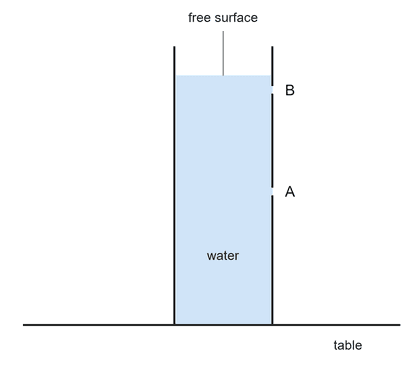
State and explain your observation.
Solve with AIWritten solution
Solution:
Concept: Laws of liquid pressure: inside a liquid the pressure increases with depth; in a still liquid it is the same at all points on the same horizontal level; at a point it is the same in all directions; at the same depth it is greater in a denser liquid; and a liquid seeks its own level.
Step 1 — Observe.
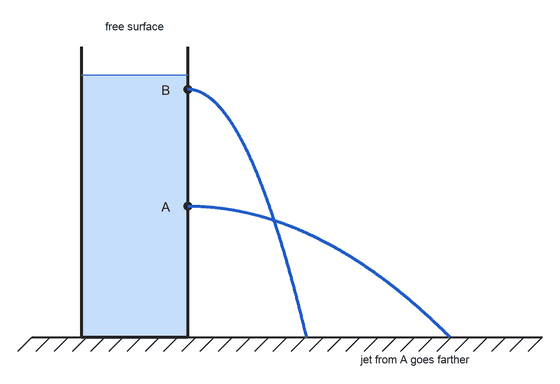
Water spurts out of both holes. The jet from hole A (near the middle) comes out with greater force and strikes the table farther from the cylinder, while the jet from hole B (just below the free surface) comes out weakly and falls close to the cylinder.
Step 2 — Explain.
Hole A is at a greater depth below the free surface than hole B. Since liquid pressure increases with depth (), the pressure at A is more, so the water leaves A faster and travels farther.
Watch out: The farther jet comes from the deeper hole even though it starts lower down.
Therefore, the jet from the deeper hole A goes farther, showing that pressure in a liquid increases with depth.
- 463 marks
Question 46
Name and state the principle on which a hydraulic press works. Write one use of the hydraulic press.
Solve with AIWritten solution
Solution:
Concept: In a hydraulic machine a small piston (area ) and a large piston (area ) are joined by an enclosed liquid. By Pascal's law both feel the same pressure, so . A small force on the small piston therefore gives a large force on the large piston: the machine is a force multiplier.
Step 1 — Name and state the principle.
A hydraulic press works on Pascal's law: the pressure exerted anywhere in a confined liquid is transmitted equally and undiminished in all directions throughout the liquid.
Step 2 — See how it multiplies force.
A small force on the small piston makes a pressure that reaches the large piston unchanged; since the force there is pressure × the larger area, it is much larger:
Step 3 — Give one use.
It is used for pressing cotton bales (also for squeezing oil out of seeds or juice out of sugarcane).
Therefore, the hydraulic press works on Pascal's law, and one use is pressing cotton bales.
- 474 marks
Question 47
Describe a simple experiment to demonstrate that a liquid enclosed in a vessel exerts pressure in all directions.
Solve with AIWritten solution
Solution:
Concept: A fluid is a substance that can flow: all liquids and gases. Because a fluid has weight and can flow, it presses on the bottom and on the walls of its container, and on anything placed in it, at every point and in every direction.
Step 1 — Collect the apparatus.
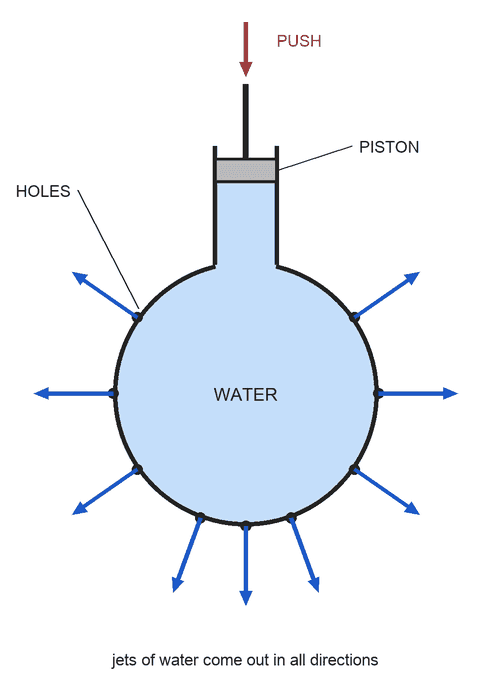
Take a hollow glass ball with several small holes made all over its surface, joined at the top to a cylinder fitted with an air-tight piston, and some water.
Step 2 — Do the experiment.
Fill the ball and the cylinder completely with water, and then push the piston down gently.
Step 3 — Observe.
Water spurts out of every hole, whether the hole faces up, sideways or down. Each jet leaves the ball at right angles to its surface, so the jets point in all directions.
Step 4 — Conclude.
The water inside presses outwards on every point of the wall and in every direction. A simpler version: make small holes at different places in the walls of a plastic bottle full of water; water spurts out of every hole.
Watch out: The jets come out in all directions only if the holes are all over the ball, not just along the bottom.
Therefore, a liquid enclosed in a vessel exerts pressure in all directions.
- 484 marks
Question 48
Deduce an expression for the pressure at a depth inside a liquid.
Solve with AIWritten solution
Solution:
Concept: The pressure on a small horizontal area inside a liquid is the weight of the liquid column standing on it, divided by its area.
Step 1 — Set up the column.
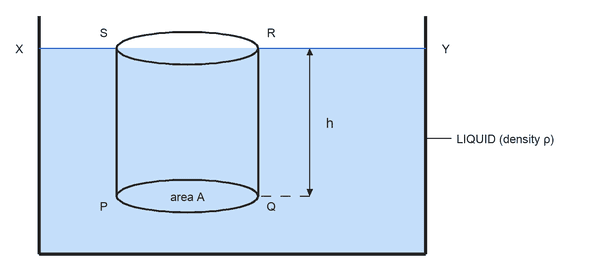
Take a vessel containing a still liquid of density . Imagine a horizontal surface PQ of area at depth below the free surface XY, and the liquid column PQRS of height standing on it, with its top RS on the free surface.
Step 2 — Find the volume and mass of the column.
The column is a cylinder of base area and height , so its volume is . Its mass is volume × density:
Step 3 — Find the thrust on PQ.
The thrust on PQ is the weight of this column, that is mass × :
Step 4 — Divide by the area.
Pressure is thrust ÷ area, so the area cancels:
Step 5 — Read the result.
The pressure depends only on the depth, the density of the liquid and , not on the shape of the vessel or the area. If the atmospheric pressure on the free surface is included, the total pressure at depth is .
Therefore, the pressure at a depth in a liquid of density is .
- 495 marks
Question 49
Explain the principle of a hydraulic machine. Name two devices which work on this principle.
Solve with AIWritten solution
Solution:
Concept: Pascal's law: the pressure exerted anywhere in a confined liquid is transmitted equally and undiminished in all directions throughout the liquid.
Step 1 — State the principle.
In a hydraulic machine a small force applied on a small piston is transmitted, by Pascal's law, to produce a large force on a bigger piston.
Step 2 — Describe the set-up.
Two cylinders P and Q, of cross-section areas (small) and (large), are joined by a tube R and filled with a liquid. They are fitted with water-tight pistons A and B.
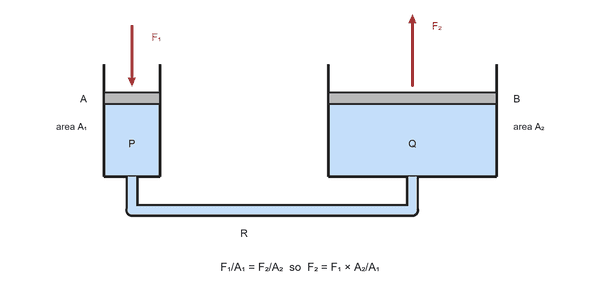
Step 3 — Find the pressure made at A.
A force on piston A produces a pressure
Step 4 — Pass it on to B.
By Pascal's law this pressure reaches piston B undiminished, so the upward force on B is pressure × area:
Step 5 — Compare the forces.
Since is larger than , is larger than : a small force gives a large force, so the machine is a force multiplier.
Step 6 — Name two devices.
The hydraulic press (Bramah press) and the hydraulic jack work on this principle (so do hydraulic brakes).
Watch out: The machine multiplies force, not energy: the large piston moves up much less than the small piston moves down.
Therefore, a hydraulic machine passes pressure through a liquid (Pascal's law) to turn a small force into a large one; two such devices are the hydraulic press and the hydraulic jack.
- 505 marks
Question 50
The diagram in Fig. 4.12 below shows a device which makes use of the principle of transmission of pressure.
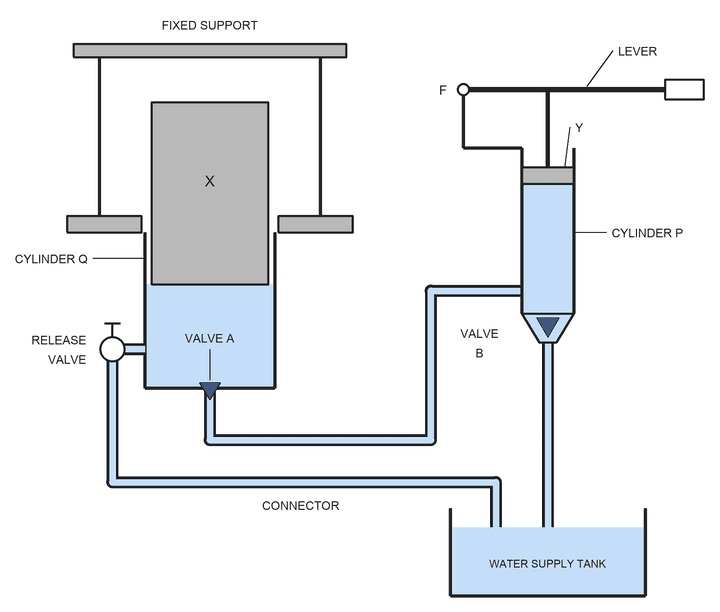
(a) Name the parts labelled by the letters and .
(b) Describe what happens to the valves and and to the quantity of water in the two cylinders when the lever arm is moved down.
(c) Give reasons for what happens to the valves and in part (ii).
(d) What happens when the release valve is opened ?
(e) What happens to the valve in cylinder when the lever arm is moved up ?
(f) Give a reason for your answer in part (v).
(f) State one use of the above device.
Solve with AIWritten solution
Solution:
Concept: This device is a hydraulic press. The pressure made in the narrow cylinder P is passed on (Pascal's law) to the wide cylinder Q. The valves are one-way: valve B lets water go only from the tank into P, and valve A lets water go only from P into Q.
Step 1 — Read the labels.
The book prints the sub-parts as (a) to (f) with "(f)" twice, and it says "part (ii)" and "part (v)" for parts (b) and (e). The answers below follow the printed labels.
Step 2 — Part (a): name X and Y.
X is the ram (press plunger), the large piston of the wide cylinder Q. Y is the pump plunger, the small piston of the narrow cylinder P.
Step 3 — Part (b): lever arm moved down.
Piston Y is pushed down. Valve B closes and valve A opens. Water is forced from cylinder P into cylinder Q, so the quantity of water in P decreases and in Q increases. The ram X is pushed up against the fixed support and the material placed on it is pressed.
Step 4 — Part (c): reasons for the valves in part (b).
Pushing Y down increases the pressure of the water in P. This pressure presses valve B down on its seat, so B closes and no water returns to the tank. The same pressure is passed through the pipe to the underside of valve A; it is now more than the pressure in Q above A, so A is pushed up and opens, letting water into Q.
Step 5 — Part (d): release valve opened.
The water in Q flows out through the connector back to the supply tank. The pressure in Q falls, so the ram X comes down and the pressed material is released.
Step 6 — Part (e): lever arm moved up.
When the lever arm is moved up, valve B opens and water from the supply tank enters cylinder P.
Step 7 — Part (f): reason for part (e).
Raising Y enlarges the space below it, so the pressure in P falls below the atmospheric pressure. The atmospheric pressure on the water in the tank then pushes water up the pipe, lifting valve B and filling P. Valve A stays shut, because the pressure in Q is now greater than in P.
Step 8 — Part (f): one use.
The hydraulic press is used for pressing cotton bales (also for squeezing oil out of seeds and juice out of sugarcane).
Watch out: Valve B is pushed open by the atmosphere from the tank side, not pulled open by the plunger.
Therefore, X is the ram and Y the pump plunger; on the down-stroke B closes and A opens (water goes from P to Q and the ram rises), on the up-stroke B opens and P refills, opening the release valve lowers the ram, and the press is used to press cotton bales.
- 515 marks
Question 51
Draw a simple diagram of a hydraulic jack and explain its working.
Solve with AIWritten solution
Solution:
Concept: In a hydraulic machine a small piston (area ) and a large piston (area ) are joined by an enclosed liquid. By Pascal's law both feel the same pressure, so . A small force on the small piston therefore gives a large force on the large piston: the machine is a force multiplier.
Step 1 — Draw the diagram.
The labelled diagram of a hydraulic jack is shown.
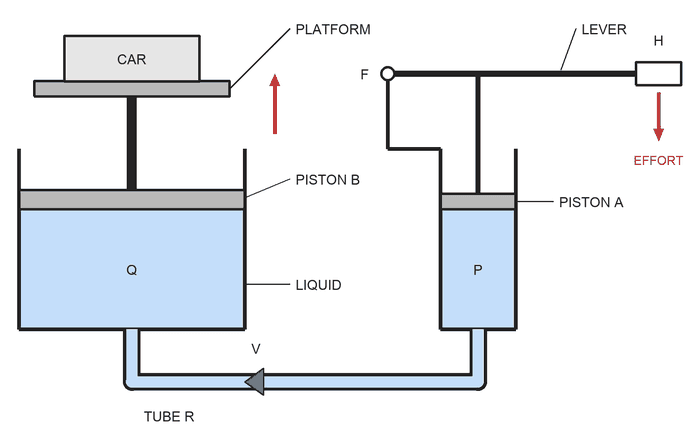
Step 2 — Describe the construction.
Two cylinders, P (narrow) and Q (wide), are joined by a tube R with a one-way valve V. Piston A of P is worked by a lever (fulcrum F, handle H). Piston B of Q carries a platform on which the car is placed. The cylinders are filled with a liquid such as oil.
Step 3 — Press the handle.
When the handle H is pressed down, piston A pushes on the liquid in P and the pressure there rises. This opens valve V, and by Pascal's law the pressure is passed through the liquid to piston B.
Step 4 — See the large force.
Piston B has a much larger area, so the upward force on it is much larger, . Liquid moves from P into Q, piston B rises and lifts the car.
Step 5 — Hold the car up.
When the handle is raised, the pressure in Q (due to the load) keeps valve V shut, so the liquid cannot flow back and the car stays up; P refills from a reservoir (not shown) for the next stroke.
Step 6 — Give the use.
It is used to lift cars and trucks in service stations for repair.
Therefore, in a hydraulic jack a small effort on the narrow piston is passed on by Pascal's law to the wide piston, which lifts the heavy car.
- 525 marks
Question 52
Explain the working of a hydraulic brake with a simple labelled diagram.
Solve with AIWritten solution
Solution:
Concept: The pressure made by the driver's foot in the master cylinder is passed on equally (Pascal's law) to the wheel cylinder of every wheel, whose larger pistons push the brake shoes with a larger force.
Step 1 — Draw the diagram.
The labelled diagram of a hydraulic brake is shown.
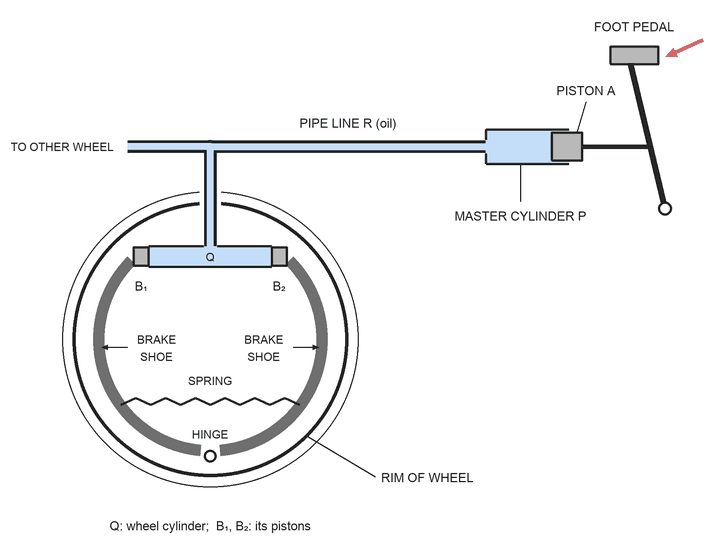
Step 2 — Describe the construction.
A pipe line R filled with oil joins the master cylinder P, whose piston A is worked by the foot pedal, to a wheel cylinder Q at each wheel. Each wheel cylinder has two pistons and , which touch the two brake shoes. The wheel cylinder is wider than the master cylinder. A spring holds the shoes away from the rim when the brake is off.
Step 3 — Press the pedal.
The driver presses the pedal, and piston A raises the pressure of the oil in P.
Step 4 — Pass the pressure on.
By Pascal's law this pressure is passed equally and at once through the oil to all the wheel cylinders.
Step 5 — Push the shoes.
The pressure pushes pistons and outwards; because their area is larger, the force on them is larger than the force on the pedal. They press the brake shoes against the rim, and friction slows down or stops the wheel. All the wheels are braked equally.
Step 6 — Release the pedal.
When the pedal is released, the spring pulls the shoes back and the oil returns to the master cylinder, so the wheels are free again.
Therefore, a hydraulic brake passes the pedal pressure through oil to all the wheel cylinders at once (Pascal's law), and their pistons press the brake shoes against the wheel rims.
- 533 marks
Question 53
A hammer exerts a force of 1.5 N on each of the two nails and . The area of cross section of tip of nail is 2 while that of nail is 6 . Calculate pressure on each nail in pascal.
Solve with AIWritten solution
Solution:
Concept: Pressure is the thrust acting on unit area of a surface: pressure is thrust ÷ area. For the same thrust, a smaller area gives a larger pressure and a larger area gives a smaller pressure. Its S.I. unit is N m, called the pascal (Pa). Here 1 mm is m.
Given: Force on each nail is 1.5 N; area of tip of A is 2 mm; area of tip of B is 6 mm.
Step 1 — Change the areas to m.
The pressure must come out in pascal, so the areas must be in square metres:
Step 2 — Find the pressure on nail A.
Divide the force by the area of the tip of A:
Step 3 — Find the pressure on nail B.
Divide the same force by the area of the tip of B:
Step 4 — Compare.
The same force on one-third of the area gives three times the pressure, so nail A goes in more easily.
Watch out: 1 mm is m (not ), because 1 mm is m and the area squares it.
Therefore, the pressure on nail A is Pa and on nail B is Pa.
- 544 marks
Question 54
A block of iron of mass 7.5 kg and of dimensions 12 cm × 8 cm × 10 cm is kept on a table top on its base of side 12 cm × 8 cm. Calculate : (a) thrust and (b) pressure exerted on the table top. Take 1 kgf = 10 N.
Solve with AIWritten solution
Solution:
Concept: Thrust is the force that acts normally (at right angles) on a surface. It is a force, so it is a vector, and its S.I. unit is the newton (N). Pressure is thrust ÷ area.
Given: Mass is 7.5 kg; base 12 cm × 8 cm; 1 kgf is 10 N.
Step 1 — Part (a): find the thrust.
The block rests on the table, so the thrust on the table is its weight. A mass of 7.5 kg weighs 7.5 kgf, and 1 kgf is 10 N:
Step 2 — Find the area of the base.
The block rests on its 12 cm × 8 cm face; change cm to m (1 cm is m):
Step 3 — Part (b): find the pressure.
Divide the thrust by the area of the base:
Watch out: Use only the face the block stands on (12 cm × 8 cm); the 10 cm height does not enter the area.
Therefore, (a) the thrust is 75 N, and (b) the pressure is 7812.5 Pa.
- 554 marks
Question 55
A vessel contains water up to a height of 1.5 m. Taking the density of water , acceleration due to gravity and area of base of vessel 100 , calculate : (a) the pressure and (b) the thrust, at the base of vessel.
- 564 marks
Question 56
The area of base of a cylindrical vessel is 300 . Water (density = 1000 ) is poured into it up to a depth of 6 cm. Calculate : (a) the pressure and (b) the thrust of water on the base. ().
- 574 marks
Question 57
(a) Calculate the height of a water column which will exert on its base the same pressure as the 70 cm column of mercury. Density of mercury is 13.6 .
(b) Will the height of the water column in part (a) change if the cross section of the water column is made wider ?
- 583 marks
Question 58
The pressure of water on the ground floor is 40,000 Pa and on the first floor is 10,000 Pa. Find the height of the first floor.
(Take : density of water = 1000 , )
- 594 marks
Question 59
A simple U tube contains mercury to the same level in both of its arms.
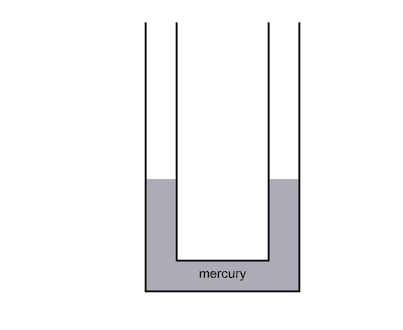
If water is poured to a height of 13.6 cm in one arm, how much will be the rise in mercury level in the other arm ?
Given : density of mercury = and density of water = .
- 603 marks
Question 60
In a hydraulic machine, a force of 2 N is applied on the piston of area of cross section 10 . What force is obtained on its piston of area of cross section 100 ?
- 613 marks
Question 61
What should be the ratio of area of cross section of the master cylinder and wheel cylinder of a hydraulic brake so that a force of 15 N can be obtained at each of its brake shoe by exerting a force of 0.5 N on the pedal ?
- 624 marks
Question 62
The areas of pistons in a hydraulic machine are 5 and 625 . What force on the smaller piston will support a load of 1250 N on the larger piston ? State any assumption which you make in your calculation.
- 634 marks
Question 63
(a) The diameter of neck and bottom of a bottle are 2 cm and 10 cm respectively. The bottle is completely filled with oil.

If the cork in the neck is pressed in with a force of 1.2 kgf, what force is exerted on the bottom of the bottle ?
(b) Name the law/principle you have used to find the force in part (a)
- 643 marks
Question 64
A force of 50 kgf is applied to the smaller piston of a hydraulic machine. Neglecting friction, find the force exerted on the large piston, if the diameters of the pistons are 5 cm and 25 cm respectively.
- 654 marks
Question 65
Two cylindrical vessels fitted with pistons and of area of cross section 8 and 320 respectively, are joined at their bottom by a tube and they are completely filled with water.

When a mass of 4 kg is placed on piston , find : (i) the pressure on piston , (ii) the pressure on piston , and (iii) the thrust on piston .
- 663 marks
Question 66
What force is applied on a piston of area of cross section 2 to obtain a force 150 N on the piston of area of cross section 12 in a hydraulic machine ?
- 671 mark
Question 67
The thrust exerted per unit area on the earth's surface due to a column of air is called :
- 681 mark
Question 68
The normal atmospheric pressure is :
- 691 mark
Question 69
The unit torr is related to the barometric height as :
- 701 mark
Question 70
The atmospheric pressure at earth surface is and inside a mine is . They are related as :
- 711 mark
Question 71
Nose bleeding occurs at high altitudes because :
- 721 mark
Question 72
Simple barometer was first designed by :
- 731 mark
Question 73
A barometer is used :
- 741 mark
Question 74
At the summit of Mount Everest, the atmospheric pressure is :
- 751 mark
Question 75
At high altitudes, the atmospheric pressure is :
- 761 mark
Question 76
Mercury is preferred as a barometric liquid because:
- 771 mark
Question 77
Which of the following properties of water is incorrect regarding its non-usage as a barometric liquid ?
- 781 mark
Question 78
If the barometric height gradually falls, it indicates:
- 791 mark
Question 79
The atmospheric pressure ............. with rising altitudes as the density of air ..................... .
- 801 mark
Question 80
Altimeter is used in an aircraft to measure :
- 811 mark
Question 81
Write the numerical value of the atmospheric pressure on the surface of the earth in pascal.
- 822 marks
Question 82
What physical quantity is measured in torr ? How is it related to the S.I. unit of the quantity ?
- 832 marks
Question 83
Name the physical quantity which is expressed in the unit 'atm'. State its value in pascal.
- 842 marks
Question 84
A partially inflated balloon is placed inside a bell jar connected to a vacuum pump. On creating vacuum inside the bell jar, balloon gets more inflated. How does the pressure change ; increase, decrease or remains same, inside the (a) bell jar and (b) balloon ?
- 851 mark
Question 85
What is the purpose of a barometer ?
- 862 marks
Question 86
What is meant by the statement 'the atmospheric pressure at a place is 76 cm of Hg'? State its value in Pa.
- 872 marks
Question 87
How is the barometric height of a simple barometer affected if
(a) its tube is pushed down into the trough of mercury?
(b) its tube is slightly tilted from vertical ?
(c) a drop of liquid is inserted inside the tube ?
- 882 marks
Question 88
State two uses of a barometer.
- 892 marks
Question 89
How is the height of mercury in a barometer affected when it is taken to (i) a mine, and (ii) a hill ?
- 902 marks
Question 90
What do the following indicate in a barometer regarding weather :
(a) gradual fall in the mercury level,
(b) sudden fall in the mercury level,
(c) gradual rise in the mercury level ?
- 912 marks
Question 91
What do you understand by the form term atmospheric pressure ?
- 922 marks
Question 92
We do not feel uneasy even under the enormous pressure of atmosphere above as well as around us. Give a reason.
- 933 marks
Question 93
Describe an experiment to demonstrate that air exerts pressure.
- 943 marks
Question 94
Explain the following :
(i) A balloon collapses when air is removed from it.
(ii) Water does not run out of a dropper unless its rubber bulb is pressed.
(iii) Two holes are made in a completely filled sealed tin can to take out oil from it.
- 952 marks
Question 95
Why does the liquid rise in a syringe when its piston is pulled up ?
- 963 marks
Question 96
How is water drawn up from a well by a water pump?
- 973 marks
Question 97
Explain how is the height of mercury column in the tube of a simple barometer, a measure of the atmospheric pressure.
- 983 marks
Question 98
Illustrate with the help of a labelled diagram of a simple barometer that the atmospheric pressure at a place is 76 cm of Hg.
- 992 marks
Question 99
Why is the barometric height used as a unit to express the atmosphric pressure ?
- 1003 marks
Question 100
How will you show that there is vacuum above the surface of mercury in a barometer ? What name is given to this vacuum ?
- 1012 marks
Question 101
Give two reasons for the use of mercury as a barometric liquid.
- 1022 marks
Question 102
Give two reasons why water is not a suitable barometric liquid.
- 1032 marks
Question 103
State two advantages of an aneroid barometer over a simple barometer.
- 1043 marks
Question 104
How does atmospheric pressure change with altitude? Draw an approximate graph to show this variation.
- 1052 marks
Question 105
State two factors which affect the atmospheric pressure as we go up.
- 1062 marks
Question 106
Why does a fountain pen leak at a high altitude ?
- 1072 marks
Question 107
Why does our nose start bleeding on high mountains ?
- 1085 marks
Question 108
What is a barometer ? How is a simple barometer constructed ?
- 1094 marks
Question 109
Mention two demerits of a simple barometer and state how they are removed in a Fortin barometer.
- 1104 marks
Question 110
What is an altimeter ? State its principle. How is its scale calibrated ?
- 1115 marks
Question 111
Draw a simple labelled diagram of a Fortin barometer and state how it is used to measure the atmospheric pressure.
- 1125 marks
Question 112
What is an aneroid barometer ? Draw a neat and labelled diagram to explain its construction and working.
- 1133 marks
Question 113
Convert 1 mm of Hg into pascal. Take density of Hg = and .
- 1143 marks
Question 114
At a given place, a mercury barometer records a pressure of 0.70 m of Hg. What would be the height of water column if mercury in barometer is replaced by water ? Take density of mercury to be .
- 1154 marks
Question 115
At sea level, the atmospheric pressure is 76 cm of Hg. If air pressure falls by 10 mm of Hg per 120 m of ascent, what is the height of a hill where the barometer reads 70 cm Hg. State the assumption made by you.
- 1163 marks
Question 116
At sea level, the atmospheric pressure is Pa. Assuming and density of air to be uniform and equal to 1.3 , find the height of the atmosphere.
- 1174 marks
Question 117
Assuming the density of air to be 1.295 , find the fall in barometric height in mm of Hg at a height of 107 m above the sea level. Take density of mercury = .
What Class 9 Physics Ch 4 covers
The sections of the chapter, in the order the book takes them. Every question above comes from one of these.
- 01Thrust and Pressure
- 02Pressure in Fluids
- 03Pressure Exerted by a Liquid Column
- 04Laws of Liquid Pressure
- 05Transmission of Pressure in Liquids; Pascal's Law
- 06Examples of Hydraulic Machines
More ways to study this chapter
The same chapter asked three other ways. Practise it, revise it, and see what the board has set on Ch 4 before.
Class 9 Physics Ch 4 questions students ask
How many questions are there in Class 9 Physics Ch 4?
117 questions. Every one is solved step by step on this page.
Are these Class 9 Physics solutions free?
Yes. Every question and its full working is free to read, with no account needed.
Can I download the Class 9 Physics Ch 4 solutions as a PDF?
There is no PDF to download. Every solution is on this page instead, which means it is searchable, always the current syllabus, and readable on a phone. Use your browser's print option if you want it on paper.