
Question 1003 marksEasy
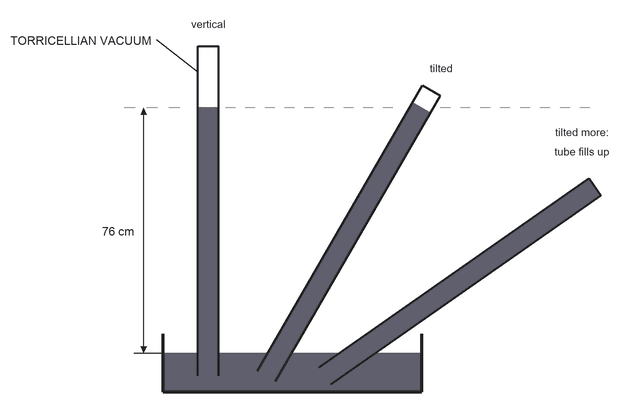
How will you show that there is vacuum above the surface of mercury in a barometer ? What name is given to this vacuum ?
Confirming your payment
Sign up now and get 250 free tokens.
Pressure in Fluids and Atmospheric Pressure · Question 100 of 117
How will you show that there is vacuum above the surface of mercury in a barometer ? What name is given to this vacuum ?
Solution:
Concept: A barometer measures atmospheric pressure. In a simple barometer the atmospheric pressure on the mercury in the trough holds up a column of mercury in a tube with a vacuum above it, so the atmospheric pressure equals , where is the vertical height of the column above the mercury in the trough. At sea level is about 76 cm.
Step 1 — Tilt the tube.
Tilt the barometer tube slowly. The vertical height of the mercury stays the same, so the mercury moves further along the tube.
Step 2 — Observe.
When the tube is tilted so far that its closed end comes below the 76 cm level, the mercury fills the tube completely and no gap is left at the top.
Step 3 — Conclude.
This shows that the space above the mercury held nothing, no air. If there had been air, it would have been squeezed into a bubble at the top instead of letting the mercury fill the tube.
Step 4 — Name the vacuum.
This vacuum is called the Torricellian vacuum.
Therefore, tilting the tube until the mercury fills it shows the vacuum, which is called the Torricellian vacuum.