
Question 1115 marksMedium
Draw a simple labelled diagram of a Fortin barometer and state how it is used to measure the atmospheric pressure.
Confirming your payment
Sign up now and get 250 free tokens.
Pressure in Fluids and Atmospheric Pressure · Question 111 of 117
Draw a simple labelled diagram of a Fortin barometer and state how it is used to measure the atmospheric pressure.
Solution:
Concept: In a Fortin barometer the mercury level in the vessel is first set to the zero of the scale; then the height of the mercury column is read with the main scale and the vernier.
Step 1 — Draw the diagram.
The labelled diagram of a Fortin barometer is shown.
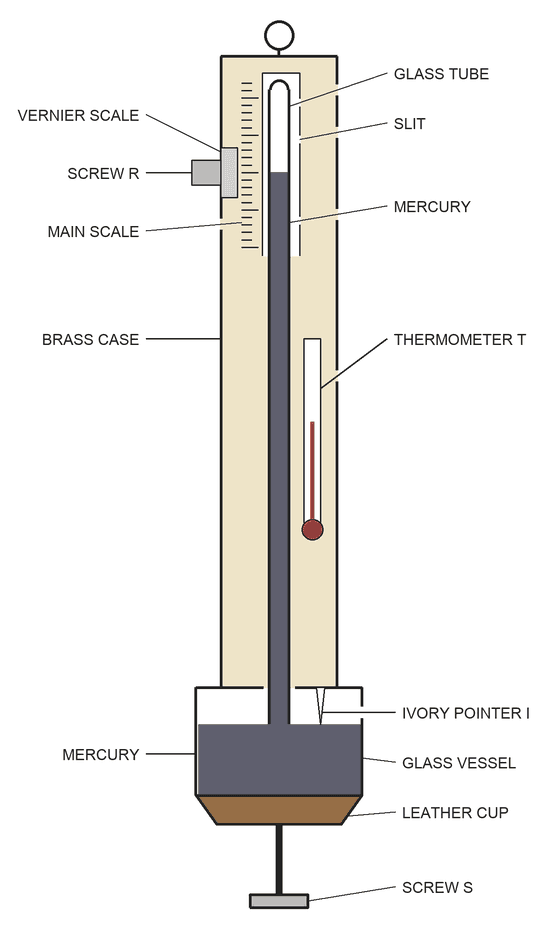
Step 2 — Describe the construction.
A glass tube about 85–90 cm long, filled with mercury, stands inverted in a glass vessel of mercury whose bottom is a leather cup. The tube is protected by a brass case. A screw S under the leather cup raises or lowers the mercury in the vessel. The zero of the main scale (in mm) is at the tip of an ivory pointer I. Near the top, a slit in the case shows the mercury level, and a vernier scale is moved by screw R. A thermometer T records the temperature.
Step 3 — Set the zero.
Turn screw S to raise or lower the leather cup until the mercury in the vessel just touches the tip of the ivory pointer.
Step 4 — Set the vernier.
Turn screw R until the lower edge of the vernier just touches the top of the mercury column seen through the slit.
Step 5 — Take the reading.
Note the main scale reading and the vernier scale reading; their sum is the barometric height, which gives the atmospheric pressure in cm or mm of Hg.
Watch out: Set the mercury to the ivory pointer before every reading; otherwise the height is measured from a wrong zero.
Therefore, after setting the mercury to the ivory pointer, the barometric height is the main scale reading plus the vernier reading.