
Question 515 marksMedium
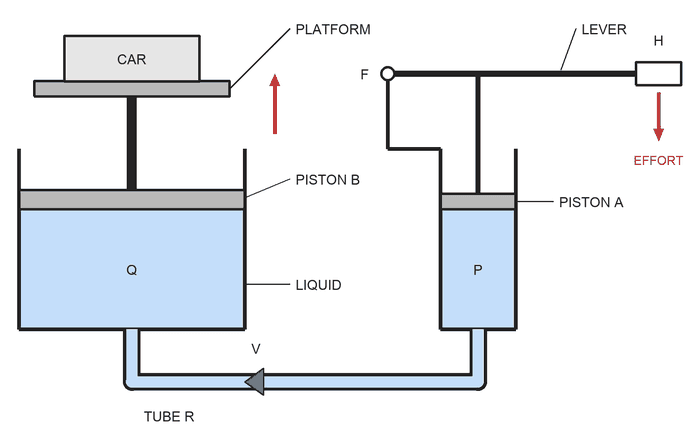
Draw a simple diagram of a hydraulic jack and explain its working.
Confirming your payment
Sign up now and get 250 free tokens.
Pressure in Fluids and Atmospheric Pressure · Question 51 of 117
Draw a simple diagram of a hydraulic jack and explain its working.
Solution:
Concept: In a hydraulic machine a small piston (area ) and a large piston (area ) are joined by an enclosed liquid. By Pascal's law both feel the same pressure, so . A small force on the small piston therefore gives a large force on the large piston: the machine is a force multiplier.
Step 1 — Draw the diagram.
The labelled diagram of a hydraulic jack is shown.
Step 2 — Describe the construction.
Two cylinders, P (narrow) and Q (wide), are joined by a tube R with a one-way valve V. Piston A of P is worked by a lever (fulcrum F, handle H). Piston B of Q carries a platform on which the car is placed. The cylinders are filled with a liquid such as oil.
Step 3 — Press the handle.
When the handle H is pressed down, piston A pushes on the liquid in P and the pressure there rises. This opens valve V, and by Pascal's law the pressure is passed through the liquid to piston B.
Step 4 — See the large force.
Piston B has a much larger area, so the upward force on it is much larger, . Liquid moves from P into Q, piston B rises and lifts the car.
Step 5 — Hold the car up.
When the handle is raised, the pressure in Q (due to the load) keeps valve V shut, so the liquid cannot flow back and the car stays up; P refills from a reservoir (not shown) for the next stroke.
Step 6 — Give the use.
It is used to lift cars and trucks in service stations for repair.
Therefore, in a hydraulic jack a small effort on the narrow piston is passed on by Pascal's law to the wide piston, which lifts the heavy car.