
Question 525 marksMedium
Explain the working of a hydraulic brake with a simple labelled diagram.
Confirming your payment
Sign up now and get 250 free tokens.
Pressure in Fluids and Atmospheric Pressure · Question 52 of 117
Explain the working of a hydraulic brake with a simple labelled diagram.
Solution:
Concept: The pressure made by the driver's foot in the master cylinder is passed on equally (Pascal's law) to the wheel cylinder of every wheel, whose larger pistons push the brake shoes with a larger force.
Step 1 — Draw the diagram.
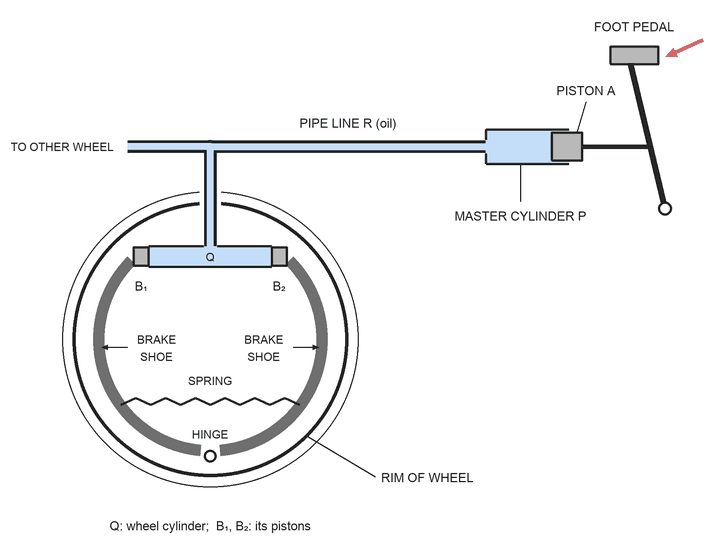
The labelled diagram of a hydraulic brake is shown.
Step 2 — Describe the construction.
A pipe line R filled with oil joins the master cylinder P, whose piston A is worked by the foot pedal, to a wheel cylinder Q at each wheel. Each wheel cylinder has two pistons and , which touch the two brake shoes. The wheel cylinder is wider than the master cylinder. A spring holds the shoes away from the rim when the brake is off.
Step 3 — Press the pedal.
The driver presses the pedal, and piston A raises the pressure of the oil in P.
Step 4 — Pass the pressure on.
By Pascal's law this pressure is passed equally and at once through the oil to all the wheel cylinders.
Step 5 — Push the shoes.
The pressure pushes pistons and outwards; because their area is larger, the force on them is larger than the force on the pedal. They press the brake shoes against the rim, and friction slows down or stops the wheel. All the wheels are braked equally.
Step 6 — Release the pedal.
When the pedal is released, the spring pulls the shoes back and the oil returns to the master cylinder, so the wheels are free again.
Therefore, a hydraulic brake passes the pedal pressure through oil to all the wheel cylinders at once (Pascal's law), and their pistons press the brake shoes against the wheel rims.