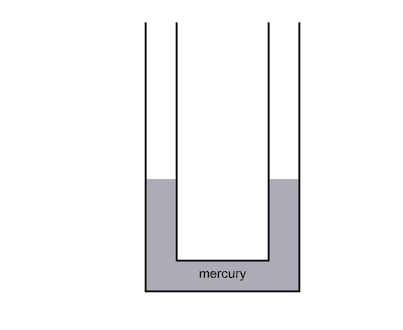
Solution:
Concept: Laws of liquid pressure: inside a liquid the pressure increases with depth; in a still liquid it is the same at all points on the same horizontal level; at a point it is the same in all directions; at the same depth it is greater in a denser liquid; and a liquid seeks its own level. Points at the same level in the same still liquid (here mercury) are at the same pressure.
Given: Height of water hw is 13.6 cm; ρw is 103 kg m−3; ρm is 13.6×10³ kg m−3.
Step 1 — See how the mercury moves.
When water is poured into one arm, the mercury in that arm is pushed down by some distance x, and the mercury in the other arm rises by the same distance x (the tube has the same width throughout). So the two mercury levels now differ by 2x.

Step 2 — Balance the pressures.
Take the level of the lower mercury surface (under the water). At this level the pressure in the water arm is due to 13.6 cm of water, and in the other arm it is due to 2x of mercury. These are equal; the atmospheric pressure on both open ends cancels:
hwρwg=2xρmg
Step 3 — Solve for 2x.
Cancel g and divide by ρm:
2x=ρmhwρw=13.6×10313.6×103=1 cm
Step 4 — Find the rise.
The rise in the other arm is half of the difference in levels:
x=21=0.5 cm
Watch out: The 1 cm is the difference between the two mercury levels; the rise above the original level is only half of it.
Therefore, the mercury level in the other arm rises by 0.5 cm (the two mercury levels then differ by 1 cm).