
Question 495 marksEasy
Explain the principle of a hydraulic machine. Name two devices which work on this principle.
Confirming your payment
Sign up now and get 250 free tokens.
Pressure in Fluids and Atmospheric Pressure · Question 49 of 117
Explain the principle of a hydraulic machine. Name two devices which work on this principle.
Solution:
Concept: Pascal's law: the pressure exerted anywhere in a confined liquid is transmitted equally and undiminished in all directions throughout the liquid.
Step 1 — State the principle.
In a hydraulic machine a small force applied on a small piston is transmitted, by Pascal's law, to produce a large force on a bigger piston.
Step 2 — Describe the set-up.
Two cylinders P and Q, of cross-section areas (small) and (large), are joined by a tube R and filled with a liquid. They are fitted with water-tight pistons A and B.
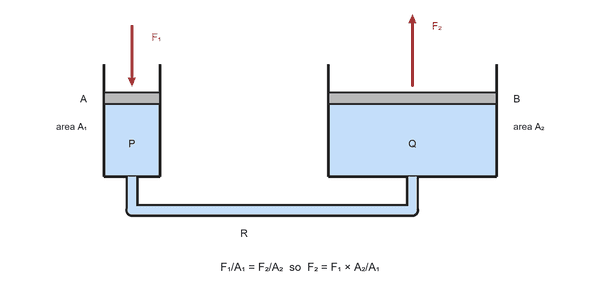
Step 3 — Find the pressure made at A.
A force on piston A produces a pressure
Step 4 — Pass it on to B.
By Pascal's law this pressure reaches piston B undiminished, so the upward force on B is pressure × area:
Step 5 — Compare the forces.
Since is larger than , is larger than : a small force gives a large force, so the machine is a force multiplier.
Step 6 — Name two devices.
The hydraulic press (Bramah press) and the hydraulic jack work on this principle (so do hydraulic brakes).
Watch out: The machine multiplies force, not energy: the large piston moves up much less than the small piston moves down.
Therefore, a hydraulic machine passes pressure through a liquid (Pascal's law) to turn a small force into a large one; two such devices are the hydraulic press and the hydraulic jack.