
Opening your dashboard
Class 9 Physics Chapter 4 Pressure in Fluids and Atmospheric Pressure: Competency-Based Questions (CBQ)
40 questions on Chapter 4, each worked through on its own page with the AI tutor. Class 9 Physics, ICSE 2026-27.
40 questions
1–5 marks · Mixed difficulty
- 11 mark
Question 1
Competency: Application & Analysis
A wooden crate of weight 600 N measures 1.0 m × 0.5 m × 0.3 m. It is to be kept on the soft floor of a storage tent. The floor sinks if the pressure on it is more than 2500 Pa. On which of its faces can the crate be rested without the floor sinking ?
- 21 mark
Question 2
Competency: Analysis
The figure shows a vessel containing water at rest. The right-hand part of the vessel is a closed side chamber that is completely filled with water. Points Q and R are at the same horizontal level.

Which statement about the pressure due to the water at P, Q and R is correct ?
- 31 mark
Question 3
Competency: Application
A rubber sucker hook is pressed hard against a smooth bathroom tile, so that the air between the sucker and the tile is forced out. The area of the sucker in contact with the tile is 20 cm and the atmospheric pressure is Pa. Taking the space behind the sucker to be a vacuum, the thrust with which the atmosphere presses the sucker against the tile is :
- 41 mark
Question 4
Competency: Understanding & Application
A syringe without a needle is completely filled with water. It is joined by a narrow tube to a small balloon that is also full of water, with no air anywhere inside. The plunger, of area 3 cm, is now pushed with an extra thrust of 6 N and held there. By how much does the pressure of the water rise at the far side of the balloon ?
- 51 mark
Question 5
Competency: Understanding
Assertion (A): In a hospital, the bottle of a 'drip' is hung well above the level of the patient's arm.
Reason (R): The pressure exerted by a liquid column increases with the height of the column.
- 61 mark
Question 6
Competency: Analysis
Assertion (A): A climber going up a very high mountain finds that the atmospheric pressure falls by the same amount in every kilometre of the climb.
Reason (R): The density of air decreases as the height above sea level increases.
- 72 marks
Question 7
Competency: Analysis
A student ties a thin rubber sheet over the mouth of a small funnel and joins the funnel by a rubber tube to a pressure gauge. She lowers the funnel into a tall jar of water and turns its mouth in different directions. The gauge shows the pressure of the water on the rubber sheet.
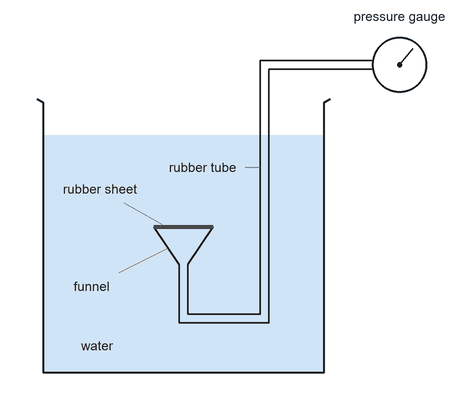
Her readings are given below.
Depth of the rubber sheet below the water surface Rubber sheet facing Gauge reading 10 cm upwards 1000 Pa 10 cm sideways 1000 Pa 10 cm downwards 1000 Pa 20 cm sideways 2000 Pa (a) State the two conclusions about liquid pressure that these readings support. For each conclusion, say which readings you have used.
(b) Predict the gauge reading when the rubber sheet faces downwards at a depth of 15 cm.
- 82 marks
Question 8
Competency: Application
A dentist's chair is raised by a hydraulic lift. A foot pedal pushes directly on a piston of area 4 cm, and the chair stands on a piston of area 80 cm. ( = 10 m s; neglect friction and the weight of the pistons.)
(a) The chair and a patient together have a mass of 96 kg. Find the least force on the pedal piston that will raise them.
(b) The dentist's assistant can push the pedal piston with a force of at most 50 N. What is the greatest total mass of chair and patient that she can raise ?
- 92 marks
Question 9
Competency: Application
Hot jam is filled into a glass jar and the metal lid is screwed on at once. When the jar has cooled, the pressure of the air and vapour trapped under the lid is only Pa, while the atmospheric pressure outside is Pa. The area of the lid is 40 cm.
(a) Calculate the net thrust that presses the lid down on the jar.
(b) The lid is very hard to pull off. But when its edge is lifted slightly with a spoon, a 'pop' is heard and the lid then comes off easily. Explain why.
- 102 marks
Question 10
Competency: Evaluation
A farmer has cut his wheat and left it in the field to dry. He reads the barometer in the village school at 8 a.m. every day. His readings are given below.
Day Monday Tuesday Wednesday Thursday Barometric height (cm of Hg) 75.1 75.4 75.7 76.0 On Thursday his neighbour says, "The reading keeps changing, so the weather is going to turn bad. Rain is coming. Cover the wheat today."
Do the readings support the neighbour's advice ? Justify your answer, and state what pattern of readings would have pointed to rain.
- 114 marks
Question 11
Competency: Analysis & Application
Case study: A factory stores fresh water in one tall tank and a salt solution (brine) in another. To check the tanks, an engineer lowers a pressure sensor into each liquid and plots the pressure due to the liquid alone against the depth below the free surface. The two lines obtained, A and B, are shown below. (Density of fresh water = 1000 kg m; = 10 m s; 1 kPa = 1000 Pa)
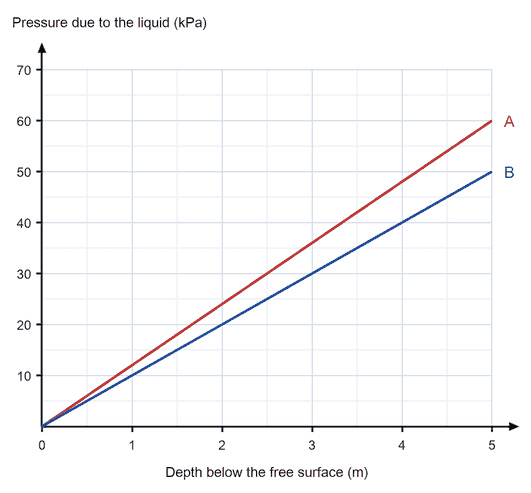
(a) Which line, A or B, is for fresh water ? Support your answer with a calculation for a depth of 4 m.
(b) Use the graph to find the density of the brine.
(c) Each tank is filled to a depth of 5 m and has a drain plug of area 50 cm in its base. Find the thrust of the liquid on the plug in the brine tank. By how much is it greater than the thrust on the plug in the water tank ?
- 124 marks
Question 12
Competency: Analysis & Evaluation
Case study: A village workshop wants a hand-operated hydraulic press to squeeze oil out of seeds. The press must give a force of at least 6000 N on its large piston when the worker pushes the small piston with a force of 150 N. Three designs are offered to the workshop. Their details are given below. (Neglect friction.)
Design Area of the small piston Area of the large piston X 4 cm 120 cm Y 5 cm 250 cm Z 2 cm 100 cm (a) For design X, calculate the pressure produced in the liquid by the push of 150 N, and the force obtained on the large piston.
(b) Which of the three designs can give the 6000 N that is needed ? Show your working.
(c) The pipe that joins the two cylinders is safe only up to a pressure of Pa. Which design should the workshop choose ? Justify your choice.
- 134 marks
Question 13
Competency: Analysis & Evaluation
Case study: Before a Himalayan expedition, the team is given the graph below. It shows how the atmospheric pressure changes with the height above sea level. Each climber carries an aneroid barometer.
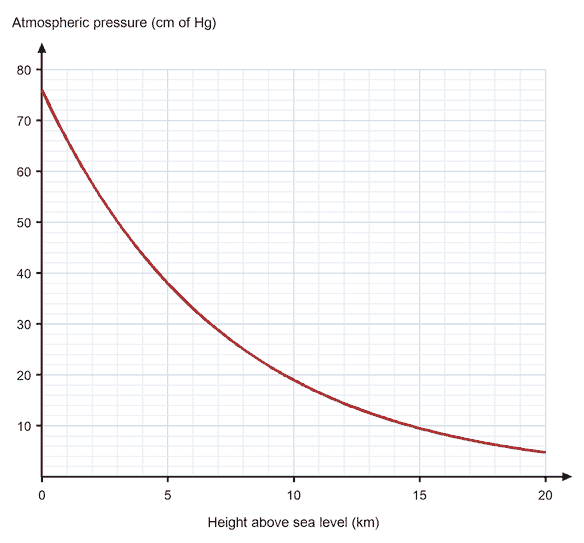
(a) Read from the graph the atmospheric pressure at sea level, at a height of 5 km and at a height of 10 km.
(b) Compare the fall in pressure during the first 5 km of ascent with the fall during the next 5 km. What does this tell you about the air at different heights ?
(c) At one camp the barometer reads 38 cm of Hg. A climber says, "The pressure here is half of that at sea level, so we have climbed half-way to the top of the atmosphere." Judge this statement, giving your reason.
- 144 marks
Question 14
Competency: Application & Creation
For the school sports day, a drinking-water dispenser on a four-legged steel stand is to be placed on a soft, wet lawn. The stand with a full jar of water weighs 800 N. Each leg ends in a flat square foot of side 4 cm, and the four feet stand at the corners of a square of side 40 cm. The groundsman says that the lawn gets dented if the pressure on it is more than Pa.
(a) Show by calculation that the stand will dent the lawn if it is placed directly on it.
(b) Design a simple base to be put under the stand so that the lawn is not dented. State the shape, size and material you choose, and show by calculation that your design works. (If your base has weight, include it.)
(c) Name one structure or device from daily life that uses the same idea as your design.
- 154 marks
Question 15
Competency: Analysis & Application
In a laboratory, four glass tubes A, B, C and D, each closed at the top, are filled with mercury and inverted in the same trough of mercury. Tubes A and C are narrow, tube B is wide, and tube D is a narrow tube held tilted. The figure shows the vertical height of the mercury in each tube above the mercury level in the trough. (Density of mercury = kg m; = 9.8 m s)
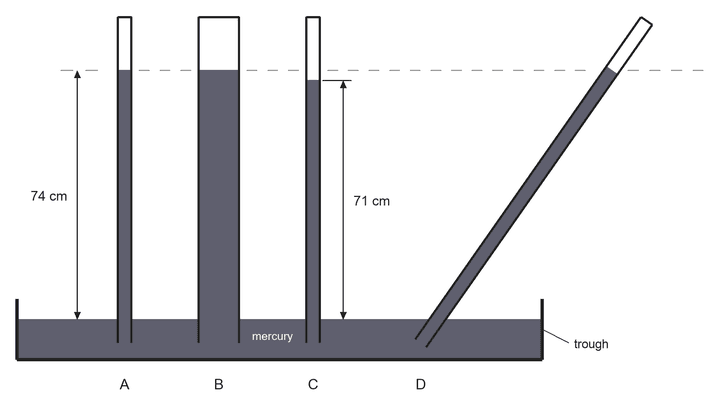
(a) What is the atmospheric pressure in the laboratory, in cm of Hg ? Express it in pascal.
(b) Tubes A, B and D differ in width and in tilt, yet the mercury stands at the same vertical height in all three. Explain why.
(c) Suggest the most likely fault in tube C. Find the pressure in the space above the mercury in tube C, in cm of Hg, showing your reasoning.
- 161 mark
Question 16
Competency: Understanding
A boy of mass 40 kg stands on a soft lawn with both feet on the ground. Each foot touches the lawn over an area of 150 cm. He now picks up a bag of mass 10 kg and, holding it, lifts one foot off the ground. ( = 10 m s)
By what factor does the pressure that he exerts on the lawn increase?
- 171 mark
Question 17
Competency: Application
A pressure sensor rests on the bed of a freshwater lake. It reads a total pressure of Pa. The atmospheric pressure over the lake is Pa. (Density of fresh water = 1000 kg m; = 10 m s.)
How deep is the lake at the place where the sensor rests?
- 181 mark
Question 18
Competency: Analysis
In the hydraulic brake of a small car the pedal pushes on a master piston of area 2 cm with a force of 40 N. The brake oil is carried by pipes to four wheel pistons: the two front pistons have an area of 6 cm each and the two rear pistons have an area of 3 cm each. Neglect friction and the weight of the oil. (Hypothetical data.)
What force acts on each rear piston?
- 191 mark
Question 19
Competency: Understanding
Assertion (A): A sealed packet of chips bought in a town on the plains looks swollen when it is carried up to a high hill station.
Reason (R): The atmospheric pressure falls as the height above sea level increases, so the air trapped in the packet pushes outwards on its walls with more pressure than the air outside pushes inwards.
- 201 mark
Question 20
Competency: Application
At a hill station the weather report gives the atmospheric pressure as 0.90 bar. (1 bar = N m; density of mercury = kg m; = 9.8 m s.)
What is this pressure in cm of Hg?
- 211 mark
Question 21
Competency: Analysis
A hiker wears a wrist altimeter. It is an aneroid barometer whose scale is marked in metres of height above sea level. At night he pitches his tent and the display reads 3 100 m. Next morning, without having moved, it reads 3 190 m. (Hypothetical data.)
Which is the best explanation?
- 221 mark
Question 22
Competency: Analysis
A pressure sensor can read to the nearest 100 Pa. In a sealed rigid cylinder of air, 40 cm tall, it gives the same reading, Pa, at the bottom and at the top. In a tank of water it reads 1000 Pa more when it is lowered by 10 cm. (Density of air = 1.3 kg m; density of water = 1000 kg m; = 10 m s.)
Which explanation of the two results is correct?
- 231 mark
Question 23
Competency: Understanding
Assertion (A): A person who must reach a child on thin ice on a frozen pond is advised to lie flat and crawl instead of walking upright.
Reason (R): Lying flat reduces the thrust that the person exerts on the ice.
- 241 mark
Question 24
Competency: Analysis
A student fills a glass tube, closed at one end and 65 cm long, completely with mercury. She closes the open end with her thumb, turns the tube upside down and opens the end under the mercury in a trough, keeping the closed end at the top. The figure shows only the position of the tube; what the mercury inside the tube does is not drawn. The tube is held upright, with its open end 5 cm below the mercury surface in the trough, so that its closed top is 60 cm above that surface. The atmospheric pressure that day is 76 cm of Hg.
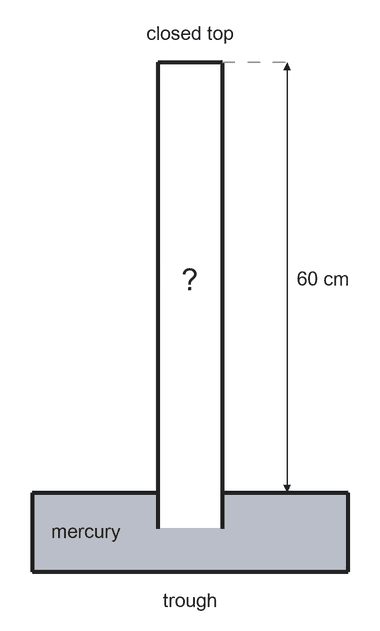
What does she observe?
- 251 mark
Question 25
Competency: Application
A technician lowers a pressure sensor into a tank to a depth of 0.50 m below the free surface of the liquid in it. The sensor shows a pressure of 6300 Pa due to the liquid alone. ( = 10 m s.) The tank holds one of the liquids in the table. (Hypothetical data.)
Liquid Water Sea water Mercury Glycerine Density (kg m) 1000 1030 13600 1260 Which liquid is in the tank?
- 262 marks
Question 26
Competency: Analysis
A deep-sea research robot has a circular viewing window of area 40 cm. The air inside the robot is kept at the atmospheric pressure of Pa. The robot descends to a depth of 200 m in sea water. (Density of sea water = 1030 kg m; = 10 m s; atmospheric pressure over the sea = Pa.)
(a) Find the net thrust that the water and the air together exert on the window at this depth.
(b) By what factor does this net thrust change if the robot goes down to 400 m?
- 272 marks
Question 27
Competency: Application
In a repair shop a motorcycle is raised on a hydraulic lift. A foot pump pushes on the small piston, of diameter 1.5 cm, with a force of 30 N. This just supports a load of 1920 N on the large piston. Neglect friction and the weight of the pistons. (Hypothetical data.)
(a) Find the diameter of the large piston.
(b) What load could the lift support if the push on the small piston were 45 N?
- 282 marks
Question 28
Competency: Application
A climbing team seals a rigid metal box at sea level, where the atmospheric pressure is 76 cm of Hg, and carries it to the summit of Mount Everest. Take the atmospheric pressure there as 30 % of its value at sea level (the measured value is close to one-third). The lid of the box has an area of 50 cm. Take the temperature of the air in the box to be unchanged and the volume of the box to be fixed. (Density of mercury = kg m; = 9.8 m s.)
(a) Express the atmospheric pressure at the summit in pascal.
(b) Find the net thrust that tends to push the lid outwards at the summit.
- 292 marks
Question 29
Competency: Evaluation
In a hydraulic machine the small piston has an area of 2 cm and the large piston has an area of 60 cm. A force of 15 N is applied on the small piston. Two students argue about the result. Anil says, "The pressure of the liquid under the large piston is 30 times that under the small piston." Binu says, "The pressure is the same under both pistons; it is the force that is 30 times as large." Neglect friction and the weight of the pistons.
(a) Calculate the pressure under the small piston and the force on the large piston.
(b) Decide whose statement is correct, and give the law on which you base your decision.
- 302 marks
Question 30
Competency: Analysis
In a school laboratory a pressure gauge is lowered into an unknown liquid in a tall jar. The pressure due to the liquid alone is read at different depths below the free surface. ( = 10 m s.) (Hypothetical data.)
Depth (cm) 10 20 30 40 50 Pressure (Pa) 800 1600 2400 3500 4000 (a) One reading is wrong. Which one is it, and what should the reading be?
(b) Use the correct readings to find the density of the liquid.
- 312 marks
Question 31
Competency: Application
A student fills a syringe with air, closes its nozzle with a rubber cap and pulls the plunger out slowly. The plunger has an area of 3 cm. She finds that it becomes harder and harder to pull. At one stage the pressure of the air trapped inside has fallen to Pa. The atmospheric pressure is Pa. Neglect friction.
(a) Why does it become harder to pull the plunger?
(b) Find the force that she must apply on the plunger at this stage.
- 323 marks
Question 32
Competency: Evaluation
A film crew needs two days of dry weather for an outdoor shoot in the hills. It can go to one of three hill towns, X, Y and Z, and all three are cloudy at present. The weather office of each town reports how its barometer has behaved over the last two days. (Hypothetical data.)
Town Barometric height two days ago (cm of Hg) Barometric height today (cm of Hg) How it changed X 68.4 68.4 no abrupt change at any time Y 68.0 68.6 rose slowly and steadily Z 69.0 68.5 fell slowly and steadily (a) State what the behaviour of the barometer indicates about the coming weather in each town.
(b) Which town should the crew choose? Give a reason, and say why each of the other two is a poorer choice.
(c) Express the rise of the barometric height in town Y in pascal, and explain why a fall in the moisture of the air makes the barometric height rise. (Density of mercury = kg m; = 9.8 m s.)
- 333 marks
Question 33
Competency: Application
An open drum 80 cm tall is filled with water up to its brim. Three small holes in its side wall are closed by plugs P, Q and R, each of area 2 cm. The holes are at heights of 20 cm, 40 cm and 60 cm above the base of the drum, respectively. (Density of water = 1000 kg m; = 10 m s; the pressure over the area of a small plug may be taken as uniform.)
(a) Find the depth of each plug below the surface of the water.
(b) Find the pressure of the water at each plug.
(c) Find the thrust of the water on each plug, and say which plug is the hardest to hold in place.
- 343 marks
Question 34
Competency: Application
Two open tanks, A and B, are joined at their bases by a short horizontal pipe with a closed tap. Tank A has a cross-section of 100 cm and tank B has a cross-section of 300 cm. Water is poured into A until it stands 1.2 m deep, and B is empty. The tap is then opened and the water is allowed to settle. (Density of water = 1000 kg m; = 10 m s; neglect the volume of the pipe.)
(a) Find the pressure of the water at the closed tap before it is opened.
(b) Find the depth of the water in each tank when it has settled.
(c) Explain, in terms of pressure, why the water stops flowing, and find the pressure of the water at the tap now.
- 353 marks
Question 35
Competency: Analysis
A hydraulic press has a pump cylinder P with a plunger A, and a larger cylinder Q with a ram B. The two cylinders are joined by a pipe R, which enters Q through a valve V that opens only into Q. The bottom of P is joined to a water reservoir through a valve V that opens only upwards, into P. A release valve at the bottom of Q joins it to the reservoir. A bale of cotton is placed on the ram and the plunger is worked up and down. The release valve is kept closed while the bale is pressed.
(a) Explain how water enters the pump cylinder when the plunger is raised.
(b) The valve V gets stuck in the open position. What happens when the plunger is pushed down, and why?
(c) A worker forgets to close the release valve. What happens, and why?
- 363 marks
Question 36
Competency: Evaluation
A water-supply office has three water tanks, A, B and C, each with vertical sides. Their sizes are given below. (Density of water = 1000 kg m; = 10 m s.) (Hypothetical data.)
Tank Depth of water Area of the base A 4 m 1 m B 4 m 10 m C 6 m 0.5 m Rohan says, "The tank with the largest base has the greatest pressure at the bottom." Beena says, "The deepest tank has the greatest thrust on its base."
(a) Find the pressure of the water at the bottom of each tank.
(b) Find the thrust of the water on the base of each tank.
(c) Decide whether each student is right, with a reason.
- 374 marks
Question 37
Competency: Analysis
Case study: A group of students studies a lake on a high plateau. They lower a pressure sensor, which reads the total pressure, from the surface to different depths and note the readings in a table. They want to find out what kind of water the lake holds and whether it lies above or below sea level. The sea-level value of the atmospheric pressure is taken as Pa, and = 10 m s. (Hypothetical data.)
Depth below the surface (m) 0 5 10 15 Total pressure ( Pa) 0.80 1.30 1.80 2.30 (a) Find the pressure due to the water alone at each depth, and show from the figures that it is in proportion to the depth.
(b) Use the readings to find the density of the water.
(c) Is the lake above or below sea level? Give a reason. What would the sensor read at a depth of 12 m in a lake at sea level that holds the same kind of water?
- 385 marks
Question 38
Competency: Creativity
Case study: Asha plans a model for the school science fair: a toy bridge that is raised by a hydraulic lifter made of two syringes joined by a tube and filled with water. The deck of the bridge weighs 24 N and rests on the large piston. Asha can comfortably push the small piston with her thumb with a force of not more than 3 N. She can buy syringes of different sizes. Friction in the pistons will make the real push a little bigger than the ideal push. (Hypothetical data.)
(a) What is the least ratio, (area of the large piston) : (area of the small piston), that the lifter must have if friction is neglected?
(b) Choose the diameters of the two syringe barrels. Show by calculation that with your choice the push needed is less than 3 N, leaving some margin for friction.
(c) State two things that Asha must do while building the lifter so that it works properly, and give the reason for each.
- 394 marks
Question 39
Competency: Analysis
Case study: A workshop tests three hydraulic jacks P, Q and R. The small piston of each jack has an area of 2 cm. An effort is applied on the small piston, and the load that the jack lifts is measured. The graph shows the load against the effort for each jack. The area of the large piston of jack Q is 40 cm. (Hypothetical data.)

(a) Read from the graph the load that each jack lifts for an effort of 50 N.
(b) Find the ratio of load to effort for jack Q from the graph, and compare it with the ratio of the areas of its pistons. Suggest a reason for the difference. If the other two jacks fall short of the ratio of their areas by the same percentage, find the areas of their large pistons.
(c) The line of jack Q is extended in the same way. Find the effort that is needed to lift a load of 1000 N with it.
- 404 marks
Question 40
Competency: Application
Case study: A panchayat wants to fit hand pumps, kept on the ground, to three wells. The water surface is 6 m below the ground in well A, 9.5 m in well B and 12 m in well C. A suction pump draws water by lowering the pressure above the water in its pipe, so that the pressure of the atmosphere pushes the water up. The atmospheric pressure is Pa, the density of water is 1000 kg m and = 10 m s. (Hypothetical data.)
(a) What is the greatest height to which the atmosphere can push water up in a pipe, if the pump could make a perfect vacuum above the water?
(b) A real pump leaves a pressure of Pa above the water because of leaks. Which of the three wells can it serve?
(c) In a hill village the atmospheric pressure is Pa. Can the same pump serve well A there? Suggest what can be done for well C.