
Opening your dashboard
Class 9 Physics Chapter 4 Pressure in Fluids and Atmospheric Pressure: Practice Questions
41 questions on Chapter 4, each worked through on its own page with the AI tutor. Class 9 Physics, ICSE 2026-27.
41 questions
1–5 marks · Mixed difficulty
- 11 mark
Question 1
Bloom's level: Remember
Which of the following are fluids ?
- 21 mark
Question 2
Bloom's level: Understand
Heavy trucks are fitted with wide tyres, often with more than four wheels. This is done mainly to :
- 31 mark
Question 3
Bloom's level: Apply
A brick of mass 2 kg measures 20 cm × 10 cm × 5 cm. The greatest pressure it can exert on the ground, when placed on one of its faces, is : ( = 10 m s)
- 41 mark
Question 4
Bloom's level: Apply
The deep end of a swimming pool is 2.5 m deep. The pressure at its bottom due to the water alone is : (density of water = 1000 kg m, = 10 m s)
- 51 mark
Question 5
Bloom's level: Understand
Three vessels of different shapes - a narrow tube, a wide beaker and a cone - stand on a table. Each contains water up to the same height.

The pressure of water at the base is :
- 61 mark
Question 6
Bloom's level: Apply
In a hydraulic press, the small piston has a radius of 2 cm and the large piston a radius of 20 cm. A force of 100 N is applied on the small piston. The force on the large piston is :
- 71 mark
Question 7
Bloom's level: Analyse
A student sets up a simple mercury barometer. The mercury column stands 74 cm vertically above the mercury in the trough. When he tilts the tube, the mercury fills 80 cm of the tube's length, but its top is still 74 cm vertically above the trough.
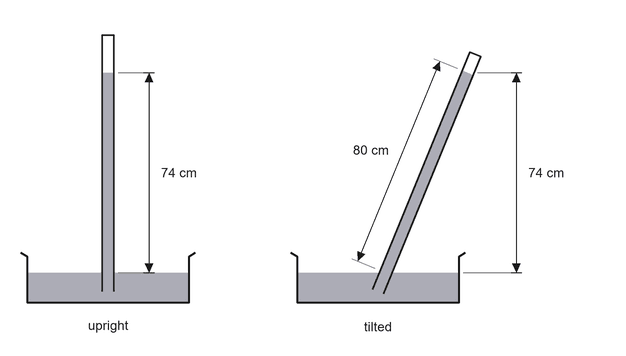
The atmospheric pressure is :
- 81 mark
Question 8
Bloom's level: Analyse
Barometer readings are taken at the same time at four places P, Q, R and S on the same day: P - 76.0 cm of Hg, Q - 68.0 cm of Hg, R - 78.0 cm of Hg, S - 72.5 cm of Hg. Which place is most likely to be at the bottom of a deep mine ?
- 91 mark
Question 9
Bloom's level: Evaluate
Ravi says, "When I drink juice through a straw, my mouth pulls the juice up by a sucking force." Which is the best judgement of his statement ?
- 101 mark
Question 10
Bloom's level: Understand
Read the Assertion (A) and the Reason (R) and choose the correct option.
Assertion (A): A hydraulic machine can lift a heavy load by applying a small force.
Reason (R): A hydraulic machine also multiplies the work done by us.
- 111 mark
Question 11
Bloom's level: Analyse
Read the Assertion (A) and the Reason (R) and choose the correct option.
Assertion (A): At a point inside a liquid at rest, the liquid pressure acts only in the downward direction.
Reason (R): The pressure at a point in a liquid increases with the depth of the point below the free surface.
- 121 mark
Question 12
Bloom's level: Analyse
Read the Assertion (A) and the Reason (R) and choose the correct option.
Assertion (A): A gradual fall in the barometric height over a day or two indicates the chance of rain.
Reason (R): Air containing a lot of water vapour is less dense than dry air, so it exerts less pressure.
- 131 mark
Question 13
Bloom's level: Remember
Express the normal atmospheric pressure at sea level in (a) cm of Hg, (b) pascal and (c) torr.
- 141 mark
Question 14
Bloom's level: Remember
According to Pascal's law, what is transmitted equally and undiminished through an enclosed liquid - the force or the pressure ? In which direction(s) is it transmitted ?
- 151 mark
Question 15
Bloom's level: Remember
Name the instrument or device that is used :
(a) to measure the atmospheric pressure in a laboratory,
(b) to show the height of an aeroplane above sea level,
(c) to lift a car in a service station using a liquid.
- 162 marks
Question 16
Bloom's level: Understand
A brick resting at the bottom of an empty bucket presses only on the bottom of the bucket. But when the bucket is filled with water, the water presses on the bottom and on the sides. Explain this difference.
- 172 marks
Question 17
Bloom's level: Understand
While travelling up a hill road in a car, people often feel their ears 'pop'. Explain why.
- 182 marks
Question 18
Bloom's level: Understand
A swimming pool has a shallow end and a deep end. Point A is 1.5 m below the surface at the shallow end, point B is 1.5 m below the surface near the deep end, and point C is on the floor of the deep end, 3 m below the surface.

Compare the water pressure at A, B and C. Give a reason.
- 192 marks
Question 19
Bloom's level: Apply
A diver is 30 m below the surface of the sea. Find (a) the pressure on the diver due to the sea water and (b) the total pressure on him. (Density of sea water = 1030 kg m, = 10 m s, atmospheric pressure = Pa)
- 202 marks
Question 20
Bloom's level: Apply
In a hydraulic jack, the area of the small piston is 4 cm and that of the large piston is 400 cm. A car of mass 1200 kg rests on the large piston. What force must be applied on the small piston to lift the car ? ( = 10 m s; neglect friction and the mass of the pistons)
- 212 marks
Question 21
Bloom's level: Apply
At a place the atmospheric pressure is 76 cm of Hg. If a barometer were made with an oil of density 800 kg m instead of mercury (density 13600 kg m), how tall would the oil column be ? What does this tell you about the choice of mercury ?
- 222 marks
Question 22
Bloom's level: Evaluate
A girl of mass 50 kg stands on the heel of one stiletto shoe, whose area of contact with the floor is 1 cm. An elephant of mass 4000 kg stands on four feet, each of area 0.1 m. Her friend says, "The elephant exerts a much greater pressure on the floor than the girl." Check this claim by calculation. ( = 10 m s)
- 234 marks
Question 23
Bloom's level: Apply
A U-tube contains some water. Oil, which does not mix with water, is poured into the left arm. When the liquids come to rest, the oil column in the left arm is 15 cm high, measured from the oil-water surface. In the right arm, the water stands 12 cm above the level of that oil-water surface.

(Density of water = 1000 kg m, = 10 m s)
(a) Why is the pressure at the level of the oil-water surface the same in both arms ?
(b) Find the density of the oil.
(c) Find the pressure (above atmospheric) at the level of the oil-water surface.
- 244 marks
Question 24
Bloom's level: Apply
Case study: A service station uses a hydraulic lift to raise cars. The small piston has a diameter of 4 cm and the large piston a diameter of 40 cm. A car together with the platform has a mass of 1500 kg. ( = 10 m s; neglect friction)
(a) How many times larger is the area of the large piston than that of the small piston ?
(b) What force must be applied on the small piston to just lift the car ?
(c) The small piston is pushed down by 50 cm. How far does the car rise ? Show that the work done on the small piston equals the work done in raising the car.
- 253 marks
Question 25
Bloom's level: Understand
State Pascal's law. Explain why it applies to an enclosed liquid but not to a solid. A mechanic finds that the brakes of a car feel 'spongy' because air bubbles have entered the brake fluid. Explain why the brakes work poorly.
- 264 marks
Question 26
Bloom's level: Analyse
Case study: The fishermen of a coastal village keep a barometer at the jetty and note its readings:
Day and time Day 1, 9 am Day 1, 6 pm Day 2, 9 am Day 2, 6 pm Day 3, 9 am Day 3, 11 am Reading (cm of Hg) 76.0 75.8 75.5 75.2 75.1 73.6 (a) Describe how the reading changes from Day 1, 9 am to Day 3, 9 am, and by how much it falls in this time.
(b) What weather does this change indicate ?
(c) What happens between 9 am and 11 am on Day 3 ? What does it indicate, and what should the fishermen do ?
- 274 marks
Question 27
Bloom's level: Evaluate
A group is planning a trek in the Himalayas and wants to carry an instrument to measure the atmospheric pressure (and so estimate their height). The leader says, "Let us carry a simple mercury barometer, because it is the most accurate." Another member suggests a water barometer, and a third suggests an aneroid barometer.
(a) Give two reasons why the simple mercury barometer is a poor choice for a trek.
(b) Why is the water barometer impossible to use ?
(c) Which instrument should they take ? Justify your choice, and say how it can also show the height.
- 284 marks
Question 28
Bloom's level: Apply
A cylindrical water tank stands on a roof. The water in it is 2 m deep and the area of its base is 0.5 m. (Density of water = 1000 kg m, density of mercury = 13600 kg m, = 10 m s, atmospheric pressure = Pa)
(a) Find the pressure at the base due to the water.
(b) Find the total pressure at the base.
(c) Find the thrust on the base due to the water alone.
(d) Express the pressure due to the water in cm of mercury.
- 295 marks
Question 29
Bloom's level: Create
You are asked to plan the water supply of a three-storey house. The taps are at heights of 1 m (ground floor), 4 m (first floor) and 7 m (second floor) above the ground. Every tap must get a water pressure of at least 30000 Pa (above atmospheric) for a good flow. A tank 1.5 m deep is to be placed on a stand on the roof. ( = 10 m s, density of water = 1000 kg m)
(a) Find the least height above the ground at which the bottom of the tank must be kept, so that even when the tank is almost empty every tap gets enough pressure. Show your working.
(b) With your design, find the greatest pressure at the ground floor tap (tank full).
(c) Suggest, with a reason, which part of the pipe system should be the strongest, and give one more suggestion to improve the design.
- 305 marks
Question 30
Bloom's level: Create
Your class is putting up a science-fair stall called 'Air and Water Push !'. Plan three simple demonstrations to show:
(a) the atmosphere exerts pressure,
(b) the pressure in a liquid increases with depth,
(c) pressure applied to an enclosed liquid is transmitted equally in all directions.
For each, give the materials, what the visitors will see, and a one-line explanation.
- 314 marks
Question 31
The two pistons of a hydraulic machine have areas of cross section 6 cm and 576 cm. Find the force that must act on the smaller piston to support a load of 1152 N placed on the larger piston. State the assumption made in your calculation.
- 321 mark
Question 32
A rectangular block of weight 240 N rests on a horizontal table on its face measuring 40 cm × 30 cm. The pressure exerted by the block on the table is :
- 331 mark
Question 33
X, Y and Z are three points inside the water of a large tank at rest. X (near a wall) and Y (at the middle of the tank) are both 20 cm below the free surface, and Z is 50 cm below the free surface.
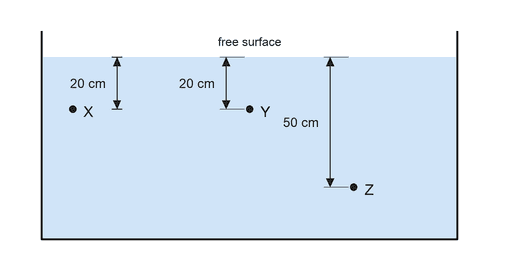
The pressures , and at these points are related as :
- 341 mark
Question 34
Assertion (A): If a simple barometer is made with water in place of mercury, its tube has to be more than 10 m long.
Reason (R): Water wets the glass and sticks to the wall of the tube.
- 352 marks
Question 35
The pressure due to kerosene at the bottom of a storage tank is 19 600 Pa. (Density of kerosene = 800 kg m, density of water = 1000 kg m, = 9.8 m s.)
(i) Calculate the depth of kerosene in the tank.
(ii) What would be the pressure at the bottom if the tank contained water up to the same depth ?
- 362 marks
Question 36
A glass flask is completely filled with water and its neck is closed by a tight-fitting piston of area 4 cm. The flat base of the flask has an area of 60 cm. A force of 10 N is applied on the piston.

(i) Calculate the pressure applied on the water by the piston.
(ii) Find the additional force that acts on the base of the flask because of this pressure. Name the law you have used.
- 372 marks
Question 37
Give a reason for each of the following.
(i) To pour oil smoothly out of a sealed tin, two holes are made in its lid instead of one.
(ii) A glass tumbler is filled to the brim with water and covered with a stiff card. When the tumbler is turned upside down and the hand is removed from the card, the water does not fall out.
- 382 marks
Question 38
A mercury barometer reads 76.0 cm at the foot of a tower and 75.5 cm at its top. (Density of mercury = kg m, average density of air = 1.25 kg m.)
(i) Why is the reading smaller at the top of the tower ?
(ii) Calculate the height of the tower.
- 394 marks
Question 39
In a hydraulic press, the area of cross-section of the smaller piston is 15 cm and that of the larger piston is 1800 cm. A load of 9000 N is to be supported on the larger piston. Neglect friction and the weights of the pistons.
(i) Name and state the principle on which the hydraulic press works.
(ii) Calculate the pressure that must be produced in the liquid.
(iii) Calculate the force needed on the smaller piston. Hence explain why the press is called a force multiplier.
- 404 marks
Question 40
At a certain place, the mercury in the tube of a simple barometer stands at a vertical height of 75 cm above the mercury level in the trough. (Density of mercury = kg m, = 9.8 m s.)
(i) Calculate the atmospheric pressure at the place in pascal.
(ii) What is present in the space above the mercury in the tube ? What is this space called ?
(iii) State, with a reason in each case, how the vertical height of the mercury column will be affected if (a) a tube of wider bore is used, (b) a drop of water gets into the space above the mercury.
- 413 marks
Question 41
The graph shows how the pressure due to the liquid changes with the depth below the free surface for two liquids A and B at rest. (Take = 10 m s.)
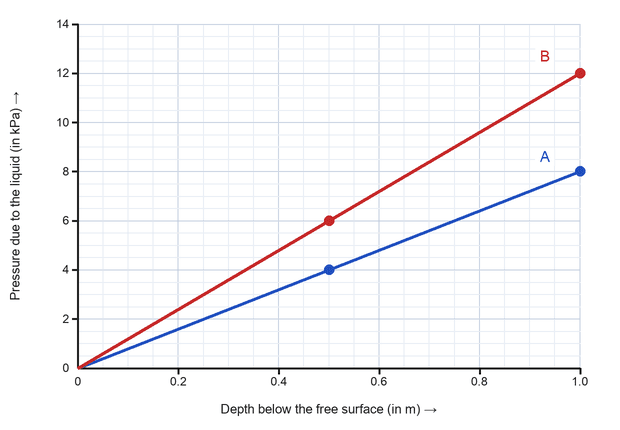
(i) What does the graph show about the way the pressure in a liquid depends on the depth ?
(ii) Calculate the density of liquid A.
(iii) At what depth in liquid A is the pressure the same as the pressure at a depth of 0.5 m in liquid B ?