
Opening your dashboard
Class 7 Maths Chapter 18: Pythagoras Theorem Solutions
30 textbook questions with step-by-step answers, free to read, for ICSE 2026-27.
Get talked through Ch 18, not just shown the answer
Reading a finished solution is not the same as being able to do it. The AI tutor takes one question at a time and works it with you, in your own words, until you can.
- Ask it out loud, in your own words
- It gives you the next step, not the answer
- Stuck on part (ii)? Start there
30 questions with solutions
1–3 marks · Mixed difficulty
- 13 marks
Question 1
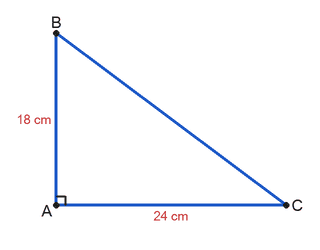
Triangle ABC is right-angled at vertex A. Calculate the length of BC, if AB = 18 cm and AC = 24 cm.
 Solve with AI
Written solution
Solution:
Concept: By Pythagoras theorem, in a right-angled triangle the square of the hypotenuse equals the sum of the squares of the other two sides. The hypotenuse is the side opposite the right angle; it is always the longest side.
Given: Triangle ABC is right-angled at A, AB = 18 cm and AC = 24 cm.
Step 1 — Identify the hypotenuse.
The right angle is at A, so the side opposite A, which is BC, is the hypotenuse. AB and AC are the two shorter sides.
Step 2 — Apply Pythagoras theorem.
We square the two shorter sides and add them to get the square of BC.
Step 3 — Take the square root.
BC is a length, so we take the positive square root of 900.
Watch out: First find the right angle; the side opposite it is the hypotenuse, and only the hypotenuse is squared on its own.
Therefore, BC = 30 cm.
- 23 marks
Question 2
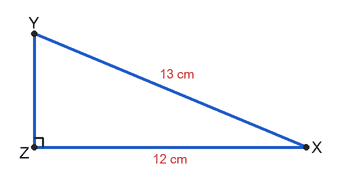
Triangle XYZ is right-angled at vertex Z. Calculate the length of YZ, if XY = 13 cm and XZ = 12 cm.
 Solve with AI
Written solution
Solution:
Concept: By Pythagoras theorem, in a right-angled triangle the square of the hypotenuse equals the sum of the squares of the other two sides. The hypotenuse is the side opposite the right angle; it is always the longest side. To find one of the two shorter sides, we rearrange the rule: (shorter side)² = (hypotenuse)² − (other shorter side)².
Given: Triangle XYZ is right-angled at Z, XY = 13 cm and XZ = 12 cm.
Step 1 — Identify the hypotenuse.
The right angle is at Z, so the side opposite Z, which is XY, is the hypotenuse. YZ is one of the two shorter sides.
Step 2 — Rearrange Pythagoras theorem for YZ.
Since , we subtract from to get .
Step 3 — Take the square root.
We take the positive square root, since YZ is a length.
Watch out: When the hypotenuse is known, subtract the squares; adding them would give a side longer than the hypotenuse.
Therefore, YZ = 5 cm.
- 33 marks
Question 3
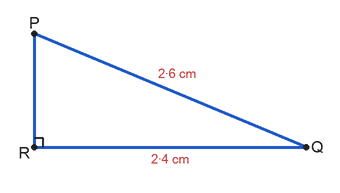
Triangle PQR is right-angled at vertex R. Calculate the length of PR, if :
PQ = 2·6 cm and QR = 2·4 cm.
 Solve with AI
Written solution
Solution:
Concept: By Pythagoras theorem, in a right-angled triangle the square of the hypotenuse equals the sum of the squares of the other two sides. The hypotenuse is the side opposite the right angle; it is always the longest side. To find one of the two shorter sides, we rearrange the rule: (shorter side)² = (hypotenuse)² − (other shorter side)².
Given: Triangle PQR is right-angled at R, PQ = 2.6 cm and QR = 2.4 cm.
Step 1 — Identify the hypotenuse.
The right angle is at R, so PQ (opposite R) is the hypotenuse, and PR is one of the shorter sides. The book writes 2·6 for the decimal 2.6.
Step 2 — Rearrange Pythagoras theorem for PR.
We subtract from .
Step 3 — Take the square root.
The positive square root of 1 is 1.
Watch out: Square the whole decimal: , not 4.36.
Therefore, PR = 1 cm.
- 43 marks
Question 4
The sides of certain triangles are given below. Find whether they are right angled triangles or not.
(i) 16 cm, 20 cm and 12 cm
Solve with AIWritten solution
Solution:
Concept: By the converse of Pythagoras theorem, if the square of the longest side of a triangle equals the sum of the squares of the other two sides, then the angle opposite the longest side is a right angle. If the two numbers are not equal, the triangle is not right-angled.
Step 1 — Find the longest side.
Of 16 cm, 20 cm and 12 cm, the longest side is 20 cm. If the triangle is right-angled, this side must be the hypotenuse.
Step 2 — Square the longest side.
We work out the square of 20.
Step 3 — Add the squares of the other two sides.
We add the squares of 16 and 12.
Step 4 — Compare.
The two results are equal, so by the converse of Pythagoras theorem the angle opposite the 20 cm side is 90°.
Watch out: Always compare with the LONGEST side; checking against proves nothing.
Therefore, the triangle with sides 16 cm, 20 cm and 12 cm is a right-angled triangle (the right angle is opposite the 20 cm side).
- 53 marks
Question 5
The sides of certain triangles are given below. Find whether they are right angled triangles or not.
(ii) 6 m, 9 m and 13 m
Solve with AIWritten solution
Solution:
Concept: By the converse of Pythagoras theorem, if the square of the longest side of a triangle equals the sum of the squares of the other two sides, then the angle opposite the longest side is a right angle. If the two numbers are not equal, the triangle is not right-angled.
Step 1 — Find the longest side.
Of 6 m, 9 m and 13 m, the longest side is 13 m.
Step 2 — Square the longest side.
We work out the square of 13.
Step 3 — Add the squares of the other two sides.
We add the squares of 6 and 9.
Step 4 — Compare.
Since , the square of the longest side is not the sum of the squares of the other two sides. So, by the converse of Pythagoras theorem, no angle of this triangle is 90°.
Watch out: A single mismatch is enough: if the longest side fails the test, the triangle cannot be right-angled.
Therefore, the triangle with sides 6 m, 9 m and 13 m is not a right-angled triangle.
- 63 marks
Question 6
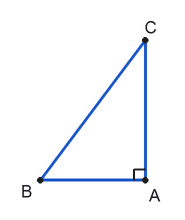
In the adjoining figure, angle BAC = 90°, AC = 400 m and AB = 300 m. Find the length of BC
 Solve with AI
Written solution
Solution:
Concept: By Pythagoras theorem, in a right-angled triangle the square of the hypotenuse equals the sum of the squares of the other two sides. The hypotenuse is the side opposite the right angle; it is always the longest side.
Given: Angle BAC = 90°, AC = 400 m and AB = 300 m.
Step 1 — Identify the hypotenuse.
Angle BAC is 90°, so BC (opposite A) is the hypotenuse; AB and AC are the shorter sides.
Step 2 — Apply Pythagoras theorem.
We add the squares of AB and AC.
Step 3 — Take the square root.
Since , the positive square root is 500.
Watch out: Count the zeros carefully: is 90000 (four zeros), not 9000.
Therefore, BC = 500 m.
- 73 marks
Question 7
In the given figures, angle ACP = ∠BDP = 90°, AC = 12 m, BD = 9 m and PA = PB = 15 m. Find :

(i) CP
(ii) PD
(iii) CD
Solve with AIWritten solution
Solution:
Concept: By Pythagoras theorem, in a right-angled triangle the square of the hypotenuse equals the sum of the squares of the other two sides. The hypotenuse is the side opposite the right angle; it is always the longest side. To find one of the two shorter sides, we rearrange the rule: (shorter side)² = (hypotenuse)² − (other shorter side)².
Given: ∠ACP and ∠BDP are right angles; AC is 12 m, BD is 9 m, and PA and PB are both 15 m.
Step 1 — Find CP in triangle ACP.
Triangle ACP is right-angled at C, so PA is its hypotenuse. We subtract from .
Step 2 — Find PD in triangle BDP.
Triangle BDP is right-angled at D, so PB is its hypotenuse. We subtract from .
Step 3 — Find CD.
P lies on the line segment CD, between C and D, so CD is the sum of CP and PD.
Watch out: PA and PB are equal, but CP and PD are not: each comes from its own triangle.
Therefore, (i) CP is 9 m; (ii) PD is 12 m; (iii) CD is 21 m.
- 83 marks
Question 8
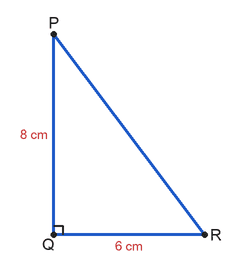
In triangle PQR, angle Q = 90°, find :
(i) PR, if PQ = 8 cm and QR = 6 cm
 Solve with AI
Written solution
Solution:
Concept: By Pythagoras theorem, in a right-angled triangle the square of the hypotenuse equals the sum of the squares of the other two sides. The hypotenuse is the side opposite the right angle; it is always the longest side.
Given: In triangle PQR, ∠Q = 90°, PQ = 8 cm and QR = 6 cm.
Step 1 — Identify the hypotenuse.
Angle Q is 90°, so PR (opposite Q) is the hypotenuse; PQ and QR are the shorter sides.
Step 2 — Apply Pythagoras theorem.
We add the squares of PQ and QR.
Step 3 — Take the square root.
The positive square root of 100 is 10.
Watch out: First find the right angle; the side opposite it is the hypotenuse, and only the hypotenuse is squared on its own.
Therefore, PR = 10 cm.
- 93 marks
Question 9
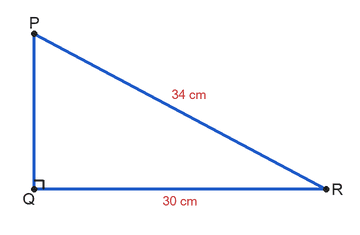
In triangle PQR, angle Q = 90°, find :
(ii) PQ, if PR = 34 cm and QR = 30 cm
 Solve with AI
Written solution
Solution:
Concept: By Pythagoras theorem, in a right-angled triangle the square of the hypotenuse equals the sum of the squares of the other two sides. The hypotenuse is the side opposite the right angle; it is always the longest side. To find one of the two shorter sides, we rearrange the rule: (shorter side)² = (hypotenuse)² − (other shorter side)².
Given: In triangle PQR, ∠Q = 90°, PR = 34 cm and QR = 30 cm.
Step 1 — Identify the hypotenuse.
Angle Q is 90°, so PR is the hypotenuse and PQ is one of the shorter sides.
Step 2 — Rearrange Pythagoras theorem for PQ.
We subtract from .
Step 3 — Take the square root.
Since , the positive square root is 16.
Watch out: When the hypotenuse is known, subtract the squares; adding them would give a side longer than the hypotenuse.
Therefore, PQ = 16 cm.
- 103 marks
Question 10
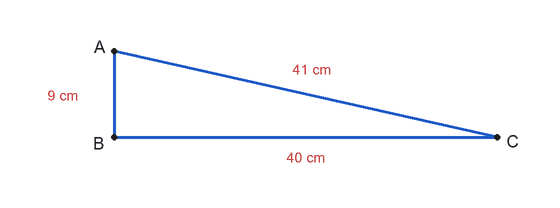
Show that the triangle ABC is a right-angled triangle; if :
AB = 9 cm, BC = 40 cm and AC = 41 cm.
 Solve with AI
Written solution
Solution:
Concept: By the converse of Pythagoras theorem, if the square of the longest side of a triangle equals the sum of the squares of the other two sides, then the angle opposite the longest side is a right angle. If the two numbers are not equal, the triangle is not right-angled.
Given: AB = 9 cm, BC = 40 cm and AC = 41 cm.
Step 1 — Find the longest side.
Of AB = 9 cm, BC = 40 cm and AC = 41 cm, the longest side is AC.
Step 2 — Square the longest side.
We work out .
Step 3 — Add the squares of the other two sides.
We add and .
Step 4 — Compare.
Since , the converse of Pythagoras theorem tells us that the angle opposite AC is 90°. The side AC is opposite vertex B, so ∠B = 90°.
Watch out: The right angle is opposite the longest side: AC is opposite B, so the right angle is at B, not at A or C.
Therefore, triangle ABC is a right-angled triangle, right-angled at B.
- 113 marks
Question 11
In the given figure, angle ACB = 90° = angle ACD.
If AB = 10 cm, BC = 6 cm and AD = 17 cm, find :
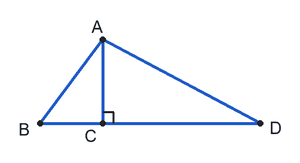
(i) AC
(ii) CD
Solve with AIWritten solution
Solution:
Concept: By Pythagoras theorem, in a right-angled triangle the square of the hypotenuse equals the sum of the squares of the other two sides. The hypotenuse is the side opposite the right angle; it is always the longest side. To find one of the two shorter sides, we rearrange the rule: (shorter side)² = (hypotenuse)² − (other shorter side)².
Given: ∠ACB and ∠ACD are right angles; AB is 10 cm, BC is 6 cm and AD is 17 cm.
Step 1 — Find AC in triangle ACB.
Triangle ACB is right-angled at C, so AB is its hypotenuse. It has two known sides, so we start here.
Step 2 — Find CD in triangle ACD.
Triangle ACD is right-angled at C, so AD is its hypotenuse. We now use AC = 8 cm.
Watch out: AC is a side of BOTH right triangles; find it first, then use it in the second triangle.
Therefore, (i) AC is 8 cm; (ii) CD is 15 cm.
- 123 marks
Question 12
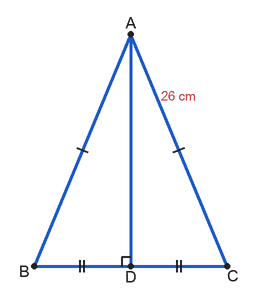
In the given figure, angle ADB = 90°, AC = AB = 26 cm and BD = DC. If the length of AD = 24 cm; find the length of BC.
 Solve with AI
Written solution
Solution:
Concept: By Pythagoras theorem, in a right-angled triangle the square of the hypotenuse equals the sum of the squares of the other two sides. The hypotenuse is the side opposite the right angle; it is always the longest side. To find one of the two shorter sides, we rearrange the rule: (shorter side)² = (hypotenuse)² − (other shorter side)².
Given: ∠ADB is a right angle; AC and AB are both 26 cm, BD equals DC, and AD is 24 cm.
Step 1 — Find BD in triangle ADB.
Triangle ADB is right-angled at D, so AB is its hypotenuse. We subtract from .
Step 2 — Find BC.
D lies on BC and BD = DC, so BC is twice BD.
Watch out: BD is only half of BC; remember to double it.
Therefore, BC = 20 cm.
- 133 marks
Question 13
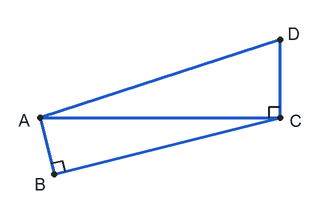
In the given figure, AD = 13 cm, BC = 12 cm, AB = 3 cm and angle ACD = angle ABC = 90°. Find the length of DC.
 Solve with AI
Written solution
Solution:
Concept: By Pythagoras theorem, in a right-angled triangle the square of the hypotenuse equals the sum of the squares of the other two sides. The hypotenuse is the side opposite the right angle; it is always the longest side. To find one of the two shorter sides, we rearrange the rule: (shorter side)² = (hypotenuse)² − (other shorter side)².
Given: AD is 13 cm, BC is 12 cm, AB is 3 cm, and ∠ACD and ∠ABC are right angles.
Step 1 — Find AC² in triangle ABC.
Triangle ABC is right-angled at B, so AC is its hypotenuse. We add the squares of AB and BC.
Step 2 — Find DC in triangle ACD.
Triangle ACD is right-angled at C, so AD is its hypotenuse. We subtract from ; we can use directly, without finding AC.
Watch out: There is no need to find AC itself ( is not a whole number); is all we need.
Therefore, DC = 4 cm.
- 143 marks
Question 14
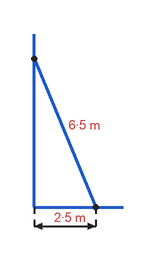
A ladder, 6·5 m long, rests against a vertical wall. If the foot of the ladder is 2·5 m from the foot of the wall, find upto how much height does the ladder reach ?
 Solve with AI
Written solution
Solution:
Concept: By Pythagoras theorem, in a right-angled triangle the square of the hypotenuse equals the sum of the squares of the other two sides. The hypotenuse is the side opposite the right angle; it is always the longest side. To find one of the two shorter sides, we rearrange the rule: (shorter side)² = (hypotenuse)² − (other shorter side)².
Given: The ladder is 6.5 m long, and its foot is 2.5 m from the foot of the wall.
Step 1 — Draw the right triangle.
The wall is vertical and the ground is horizontal, so they meet at 90°. The ladder joins the top of its reach on the wall to its foot on the ground, so the ladder is the hypotenuse. Let the height reached be metres.
Step 2 — Rearrange Pythagoras theorem for h.
We subtract the square of the distance from the wall from the square of the ladder's length.
Step 3 — Take the square root.
The height is the positive square root of 36.
Watch out: The ladder (6.5 m) is the hypotenuse, not the wall, so the height must come out shorter than 6.5 m.
Therefore, the ladder reaches a height of 6 m on the wall.
- 153 marks
Question 15
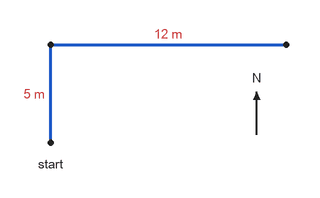
A boy first goes 5 m due north and then 12 m due east. Find the distance between the initial and the final positions of the boy.
 Solve with AI
Written solution
Solution:
Concept: By Pythagoras theorem, in a right-angled triangle the square of the hypotenuse equals the sum of the squares of the other two sides. The hypotenuse is the side opposite the right angle; it is always the longest side.
Given: The boy walks 5 m due north and then 12 m due east.
Step 1 — Draw the right triangle.
North and east are at right angles, so the two walks are the shorter sides of a right triangle. The straight-line distance from the start to the finish is the hypotenuse.
Step 2 — Apply Pythagoras theorem.
We add the squares of the two walks.
Step 3 — Take the square root.
The distance is the positive square root of 169.
Watch out: The distance between the two positions is the straight line, not the path walked ( m).
Therefore, the distance between the initial and the final positions of the boy is 13 m.
- 163 marks
Question 16
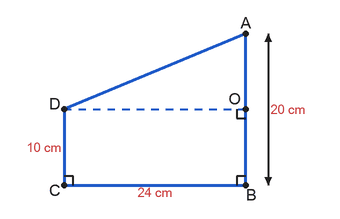
Use the information given in the adjoining figure to find the length of AD.
 Solve with AI
Written solution
Solution:
Concept: By Pythagoras theorem, in a right-angled triangle the square of the hypotenuse equals the sum of the squares of the other two sides. The hypotenuse is the side opposite the right angle; it is always the longest side. Opposite sides of a rectangle are equal.
Given: DC = 10 cm, CB = 24 cm, AB = 20 cm, and the angles at C, B and O are right angles.
Step 1 — Find the rectangle DOBC.
The angles at C, B and O are right angles, so DOBC is a rectangle. Opposite sides of a rectangle are equal, so DO equals CB (24 cm) and OB equals DC (10 cm).
Step 2 — Find AO.
O lies on AB, so AO is what is left of AB after OB.
Step 3 — Apply Pythagoras theorem in triangle AOD.
Triangle AOD is right-angled at O, so AD is its hypotenuse.
Watch out: AO is not the whole of AB: subtract OB, which equals DC (10 cm), first.
Therefore, AD = 26 cm.
- 171 mark
Question 17
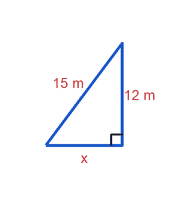
The value of x is :
 Solve with AI
Answer
(A) 10 m
- Correct
(B) 9 m
(C) 16 m
(D) none of these
Answer: (B) 9 m
Concept: By Pythagoras theorem, in a right-angled triangle the square of the hypotenuse equals the sum of the squares of the other two sides. The hypotenuse is the side opposite the right angle; it is always the longest side. To find one of the two shorter sides, we rearrange the rule: (shorter side)² = (hypotenuse)² − (other shorter side)².
Step 1 — Identify the hypotenuse.
The 15 m side is opposite the right angle, so it is the hypotenuse; x and 12 m are the shorter sides.
Step 2 — Find x.
We subtract the square of 12 from the square of 15.
Watch out: When the hypotenuse is known, subtract the squares; adding them would give a side longer than the hypotenuse.
Why the other options are wrong:
- (A) 10 m: With , , which is not .
- (C) 16 m: 16 m is longer than the hypotenuse (15 m), which is impossible for a shorter side.
- (D) none of these: The correct value, 9 m, is one of the options, so “none of these” is wrong.
Therefore, x = 9 m, option (B).
- 181 mark
Question 18
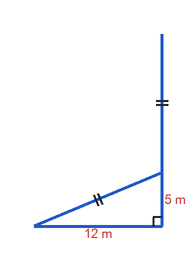
A tree is broken at a height of 5 m from the ground and its top touches the ground at a distance of 12 m from the base of the tree. The original height of the tree is :
 Solve with AI
Answer
(A) 13 m
(B) 27 m
- Correct
(C) 18 m
(D) 20 m
Answer: (C) 18 m
Concept: By Pythagoras theorem, in a right-angled triangle the square of the hypotenuse equals the sum of the squares of the other two sides. The hypotenuse is the side opposite the right angle; it is always the longest side.
Step 1 — Draw the right triangle.
The standing part (5 m) is vertical and the ground is horizontal, so they meet at 90°. The broken part joins the break to the point on the ground, so it is the hypotenuse.
Step 2 — Find the broken part.
Let the broken part be m. We add the squares of 5 and 12.
Step 3 — Find the original height.
Before it broke, the tree was the standing part plus the broken part.
Watch out: The answer is the whole tree, not only the broken part.
Why the other options are wrong:
- (A) 13 m: 13 m is only the broken part; the 5 m standing part must be added.
- (B) 27 m: 27 m would make the broken part m, but , not 169.
- (D) 20 m: 20 m would make the broken part m, but , not 169.
Therefore, the original height of the tree is 18 m, option (C).
- 191 mark
Question 19
From a point P, a boy travels 12 km due east and then travels 9 km due north to point Q.
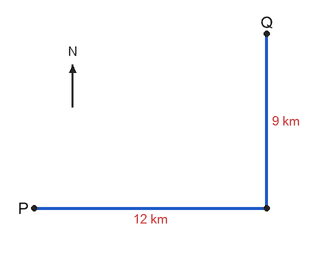
The shortest distance between points P and Q is :
Solve with AIAnswer
- Correct
(A) 15 km
(B) 3 km
(C) 21 km
(D) 20 km
Answer: (A) 15 km
Concept: By Pythagoras theorem, in a right-angled triangle the square of the hypotenuse equals the sum of the squares of the other two sides. The hypotenuse is the side opposite the right angle; it is always the longest side.
Step 1 — Draw the right triangle.
East and north are at right angles, so the two journeys are the shorter sides and the straight line PQ is the hypotenuse.
Step 2 — Apply Pythagoras theorem.
We add the squares of 12 and 9.
Watch out: The shortest distance is the straight line PQ, not the distance travelled.
Why the other options are wrong:
- (B) 3 km: 3 km is the difference , which is not the length of PQ.
- (C) 21 km: 21 km is the distance travelled, ; the straight line is shorter.
- (D) 20 km: With PQ = 20 km, , which is not .
Therefore, the shortest distance between P and Q is 15 km, option (A).
- 201 mark
Question 20
The value of x is :
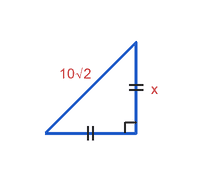 Solve with AI
Answer
(A)
(B) 5
- Correct
(C) 10
(D) 6
Answer: (C) 10
Concept: By Pythagoras theorem, in a right-angled triangle the square of the hypotenuse equals the sum of the squares of the other two sides. The hypotenuse is the side opposite the right angle; it is always the longest side.
Step 1 — Use the equal sides.
The two shorter sides carry the same marks, so both are . The side is opposite the right angle, so it is the hypotenuse.
Step 2 — Apply Pythagoras theorem.
We write the rule with both legs equal to and solve; note that is .
The length is the positive square root of 100.
Watch out: Square both factors of : , not 20.
Why the other options are wrong:
- (A) : is half the hypotenuse; then , not 200.
- (B) 5: With , , not 200.
- (D) 6: With , , not 200.
Therefore, x = 10, option (C).
- 211 mark
Question 21
The value of x is :
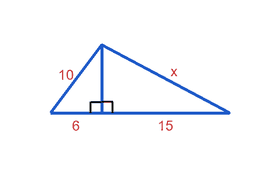 Solve with AI
Answer
(A) 15
(B) 21
(C) 23
- Correct
(D) 17
Answer: (D) 17
Concept: By Pythagoras theorem, in a right-angled triangle the square of the hypotenuse equals the sum of the squares of the other two sides. The hypotenuse is the side opposite the right angle; it is always the longest side. To find one of the two shorter sides, we rearrange the rule: (shorter side)² = (hypotenuse)² − (other shorter side)².
Step 1 — Find the height in the left triangle.
The height makes a right angle with the base. In the left triangle the side 10 is the hypotenuse and the base piece 6 is a shorter side. Let the height be .
Step 2 — Find x in the right triangle.
In the right triangle, x is the hypotenuse, with shorter sides and 15.
Watch out: The height is shared by both triangles; find it first.
Why the other options are wrong:
- (A) 15: 15 is a shorter side of the right triangle; its hypotenuse x must be longer than 15.
- (B) 21: 21 is the whole base, , not the slanting side x.
- (C) 23: With , , but .
Therefore, x = 17, option (D).
- 221 mark
Question 22
The value of x is :
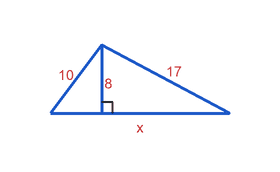 Solve with AI
Answer
- Correct
(A) 21
(B) 15
(C) 17
(D) 27
Answer: (A) 21
Concept: By Pythagoras theorem, in a right-angled triangle the square of the hypotenuse equals the sum of the squares of the other two sides. The hypotenuse is the side opposite the right angle; it is always the longest side. To find one of the two shorter sides, we rearrange the rule: (shorter side)² = (hypotenuse)² − (other shorter side)².
Step 1 — Find the left piece of the base.
The height 8 is at right angles to the base. In the left triangle 10 is the hypotenuse, so the left piece comes from subtracting squares.
Step 2 — Find the right piece of the base.
In the right triangle 17 is the hypotenuse; let the right piece be .
Step 3 — Add the pieces.
The base x is made of the two pieces.
Watch out: X is the whole base, so both pieces are needed.
Why the other options are wrong:
- (B) 15: 15 is only the right piece of the base.
- (C) 17: 17 is the slanting side of the right triangle, not the base.
- (D) 27: 27 is , the two slanting sides added, which is not the base.
Therefore, x = 21, option (A).
- 231 mark
Question 23
The perimeter of quadrilateral (rhombus) ABCD is :
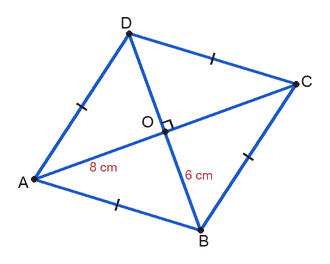 Solve with AI
Answer
(A) 56 cm
- Correct
(B) 40 cm
(C) 28 cm
(D) none of these
Answer: (B) 40 cm
Concept: The diagonals of a rhombus bisect each other at right angles, and all four sides of a rhombus are equal. By Pythagoras theorem, in a right-angled triangle the square of the hypotenuse equals the sum of the squares of the other two sides. The hypotenuse is the side opposite the right angle; it is always the longest side.
Step 1 — Use the diagonals of the rhombus.
The diagonals of a rhombus bisect each other at right angles, so triangle AOB is right-angled at O with AO = 8 cm and OB = 6 cm.
Step 2 — Find the side AB.
AB is the hypotenuse of triangle AOB.
Step 3 — Find the perimeter.
All four sides of a rhombus are equal.
Watch out: AO and OB are halves of the diagonals, not sides of the rhombus.
Why the other options are wrong:
- (A) 56 cm: 56 cm is , which treats as a side.
- (C) 28 cm: 28 cm is , which uses the half-diagonals instead of the sides.
- (D) none of these: The correct perimeter, 40 cm, is one of the options.
Therefore, the perimeter of rhombus ABCD is 40 cm, option (B).
- 241 mark
Question 24
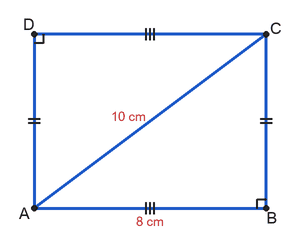
The perimeter of quadrilateral (rectangle) ABCD is :
 Solve with AI
Answer
(A) 32 cm
(B) 36 cm
- Correct
(C) 28 cm
(D) 38 cm
Answer: (C) 28 cm
Concept: Every angle of a rectangle is 90° and its opposite sides are equal. By Pythagoras theorem, in a right-angled triangle the square of the hypotenuse equals the sum of the squares of the other two sides. The hypotenuse is the side opposite the right angle; it is always the longest side. To find one of the two shorter sides, we rearrange the rule: (shorter side)² = (hypotenuse)² − (other shorter side)².
Step 1 — Use the right angle at B.
Every angle of a rectangle is 90°, so triangle ABC is right-angled at B with hypotenuse AC = 10 cm and AB = 8 cm.
Step 2 — Find BC.
We subtract the square of AB from the square of AC.
Step 3 — Find the perimeter.
Opposite sides of a rectangle are equal, so the perimeter is twice the sum of the length and the breadth.
Watch out: The diagonal AC is not a side of the rectangle.
Why the other options are wrong:
- (A) 32 cm: 32 cm is , as if the rectangle were a square of side 8 cm.
- (B) 36 cm: 36 cm is , which uses the diagonal as a side.
- (D) 38 cm: 38 cm would need , so BC = 11 cm, longer than the diagonal 10 cm, which is impossible.
Therefore, the perimeter of rectangle ABCD is 28 cm, option (C).
- 251 mark
Question 25
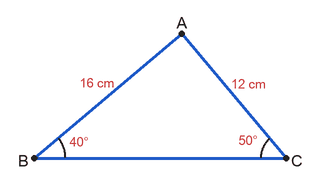
Length of BC is :
 Solve with AI
Answer
(A) 16 cm
(B) 28 cm
(C) 10 cm
- Correct
(D) 20 cm
Answer: (D) 20 cm
Concept: The angles of a triangle add up to 180°. By Pythagoras theorem, in a right-angled triangle the square of the hypotenuse equals the sum of the squares of the other two sides. The hypotenuse is the side opposite the right angle; it is always the longest side.
Step 1 — Find angle A.
The angles of a triangle add up to 180°, so ∠A is 180° minus the two given angles.
Step 2 — Apply Pythagoras theorem.
Since ∠A is 90°, BC (opposite A) is the hypotenuse.
Watch out: BC is the longest side, so it must be longer than both 16 cm and 12 cm.
Note: With AB = 16 cm and AC = 12 cm, the angles B and C are really about 37° and 53°; the printed 40° and 50° only show that ∠A = 90°, and the answer is the same.
Why the other options are wrong:
- (A) 16 cm: 16 cm is AB; the hypotenuse BC must be longer than AB.
- (B) 28 cm: 28 cm is ; adding the sides is not Pythagoras theorem.
- (C) 10 cm: 10 cm is shorter than both other sides, but the hypotenuse is the longest side.
Therefore, BC = 20 cm, option (D).
- 261 mark
Question 26
Statement 1 : The sides of a triangle are of length 6 cm, 4·5 cm and 7·5 cm. The angle opposite to the side 7·5 cm is 90°.
Statement 2 : A triangle having one or more angles as a right angle or 90° is called a right-angled triangle.
Which of the following options is correct?
Solve with AIAnswer
(A) Both the statements are true.
(B) Both the statements are false.
- Correct
(C) Statement 1 is true, and statement 2 is false.
(D) Statement 1 is false, and statement 2 is true.
Answer: (C) Statement 1 is true, and statement 2 is false.
Concept: By the converse of Pythagoras theorem, if the square of the longest side of a triangle equals the sum of the squares of the other two sides, then the angle opposite the longest side is a right angle. If the two numbers are not equal, the triangle is not right-angled. The angles of a triangle add up to 180°.
Step 1 — Judge statement 1.
The longest side is 7.5 cm (printed 7·5). We compare its square with the sum of the squares of the other two sides.
They are equal, so by the converse of Pythagoras theorem the angle opposite 7.5 cm is 90°. Statement 1 is true.
Step 2 — Judge statement 2.
A triangle can have at most one right angle: two right angles would already add up to 180°, leaving nothing for the third angle. So “one or more” right angles is wrong, and statement 2 is false as written.
Watch out: A right-angled triangle has exactly ONE right angle.
Why the other options are wrong:
- (A): Statement 2 is false, so both cannot be true.
- (B): Statement 1 is true: .
- (D): This reverses the verdicts: statement 1 is true and statement 2 is false.
Therefore, statement 1 is true and statement 2 is false, option (C).
- 271 mark
Question 27
Statement 1 : A right angled triangle may be an isosceles triangle.
Statement 2 : Vertex angle of a right angled isosceles triangle is 90°.
Which of the following options is correct?
Solve with AIAnswer
- Correct
(A) Both the statements are true.
(B) Both the statements are false.
(C) Statement 1 is true, and statement 2 is false.
(D) Statement 1 is false, and statement 2 is true.
Answer: (A) Both the statements are true.
Concept: An isosceles triangle has two equal sides; the angle between them is its vertex angle, and the angles opposite the equal sides are equal. The angles of a triangle add up to 180°.
Step 1 — Judge statement 1.
A triangle with angles 90°, 45° and 45° has two equal angles, so the sides opposite them are equal. It is both right-angled and isosceles, so statement 1 is true.
Step 2 — Judge statement 2.
In a right-angled isosceles triangle the two equal sides are the arms of the right angle. The vertex angle is the angle between the two equal sides, so it is the right angle, 90°. Statement 2 is true.
Watch out: The hypotenuse is the longest side, so it can never be one of the two equal sides.
Why the other options are wrong:
- (B): Both statements are true, so “both false” is wrong.
- (C): Statement 2 is also true: the vertex angle is the 90° angle.
- (D): Statement 1 is also true: a 90°, 45°, 45° triangle is right-angled and isosceles.
Therefore, both statements are true, option (A).
- 281 mark
Question 28
The following questions are Assertion-Reason based questions. Choose your answer based on the codes given below :
(1) A is true, R is false.
(2) A is false, R is true.
(3) Both A and R are true.
(4) Both A and R are false.
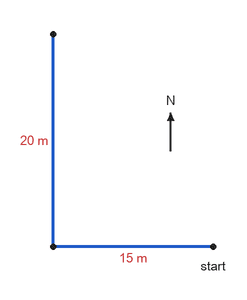
Assertion (A) : A man goes 15 m due West and then 20 m due North, then he is 25 m from the starting point.
Reason (R) : According to Pythagoras theorem, in a triangle, the square of the hypotenuse is equal to the sum of the squares of the other two sides.
Solve with AIAnswer
(A) (1)
(B) (2)
- Correct
(C) (3)
(D) (4)
Answer: (C) (3)
Concept: In an Assertion–Reason item we judge the Assertion (A) and the Reason (R) separately, as true or false, and then choose the code that matches both verdicts. By Pythagoras theorem, in a right-angled triangle the square of the hypotenuse equals the sum of the squares of the other two sides. The hypotenuse is the side opposite the right angle; it is always the longest side.
Step 1 — Judge the Assertion.
West and north are at right angles, so the two walks are the shorter sides of a right triangle and the distance from the start is its hypotenuse.
He is 25 m from the start, so A is true.
Step 2 — Judge the Reason.
R states Pythagoras theorem. The word “hypotenuse” is used only for a right-angled triangle, so R is the theorem as it applies there, and R is true.
Step 3 — Choose the code.
A is true and R is true. This matches code (3).
Watch out: The distance from the start is the straight line, not the path walked ( m).
Why the other options are wrong:
- (A): Code (1) says R is false, but R is Pythagoras theorem.
- (B): Code (2) says A is false, but the distance is exactly 25 m.
- (D): Code (4) says both are false, but both are true.
Therefore, both A and R are true, option (C).
- 291 mark
Question 29
The following questions are Assertion-Reason based questions. Choose your answer based on the codes given below :
(1) A is true, R is false.
(2) A is false, R is true.
(3) Both A and R are true.
(4) Both A and R are false.
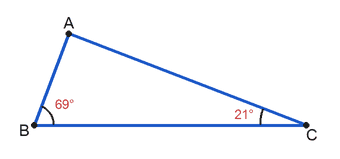
Assertion (A) : Angles B and C of ΔABC are 69° and 21°, then AC² – AB² = BC²
Reason (R) : In a triangle if sum of any two angles is 90° then the 3rd. angle is right angle.
Solve with AIAnswer
(A) (1)
- Correct
(B) (2)
(C) (3)
(D) (4)
Answer: (B) (2)
Concept: In an Assertion–Reason item we judge A and R separately and then choose the matching code. The angles of a triangle add up to 180°. By Pythagoras theorem, in a right-angled triangle the square of the hypotenuse equals the sum of the squares of the other two sides. The hypotenuse is the side opposite the right angle; it is always the longest side.
Step 1 — Find the third angle.
The angles of a triangle add up to 180°.
Step 2 — Judge the Assertion.
Since ∠A is 90°, the hypotenuse is BC, the side opposite A. Pythagoras theorem gives:
Subtracting from both sides gives:
The Assertion instead says , which would need the right angle at B. Here ∠B is 69°, so A is false.
Step 3 — Judge the Reason.
If two angles add up to 90°, the third angle is 180° − 90° = 90°, a right angle. So R is true.
Step 4 — Choose the code.
A is false and R is true. This matches code (2).
Watch out: The hypotenuse is opposite the right angle; here that is BC, not AC.
Why the other options are wrong:
- (A): Code (1) says A is true, but the Assertion puts the hypotenuse at AC instead of BC.
- (C): Code (3) says A is true, but A is false.
- (D): Code (4) says R is false, but R is true.
Therefore, A is false and R is true, option (B).
- 301 mark
Question 30
The following questions are Assertion-Reason based questions. Choose your answer based on the codes given below :
(1) A is true, R is false.
(2) A is false, R is true.
(3) Both A and R are true.
(4) Both A and R are false.
Assertion (A) : If you walk diagonally across a rectangular field 60 m long and 80 m wide then you will walk 40 m shorter.

Reason (R) : Line joining any two non-consecutive vertices of a rectangle is a diagonal of the rectangle..
Solve with AIAnswer
(A) (1)
(B) (2)
- Correct
(C) (3)
(D) (4)
Answer: (C) (3)
Concept: In an Assertion–Reason item we judge A and R separately and then choose the matching code. By Pythagoras theorem, in a right-angled triangle the square of the hypotenuse equals the sum of the squares of the other two sides. The hypotenuse is the side opposite the right angle; it is always the longest side.
Step 1 — Find the diagonal.
The sides of a rectangle meet at right angles, so the diagonal is the hypotenuse of a right triangle with shorter sides 60 m and 80 m.
Step 2 — Compare with walking along two sides.
Without the short cut we walk along a length and a breadth.
So walking diagonally is 40 m shorter, and A is true (compared with walking along the two sides).
Step 3 — Judge the Reason.
Non-consecutive vertices of a rectangle are opposite corners, and the line joining them is a diagonal. R is the definition of a diagonal, so R is true.
Step 4 — Choose the code.
A is true and R is true. This matches code (3).
Watch out: The saving is the difference between the two routes, not the diagonal itself.
Why the other options are wrong:
- (A): Code (1) says R is false, but R is the definition of a diagonal.
- (B): Code (2) says A is false, but the saving is exactly 40 m.
- (D): Code (4) says both are false, but both are true.
Therefore, both A and R are true, option (C).
What Class 7 Maths Ch 18 covers
The sections of the chapter, in the order the book takes them. Every question above comes from one of these.
- 01Pythagoras Theorem
- 02Converse of Pythagoras Theorem
More ways to study this chapter
The same chapter asked three other ways. Practise it, revise it, and see what the board has set on Ch 18 before.
Class 7 Maths Ch 18 questions students ask
How many questions are there in Class 7 Maths Ch 18?
30 questions. Every one is solved step by step on this page.
Are these Class 7 Maths solutions free?
Yes. Every question and its full working is free to read, with no account needed.
Can I download the Class 7 Maths Ch 18 solutions as a PDF?
There is no PDF to download. Every solution is on this page instead, which means it is searchable, always the current syllabus, and readable on a phone. Use your browser's print option if you want it on paper.