
Question 163 marksMedium
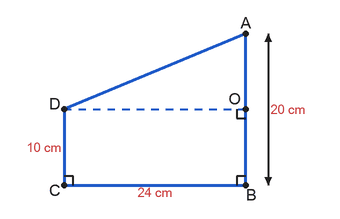
Use the information given in the adjoining figure to find the length of AD.
Confirming your payment
Sign up now and get 250 free tokens.
Pythagoras Theorem · Question 16 of 30
Use the information given in the adjoining figure to find the length of AD.
Solution:
Concept: By Pythagoras theorem, in a right-angled triangle the square of the hypotenuse equals the sum of the squares of the other two sides. The hypotenuse is the side opposite the right angle; it is always the longest side. Opposite sides of a rectangle are equal.
Given: DC = 10 cm, CB = 24 cm, AB = 20 cm, and the angles at C, B and O are right angles.
Step 1 — Find the rectangle DOBC.
The angles at C, B and O are right angles, so DOBC is a rectangle. Opposite sides of a rectangle are equal, so DO equals CB (24 cm) and OB equals DC (10 cm).
Step 2 — Find AO.
O lies on AB, so AO is what is left of AB after OB.
Step 3 — Apply Pythagoras theorem in triangle AOD.
Triangle AOD is right-angled at O, so AD is its hypotenuse.
Watch out: AO is not the whole of AB: subtract OB, which equals DC (10 cm), first.
Therefore, AD = 26 cm.