
Question 153 marksEasy
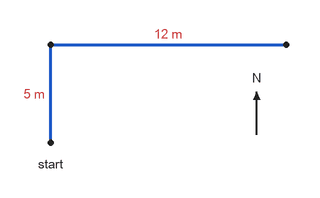
A boy first goes 5 m due north and then 12 m due east. Find the distance between the initial and the final positions of the boy.
Confirming your payment
Sign up now and get 250 free tokens.
Pythagoras Theorem · Question 15 of 30
A boy first goes 5 m due north and then 12 m due east. Find the distance between the initial and the final positions of the boy.
Solution:
Concept: By Pythagoras theorem, in a right-angled triangle the square of the hypotenuse equals the sum of the squares of the other two sides. The hypotenuse is the side opposite the right angle; it is always the longest side.
Given: The boy walks 5 m due north and then 12 m due east.
Step 1 — Draw the right triangle.
North and east are at right angles, so the two walks are the shorter sides of a right triangle. The straight-line distance from the start to the finish is the hypotenuse.
Step 2 — Apply Pythagoras theorem.
We add the squares of the two walks.
Step 3 — Take the square root.
The distance is the positive square root of 169.
Watch out: The distance between the two positions is the straight line, not the path walked ( m).
Therefore, the distance between the initial and the final positions of the boy is 13 m.