
Question 143 marksEasy
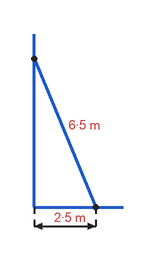
A ladder, 6·5 m long, rests against a vertical wall. If the foot of the ladder is 2·5 m from the foot of the wall, find upto how much height does the ladder reach ?
Confirming your payment
Sign up now and get 250 free tokens.
Pythagoras Theorem · Question 14 of 30
A ladder, 6·5 m long, rests against a vertical wall. If the foot of the ladder is 2·5 m from the foot of the wall, find upto how much height does the ladder reach ?
Solution:
Concept: By Pythagoras theorem, in a right-angled triangle the square of the hypotenuse equals the sum of the squares of the other two sides. The hypotenuse is the side opposite the right angle; it is always the longest side. To find one of the two shorter sides, we rearrange the rule: (shorter side)² = (hypotenuse)² − (other shorter side)².
Given: The ladder is 6.5 m long, and its foot is 2.5 m from the foot of the wall.
Step 1 — Draw the right triangle.
The wall is vertical and the ground is horizontal, so they meet at 90°. The ladder joins the top of its reach on the wall to its foot on the ground, so the ladder is the hypotenuse. Let the height reached be metres.
Step 2 — Rearrange Pythagoras theorem for h.
We subtract the square of the distance from the wall from the square of the ladder's length.
Step 3 — Take the square root.
The height is the positive square root of 36.
Watch out: The ladder (6.5 m) is the hypotenuse, not the wall, so the height must come out shorter than 6.5 m.
Therefore, the ladder reaches a height of 6 m on the wall.