
Question 133 marksMedium
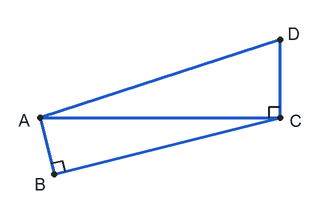
In the given figure, AD = 13 cm, BC = 12 cm, AB = 3 cm and angle ACD = angle ABC = 90°. Find the length of DC.
Confirming your payment
Sign up now and get 250 free tokens.
Pythagoras Theorem · Question 13 of 30
In the given figure, AD = 13 cm, BC = 12 cm, AB = 3 cm and angle ACD = angle ABC = 90°. Find the length of DC.
Solution:
Concept: By Pythagoras theorem, in a right-angled triangle the square of the hypotenuse equals the sum of the squares of the other two sides. The hypotenuse is the side opposite the right angle; it is always the longest side. To find one of the two shorter sides, we rearrange the rule: (shorter side)² = (hypotenuse)² − (other shorter side)².
Given: AD is 13 cm, BC is 12 cm, AB is 3 cm, and ∠ACD and ∠ABC are right angles.
Step 1 — Find AC² in triangle ABC.
Triangle ABC is right-angled at B, so AC is its hypotenuse. We add the squares of AB and BC.
Step 2 — Find DC in triangle ACD.
Triangle ACD is right-angled at C, so AD is its hypotenuse. We subtract from ; we can use directly, without finding AC.
Watch out: There is no need to find AC itself ( is not a whole number); is all we need.
Therefore, DC = 4 cm.