
Question 23 marksEasy
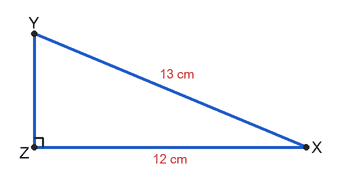
Triangle XYZ is right-angled at vertex Z. Calculate the length of YZ, if XY = 13 cm and XZ = 12 cm.
Confirming your payment
Sign up now and get 250 free tokens.
Pythagoras Theorem · Question 2 of 30
Triangle XYZ is right-angled at vertex Z. Calculate the length of YZ, if XY = 13 cm and XZ = 12 cm.
Solution:
Concept: By Pythagoras theorem, in a right-angled triangle the square of the hypotenuse equals the sum of the squares of the other two sides. The hypotenuse is the side opposite the right angle; it is always the longest side. To find one of the two shorter sides, we rearrange the rule: (shorter side)² = (hypotenuse)² − (other shorter side)².
Given: Triangle XYZ is right-angled at Z, XY = 13 cm and XZ = 12 cm.
Step 1 — Identify the hypotenuse.
The right angle is at Z, so the side opposite Z, which is XY, is the hypotenuse. YZ is one of the two shorter sides.
Step 2 — Rearrange Pythagoras theorem for YZ.
Since , we subtract from to get .
Step 3 — Take the square root.
We take the positive square root, since YZ is a length.
Watch out: When the hypotenuse is known, subtract the squares; adding them would give a side longer than the hypotenuse.
Therefore, YZ = 5 cm.