
Question 33 marksEasy
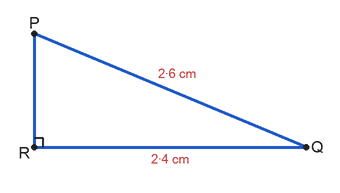
Triangle PQR is right-angled at vertex R. Calculate the length of PR, if :
PQ = 2·6 cm and QR = 2·4 cm.
Confirming your payment
Sign up now and get 250 free tokens.
Pythagoras Theorem · Question 3 of 30
Triangle PQR is right-angled at vertex R. Calculate the length of PR, if :
PQ = 2·6 cm and QR = 2·4 cm.
Solution:
Concept: By Pythagoras theorem, in a right-angled triangle the square of the hypotenuse equals the sum of the squares of the other two sides. The hypotenuse is the side opposite the right angle; it is always the longest side. To find one of the two shorter sides, we rearrange the rule: (shorter side)² = (hypotenuse)² − (other shorter side)².
Given: Triangle PQR is right-angled at R, PQ = 2.6 cm and QR = 2.4 cm.
Step 1 — Identify the hypotenuse.
The right angle is at R, so PQ (opposite R) is the hypotenuse, and PR is one of the shorter sides. The book writes 2·6 for the decimal 2.6.
Step 2 — Rearrange Pythagoras theorem for PR.
We subtract from .
Step 3 — Take the square root.
The positive square root of 1 is 1.
Watch out: Square the whole decimal: , not 4.36.
Therefore, PR = 1 cm.