The following questions are Assertion-Reason based questions. Choose your answer based on the codes given below
Question 281 markMCQEasy
The following questions are Assertion-Reason based questions. Choose your answer based on the codes given below :
(1) A is true, R is false.
(2) A is false, R is true.
(3) Both A and R are true.
(4) Both A and R are false.
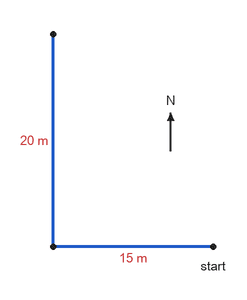
Assertion (A) : A man goes 15 m due West and then 20 m due North, then he is 25 m from the starting point.
Reason (R) : According to Pythagoras theorem, in a triangle, the square of the hypotenuse is equal to the sum of the squares of the other two sides.
Select your answer
(A) (1)
(B) (2)
(C) (3)
Correct answer
(D) (4)
Answer: (C) (3)
Concept: In an Assertion–Reason item we judge the Assertion (A) and the Reason (R) separately, as true or false, and then choose the code that matches both verdicts. By Pythagoras theorem, in a right-angled triangle the square of the hypotenuse equals the sum of the squares of the other two sides. The hypotenuse is the side opposite the right angle; it is always the longest side.
Step 1 — Judge the Assertion.
West and north are at right angles, so the two walks are the shorter sides of a right triangle and the distance d from the start is its hypotenuse.
d2=152+202=225+400=625d=625=25
He is 25 m from the start, so A is true.
Step 2 — Judge the Reason.
R states Pythagoras theorem. The word “hypotenuse” is used only for a right-angled triangle, so R is the theorem as it applies there, and R is true.
Step 3 — Choose the code.
A is true and R is true. This matches code (3).
Watch out: The distance from the start is the straight line, not the path walked (15+20=35 m).
Why the other options are wrong:
(A): Code (1) says R is false, but R is Pythagoras theorem.
(B): Code (2) says A is false, but the distance is exactly 25 m.
(D): Code (4) says both are false, but both are true.