
Question 191 markMCQEasy
From a point P, a boy travels 12 km due east and then travels 9 km due north to point Q.
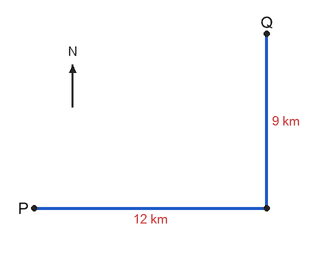
The shortest distance between points P and Q is :
Confirming your payment
Sign up now and get 250 free tokens.
Pythagoras Theorem · Question 19 of 30
From a point P, a boy travels 12 km due east and then travels 9 km due north to point Q.
The shortest distance between points P and Q is :
(A) 15 km
(B) 3 km
(C) 21 km
(D) 20 km
Answer: (A) 15 km
Concept: By Pythagoras theorem, in a right-angled triangle the square of the hypotenuse equals the sum of the squares of the other two sides. The hypotenuse is the side opposite the right angle; it is always the longest side.
Step 1 — Draw the right triangle.
East and north are at right angles, so the two journeys are the shorter sides and the straight line PQ is the hypotenuse.
Step 2 — Apply Pythagoras theorem.
We add the squares of 12 and 9.
Watch out: The shortest distance is the straight line PQ, not the distance travelled.
Why the other options are wrong:
Therefore, the shortest distance between P and Q is 15 km, option (A).