
Opening your dashboard
Class 12 Physics Chapter 9: Magnetism and Matter Solutions
66 textbook questions with step-by-step answers, free to read, for ISC 2026-27.
Get talked through Ch 9, not just shown the answer
Reading a finished solution is not the same as being able to do it. The AI tutor takes one question at a time and works it with you, in your own words, until you can.
- Ask it out loud, in your own words
- It gives you the next step, not the answer
- Stuck on part (ii)? Start there
66 questions with solutions
1–5 marks · Mixed difficulty
The first 20 solutions are on this page. This chapter is a long one, so the rest open on their own page to keep this one quick to load.
- 11 mark
Question 1
An iron rod of length and magnetic moment is bent in the form of a semicircle. Now its magnetic moment will be
Solve with AIAnswer
(A)
- Correct
(B)
(C)
(D)
Answer: (B)
Key idea: The magnetic moment of a magnet is its pole strength times the straight-line distance between its two poles. Bending the rod does not change the pole strength; it only changes how far apart the poles are.
Step 1 — Write the moment of the straight rod.
For the straight rod the poles are at its ends, a distance apart.
Step 2 — Find the radius of the semicircle.
The rod of length now forms half a circle of radius , so its length equals half the circumference.
Step 3 — Find the new distance between the poles.
The two ends of a semicircle lie at the two ends of a diameter, so the poles are now a distance apart.
Step 4 — Find the new magnetic moment.
The pole strength is unchanged, so we multiply it by the new separation.
Why the other options are wrong:
- (A) is wrong: The moment stays only if the poles stay a distance apart, but the straight distance between the ends shrinks to , about .
- (C) is wrong: This is what we get by using the radius as the pole separation instead of the diameter .
- (D) is wrong: This is larger than , but bending can only bring the poles closer together, so the moment can only decrease.
Therefore, the magnetic moment of the bent rod is : option (B).
- 21 mark
Question 2
Unit of magnetic flux density (or magnetic induction) is
Solve with AIAnswer
(A) Tesla
(B) Weber/metre
(C) Newton/ampere-metre
- Correct
(D) All of the above
Answer: (D) All of the above
Key idea: The magnetic flux density can be defined in two equivalent ways: as magnetic flux per unit area (), or through the force on a current-carrying wire at right angles to the field (). Each definition gives a name for the same S.I. unit.
Step 1 — Name the S.I. unit.
The S.I. unit of magnetic flux density is called the tesla (T).
Step 2 — Find the unit from flux per unit area.
Flux is measured in webers and area in square metres. So the unit of is the weber per square metre.
Step 3 — Find the unit from the force on a wire.
We rearrange , and get . Force is in newtons, current in amperes and length in metres.
So tesla, weber/metre and newton/ampere-metre are three names for the same unit.
Why the other options are wrong:
- (A) is wrong: The tesla is a correct unit, but it is only one of the three correct names listed, so choosing it alone leaves out the other two.
- (B) is wrong: The weber per square metre is correct (Step 2), but it too is only one of the three correct units.
- (C) is wrong: The newton per ampere-metre is correct (Step 3), but choosing it alone ignores the tesla and Wb m, which are equally correct.
Therefore, tesla, weber/metre and newton/ampere-metre are all units of magnetic flux density: option (D).
- 31 mark
Question 3
A magnetic dipole is placed in a uniform magnetic field. The net magnetic force on the dipole
Solve with AIAnswer
- Correct
(A) Is always zero
(B) Depends on the orientation of the dipole
(C) Can never be zero
(D) Depends on the strength of the dipole
Answer: (A) Is always zero
Key idea: A magnetic dipole (such as a bar magnet of pole strength ) in a uniform field has a force on each pole. In a uniform field these two forces are equal in size and opposite in direction, whatever the orientation of the dipole.
Step 1 — Find the force on each pole.
The N-pole feels a force along and the S-pole feels a force opposite to . Since the field is uniform, has the same value at both poles.
Step 2 — Add the two forces.
The two forces are equal and opposite, so their vector sum is zero.
This is true for every angle between the dipole and the field, because neither force depends on the angle.
Step 3 — See what the forces do instead.
The two forces usually act along different lines, so they form a couple. The dipole feels a torque that turns it, but no net force that moves it as a whole.
Why the other options are wrong:
- (B) is wrong: Turning the dipole changes the torque , but the two pole forces stay equal and opposite, so the net force stays zero at every angle.
- (C) is wrong: In a uniform field the net force is zero in every orientation (Step 2). A net force appears only in a non-uniform field, where the two poles sit in fields of different strengths.
- (D) is wrong: A stronger dipole has larger forces on its poles, but they are still equal and opposite. Its strength changes the torque, not the net force.
Therefore, the net magnetic force on a dipole in a uniform field is always zero: option (A).
- 41 mark
Question 4
A magnet of magnetic moment and pole strength is divided in two equal parts, then magnetic moment of each part will be
Solve with AIAnswer
(A)
- Correct
(B)
(C)
(D)
Answer: (B)
Key idea: The magnetic moment of a bar magnet is its pole strength times its magnetic length , so . Cutting a magnet changes one of these two factors, depending on the direction of the cut.
Step 1 — Cut the magnet across its length.
Each piece keeps the full cross-section, so its pole strength stays , but its length becomes .
Step 2 — Cut the magnet along its length.
Each piece now has half the cross-section, so its pole strength becomes , while its length stays .
Step 3 — Compare the two cases.
Either way, one factor is halved and the other is unchanged. So each of the two equal parts has half the original moment, and the two moments add back to .
Why the other options are wrong:
- (A) is wrong: A piece would keep the moment only if both its pole strength and its length stayed the same, but cutting in two always halves one of them.
- (C) is wrong: The moment becomes only when both the pole strength and the length are halved, which happens when the magnet is cut into four equal parts (once along and once across), not two.
- (D) is wrong: This is more than the moment of the whole magnet, but the two pieces together have only , so neither can have .
Therefore, the magnetic moment of each part is : option (B).
- 51 mark
Question 5
Two lines of force due to a bar magnet
Solve with AIAnswer
(A) Intersect at the neutral point
(B) Intersect near the poles of the magnet
(C) Intersect on the equatorial axis of the magnet
- Correct
(D) Do not intersect at all
Answer: (D) Do not intersect at all
Key idea: A magnetic line of force is drawn so that the tangent to it at any point gives the direction of the magnetic field at that point.
Step 1 — Recall that the field has one direction at a point.
At any point the resultant magnetic field has a single, definite direction.
Step 2 — Suppose two lines crossed.
At the crossing point there would be two different tangents, one for each line. This would mean the field had two directions at the same point, which is impossible.
Step 3 — Apply this everywhere.
The argument holds at every point round the magnet: near the poles, on the axial and equatorial lines, and close to neutral points. So two lines of force never intersect.
Why the other options are wrong:
- (A) is wrong: At a neutral point the resultant field is zero, so there is no field direction there at all. Lines drawn near a neutral point turn away from each other; they do not cross.
- (B) is wrong: Near the poles the field is strong, so the lines are crowded close together, but each point still has only one field direction, so they do not cross.
- (C) is wrong: On the equatorial line the field at each point has one direction (parallel to the magnet's axis), so lines pass across this line without meeting one another.
Therefore, two lines of force due to a bar magnet do not intersect at all: option (D).
- 61 mark
Question 6
The torque on a bar magnet due to the Earth's magnetic field is maximum when the axis of the magnet is
Solve with AIAnswer
- Correct
(A) Perpendicular to the field of the Earth
(B) Parallel to the vertical component of the Earth's field
(C) At an angle of with respect to the N-S direction
(D) Along the North-South (N-S) direction
Answer: (A) Perpendicular to the field of the Earth
Key idea: A magnet of moment in a field feels a torque , where is the angle between the magnet's axis and the field.
Step 1 — Find when is largest.
The greatest value of is , which happens when .
Step 2 — Write the greatest torque.
So the torque is greatest when the axis of the magnet is at right angles to the Earth's field.
Why the other options are wrong:
- (B) is wrong: The vertical direction makes an angle with the Earth's total field, where is the angle of dip. So the torque is , which is smaller than wherever the dip is not zero; and at the magnetic equator there is no vertical component to be parallel to.
- (C) is wrong: For a magnet in the horizontal plane at to the N-S line, the angle with the horizontal field is . Since , the torque is only about of its value at .
- (D) is wrong: Along the N-S direction the axis lies along the horizontal field, so and ; the torque is zero, the least possible.
Therefore, the torque is maximum when the axis of the magnet is perpendicular to the Earth's field: option (A).
- 71 mark
Question 7
A bar magnet having a magnetic moment of is free to rotate in a horizontal plane. A horizontal magnetic field T exists in the space. The work done in taking the magnet slowly from a direction parallel to the field to a direction from the field is
Solve with AIAnswer
(A) 0.6 J
(B) 12 J
- Correct
(C) 6 J
(D) 2 J
Answer: (C) 6 J
Key idea: The work done in turning a magnetic dipole slowly from angle to angle with a uniform field equals the gain in its potential energy, .
Step 1 — Write the data.
The magnet starts parallel to the field and ends at to it.
Step 2 — Find the product .
We multiply the magnetic moment by the field first.
Step 3 — Put the angles into the work formula.
We use the cosines of the two angles: 1 for and 0.5 for .
Note: A moment of is far larger than that of any real bar magnet (a school bar magnet has a few ); the data are used as printed.
Why the other options are wrong:
- (A) is wrong: This is ten times too small. It follows only from a power-of-ten slip, such as taking as T; the product is then 1.2 J, and half of it is 0.6 J.
- (B) is wrong: This is itself, the work needed to turn the magnet from to (where ), not to .
- (D) is wrong: This would need the bracket to be , and no step of the method or common slip gives that; the bracket here is .
Therefore, the work done is 6 J: option (C).
- 81 mark
Question 8
The torque acting on a bar magnet of magnetic moment in a uniform magnetic field will be
Solve with AIAnswer
- Correct
(A)
(B)
(C)
(D)
Answer: (A)
Key idea: In a uniform field the forces on the two poles of a magnet are equal and opposite and form a couple. The torque of the couple is , where is the angle between and .
Step 1 — Find the force and the arm.
Each pole of strength feels a force . For a magnet of length at angle to the field, the perpendicular distance between the two lines of action is .
Step 2 — Multiply the force by the arm.
The torque of a couple is one force times the arm, and is the magnetic moment .
Step 3 — Check the result at the special angles.
When the magnet lies along the field () the torque is zero, and it is greatest, , at . This is what is observed.
Why the other options are wrong:
- (B) is wrong: This expression would become infinite as , but a magnet lying along the field feels no torque at all.
- (C) is wrong: This is the size of the dot product , which appears in the potential energy . It would be greatest along the field, where the torque is actually zero.
- (D) is wrong: This expression would become infinite at , but there the torque has its finite greatest value .
Therefore, the torque on the magnet is : option (A).
- 91 mark
Question 9
A planar coil having 12 turns carries 15 A current. The coil is oriented with respect to the uniform magnetic field T such that its directed area is . The potential energy of the coil in the given orientation is
Solve with AIAnswer
(A) 0
(B) +0.72 J
- Correct
(C) +1.44 J
(D) −1.44 J
Answer: (C) +1.44 J
Key idea: A planar coil of turns carrying a current is a magnetic dipole of moment .
Its potential energy in a uniform field is .
Step 1 — Find the magnetic moment of the coil.
We multiply the number of turns and the current by the directed area.
Step 2 — Find the dot product .
Both vectors are along the -axis, and , so we multiply their -components.
Step 3 — Find the potential energy.
The potential energy is the negative of this dot product.
Step 4 — Interpret the result.
The moment points along while points along , so the coil's moment is antiparallel to the field. This is the position of greatest potential energy (unstable equilibrium), so a positive value is expected.
Why the other options are wrong:
- (A) is wrong: The energy would be zero only if were perpendicular to , but here both lie along the -axis.
- (B) is wrong: This is half the correct value. It needs a stray factor , but has no such factor.
- (D) is wrong: This is what we get if the minus sign of is dropped, which makes parallel to (the lowest-energy position) instead of antiparallel.
Therefore, the potential energy of the coil is +1.44 J: option (C).
- 101 mark
Question 10
A magnet of magnetic moment is placed along the -axis in a magnetic field T. The torque acting on the magnet is
Solve with AIAnswer
(A) N m
- Correct
(B) N m
(C) N m
(D) N m
Answer: (B) N m
Key idea: The torque on a magnetic moment in a field is the cross product . Only the part of perpendicular to gives a torque.
Step 1 — Write the cross product.
We put the given vectors into the torque formula.
Step 2 — Multiply out the brackets.
The cross product is distributive, so we take each part of in turn.
Step 3 — Use the unit-vector products.
A vector crossed with itself gives zero, and .
The component of along () gives no torque; only the part does.
Why the other options are wrong:
- (A) is wrong: is , which comes from adding both components of (). The component along gives no torque, because .
- (C) is wrong: is half the correct value. It comes from a stray factor , such as using instead of for the angle between and .
- (D) is wrong: This value is the product of the sizes (50 times ). It would be the torque only if the whole of were perpendicular to .
Therefore, the torque on the magnet is N m: option (B).
- 111 mark
Question 11
The angle of dip at a certain place is . If the horizontal component of the Earth's magnetic field is , the intensity of the total magnetic field is
Solve with AIAnswer
(A)
- Correct
(B)
(C)
(D)
Answer: (B)
Key idea: The angle of dip is the angle the Earth's total field makes with the horizontal. So the horizontal component is .
Step 1 — Make the subject.
We divide both sides of by .
Step 2 — Put in the angle of dip.
The dip is and .
This is about , a little more than the horizontal component, as it must be.
Why the other options are wrong:
- (A) is wrong: is smaller than , but the total field can never be smaller than its own horizontal component, because is never more than .
- (C) is wrong: This is , the total field when the dip is , not .
- (D) is wrong: This is ; it comes from dividing by instead of .
Therefore, the total intensity of the Earth's field is : option (B).
- 121 mark
Question 12
At a certain place, the horizontal component and the vertical component of the Earth's magnetic field are equal in magnitude. The total intensity at the place will be
Solve with AIAnswer
(A)
(B)
(C)
- Correct
(D)
Answer: (D)
Key idea: The horizontal and vertical components of the Earth's field are at right angles to each other. So the total field is found by Pythagoras' theorem, .
Step 1 — Put in the equal components.
Both components have the same magnitude .
Step 2 — Take the square root.
The total field is the positive square root.
Since the components are equal, the dip here is .
Why the other options are wrong:
- (A) is wrong: This is only one of the two components; adding a second, perpendicular component of the same size must give a larger total.
- (B) is wrong: The square of a field has the unit , not the tesla, so it cannot be a magnetic field.
- (C) is wrong: Doubling adds the two components as if they pointed the same way, but they are at to each other.
Therefore, the total intensity at the place is : option (D).
- 131 mark
Question 13
At which place, Earth's magnetism becomes horizontal?
Solve with AIAnswer
(A) Magnetic pole
(B) Geographical pole
(C) Magnetic meridian
- Correct
(D) Magnetic equator
Answer: (D) Magnetic equator
Key idea: The angle of dip is the angle the Earth's total field makes with the horizontal, and the vertical component is . The field is horizontal where the dip is zero.
Step 1 — State the condition for a horizontal field.
The field is wholly horizontal when its vertical component is zero, that is, when the angle of dip is .
Step 2 — Find where the dip is zero.
The line on the Earth's surface joining all places of zero dip is the magnetic equator. So the field is horizontal there.
Why the other options are wrong:
- (A) is wrong: At a magnetic pole the dip is , so the field is vertical, not horizontal.
- (B) is wrong: Near the geographic poles the field is steeply inclined (the dip is large), so it is far from horizontal.
- (C) is wrong: The magnetic meridian is the vertical plane containing the field direction at a place; it is not a set of places, and in it the field can make any angle of dip from to .
Therefore, the Earth's field is horizontal at the magnetic equator: option (D).
- 141 mark
Question 14
If and be the apparent angles of dip observed in two vertical planes at right angles to each other, then the true angle of dip is given by
Solve with AIAnswer
- Correct
(A)
(B)
(C)
(D)
Answer: (A)
Key idea: In any vertical plane the dip needle feels the whole vertical component , but only the part of the horizontal component that lies in that plane. The apparent dip in the plane satisfies , while the true dip satisfies .
Step 1 — Find the horizontal part in each plane.
Let the first plane make an angle with the magnetic meridian; the second plane, at right angles to it, makes . The horizontal parts of the field in the two planes are and .
Step 2 — Write the apparent dips.
We write the cotangent of each apparent dip as the horizontal part over the vertical part in that plane.
Step 3 — Square and add to remove .
Since , the unknown angle disappears.
Step 4 — Compare with the true dip.
For the true dip, , so the right-hand side is .
Why the other options are wrong:
- (B) is wrong: Squaring and adding the tangents gives . Since is at most , this is always at least , so it never equals .
- (C) is wrong: Subtracting the cotangent squares gives . This matches only for (the second plane then shows a dip of ), not in general.
- (D) is wrong: Subtracting the tangent squares gives , which is negative whenever , while is positive; it matches only for one special .
Therefore, the true dip is given by : option (A).
- 151 mark
Question 15
What is the S.I. unit of magnetic field strength?
Solve with AIWritten solution
Solution:
Key idea: The magnetic field (also called magnetic flux density or magnetic induction) is defined through the force it exerts on a moving charge or a current, for example for a wire at right angles to the field.
Step 1 — Name the S.I. unit.
The S.I. unit of the magnetic field is the tesla, written T.
Step 2 — Relate the tesla to other units.
From (flux per unit area) and from , the tesla can also be written in two other ways.
Note: In the study of magnetic materials, the magnetising field (magnetic intensity) has the unit ; here "magnetic field strength" means , as in this chapter.
Therefore, the S.I. unit of magnetic field is the tesla (T), the same as one weber per square metre.
- 161 mark
Question 16
What are S.I. units of dipole moment?
Solve with AIWritten solution
Solution:
Key idea: The magnetic dipole moment of a current loop is , and a dipole in a field feels a torque . Each formula gives a way of writing the unit of .
Step 1 — Find the unit from .
Current is in amperes and area in square metres, so the unit is the ampere square metre.
Step 2 — Find the unit from the torque formula.
We rearrange , and get . Torque is in N m (the same unit as the joule) and is in tesla, so the unit is the joule per tesla.
The two units are the same, because .
Therefore, the S.I. unit of magnetic dipole moment is the ampere metre (), equal to the joule per tesla ().
- 171 mark
Question 17
What is the direction of dipole moment?
Solve with AIWritten solution
Solution:
Key idea: Magnetic dipole moment is a vector, so it has a direction as well as a size. The direction is fixed by a convention for a magnet and by the right-hand rule for a current loop.
Step 1 — Give the direction for a bar magnet.
For a bar magnet the dipole moment points along the magnetic axis, from the south pole to the north pole (inside the magnet).
Step 2 — Give the direction for a current loop.
For a current loop the moment is along the normal to the plane of the loop. Curl the fingers of the right hand in the direction of the current; the thumb then points along . This side of the loop behaves as its north pole.
Therefore, the magnetic dipole moment is directed along the axis from the S-pole to the N-pole of the magnet (for a loop, along the normal given by the right-hand rule).
- 181 mark
Question 18
Is dipole moment a scalar or vector?
Solve with AIWritten solution
Solution:
Key idea: A vector quantity has both magnitude and direction and combines by the rules of vector algebra.
Step 1 — Check whether it has a direction.
The magnetic dipole moment has a magnitude (, or for a coil) and a definite direction, from the S-pole to the N-pole of the magnet.
Step 2 — Check how it enters the laws.
It enters the torque as a cross product, , and the energy as a dot product, . Such products are defined only for vectors.
Therefore, magnetic dipole moment is a vector quantity.
- 191 mark
Question 19
Distinguish between magnetic dipole and electric dipole.
Solve with AIWritten solution
Solution:
Key idea: Both are dipoles: a pair of equal and opposite "sources" a small distance apart. They differ in whether the two sources can exist on their own.
Step 1 — Describe an electric dipole.
An electric dipole is a pair of equal and opposite charges and a small distance apart. Its dipole moment points from to . The two charges are real, separate objects: an isolated positive or negative charge can exist on its own.
Step 2 — Describe a magnetic dipole.
A magnetic dipole is a bar magnet (two equal and opposite poles a distance apart) or a small current loop. Its moment points from the S-pole to the N-pole. Its poles cannot be separated: cutting a magnet only gives smaller magnets, each with two poles, and no isolated magnetic pole (monopole) has ever been found.
Step 3 — Compare their field lines.
Electrostatic field lines start on positive charges and end on negative charges. Magnetic field lines have no beginning or end: they form closed loops, running from N to S outside the magnet and from S to N inside it.
Therefore, the charges of an electric dipole can exist separately, but the poles of a magnetic dipole cannot: no isolated magnetic pole has ever been found, so magnetic field lines always form closed loops.
- 201 mark
Question 20
What are magnetic elements at a place?
Solve with AIWritten solution
Solution:
Key idea: The Earth's magnetic field at a place is fully known when we know its direction (in the horizontal and in the vertical plane) and its strength. The three quantities that give this are called the magnetic elements of the place.
Step 1 — Name the angle in the horizontal plane.
The angle of declination is the angle between the geographic meridian and the magnetic meridian at the place.
Step 2 — Name the angle in the vertical plane.
The angle of dip (inclination) is the angle the Earth's total field makes with the horizontal, measured in the magnetic meridian.
Step 3 — Name the strength.
The horizontal component of the Earth's field gives its strength. From and the dip the other values follow: , and the total field is .
Therefore, the magnetic elements at a place are the angle of declination, the angle of dip and the horizontal component of the Earth's magnetic field.
- 211 mark
Question 21
What is the strength of Earth's magnetic field at the surface of the Earth?
- 221 mark
Question 22
What are isogonic, isoclinic and isodynamic lines?
- 231 mark
Question 23
Where is the vertical component of Earth's magnetic field zero?
- 241 mark
Question 24
What are the values of horizontal component of Earth's field and the angle of dip at north pole of the Earth?
- 251 mark
Question 25
A magnetic needle free to rotate in a vertical plane orients itself with its axis vertical at a certain place on the Earth. What are the values of (a) horizontal component of Earth's field and (b) angle of dip at this place?
- 261 mark
Question 26
Give one difference between magnetic and electric lines of force.
- 271 mark
Question 27
Is it possible to produce a magnet with no poles?
- 281 mark
Question 28
A magnetic dipole is situated in the direction of a magnetic field. What is its potential energy? If it is rotated by , then what amount of work will be done?
- 291 mark
Question 29
Does a magnetic monopole exist? Justify your answer and how magnetic field is produced?
- 301 mark
Question 30
What is the source of magnetic field?
- 311 mark
Question 31
A short bar magnet placed with its axis making angle with the uniform magnetic field experiences a torque . What is the magnetic dipole moment of the magnet?
- 321 mark
Question 32
What should be the orientation of a magnetic dipole in a uniform magnetic field so that its potential energy is maximum?
- 331 mark
Question 33
A magnetised needle in a uniform magnetic field experiences a torque but no net force. An iron nail near a bar magnet experiences a force of attraction in addition to a torque. Why?
- 342 marks
Question 34
Write down the expression for the magnetic field due to a magnetic dipole at a point (i) on the axial line of a magnet and (ii) on the equatorial line of the magnet. How are they related?
- 352 marks
Question 35
“An iron bar does not behave as a magnet”. Why?
- 362 marks
Question 36
Compare the magnetic fields of a bar magnet and a solenoid.
- 372 marks
Question 37
What is the name given to the curves, the tangent to which at any point gives the direction of magnetic field at that point? Can two such curves intersect each other? Justify your answer.
- 382 marks
Question 38
If a compass box and a dip circle were to be taken to the magnetic north pole of the Earth, what would one observe with regard to directions of their respective needles and why?
- 392 marks
Question 39
Name the parameters needed to completely specify the Earth's magnetic field at a point on the Earth's surface.
- 402 marks
Question 40
A bar magnet is placed in a uniform magnetic field with its magnetic moment making an angle with the field.
(i) Write an expression for the torque acting on the magnet and hence define its magnetic moment.
(ii) Write an expression for the potential energy of the magnet in this orientation. When is this energy minimum?
- 412 marks
Question 41
A coil of turns and radius carries a current . It is unwound and rewound to make another coil of radius , current remaining the same. Calculate the ratio of the magnetic moments of the new coil and the original coil.
- 422 marks
Question 42
Magnetic field lines can be entirely confined within the core of a toroid but not within a straight solenoid. Why?
- 432 marks
Question 43
A current loop is considered as a magnetic dipole. Why?
- 442 marks
Question 44
The vertical component of Earth's magnetic field at a place is times the horizontal component. What is the value of angle of dip at this place?
- 452 marks
Question 45
What is the angle of dip at a place where the horizontal and vertical components of Earth's magnetic field are equal?
- 462 marks
Question 46
In which direction would a compass needle align if taken to geographic (i) North and (ii) South pole?
- 472 marks
Question 47
If the ratio of horizontal component of Earth's magnetic field to the resultant magnetic field at a place is , what is the angle of dip at that place?
- 482 marks
Question 48
At a certain location in Africa, a compass points west of the geographic north. The north tip of the magnetic needle of a dip circle placed in the plane of magnetic meridian points above the horizontal. The horizontal component of the Earth's field is measured to be 0.16 G. Find the magnitude of the Earth's field at the location.
- 492 marks
Question 49
A long straight horizontal cable carries a current of 2.5 A in the direction south of west to north of east. The magnetic meridian of the place happens to be west of geographic meridian. The Earth's magnetic field at the location is 0.33 G and the angle of dip is zero. Locate the line of neutral points (Ignore the thickness of cables).
- 502 marks
Question 50
The horizontal component of the Earth's magnetic field at a given place is , angle of dip is . Calculate the value of (i) vertical component and (ii) the total intensity of the Earth's magnetic field.
- 513 marks
Question 51
Obtain an expression for the dipole moment of a current loop. Show the direction of the dipole moment. Give its S.I. unit. Define magnetic dipole moment in terms of torque acting on a magnetic dipole kept in a magnetic field.
- 523 marks
Question 52
Derive an expression for the magnetic dipole moment of a revolving electron. What is gyromagnetic ratio? Obtain an expression for it.
- 533 marks
Question 53
What is (i) axial line and (ii) equatorial line of a magnetic dipole? Obtain an expression for the magnetic field due to a magnetic dipole at a point (a) on its axial line and (b) on its equatorial line.
- 543 marks
Question 54
Define declination, dip and horizontal component of the total intensity of Earth's magnetic field. What are (i) isogonic lines and (ii) isoclinic lines?
- 555 marks
Question 55
(a) Obtain an expression for the torque acting on a magnetic dipole kept in a uniform magnetic field. Hence define dipole magnetic moment.
(b) Show that a revolving electron produces a magnetic field and obtain an expression for its dipole moment. Using a diagram show the direction of the magnetic dipole moment of a revolving electron.
- 565 marks
Question 56
(a) What are the magnetic elements at a place? Define them.
(b) Obtain the relation connecting dip, vertical and horizontal components of intensity of magnetic field.
(c) If and are the angles of dip observed in two vertical planes at right angles to each other then show that where is the true angle of dip.
- 573 marks
Question 57
A circular coil of turns has an effective radius of m and carries a current of A. It is placed in a uniform magnetic field of intensity . Find the work done in rotating the coil by from its equilibrium position.
- 583 marks
Question 58
A closely wound solenoid has turns and has an area of cross-section of . The solenoid carries a current of A. The axis of the solenoid makes an angle of with the direction of uniform magnetic field of strength T. Find the
(i) equivalent magnetic moment and
(ii) torque experienced by the solenoid.
- 593 marks
Question 59
A magnet of pole strength A m has a length cm. Find magnetic induction at a point on the axial line distant cm from the centre of the magnet.
- 603 marks
Question 60
A short magnet has a magnetic moment of . Find the magnetic field at a point on the equatorial line at a distance of cm from the centre of the magnet.
- 613 marks
Question 61
Calculate the magnetic field at a point on the axis of a magnet, distant cm from the centre of a short magnet of moment .
- 623 marks
Question 62
A dip needle reads at a given place when the dip circle lies in a certain vertical plane and when it lies in a plane perpendicular to it. What is the true value of the dip at the place?
- 633 marks
Question 63
The horizontal component of Earth's magnetic field is G and the total magnetic field is G. Find the angle of dip.
- 643 marks
Question 64
What will be the value of the vertical component and the total intensity of the Earth's field at a place where dip is . Horizontal component of the Earth's magnetic field is G.
- 653 marks
Question 65
A ship is sailing due west according to Mariner's compass. If the declination of the place is east, find the true direction of the ship.
- 663 marks
Question 66
The declination at a place is west. A ship is to reach a place south of west. In what direction should it be steered?
What Class 12 Physics Ch 9 covers
The sections of the chapter, in the order the book takes them. Every question above comes from one of these.
- 01Current Loop as a Magnetic Dipole
- 02Torque on a Magnetic Dipole in a Uniform Field
- 03Magnetic Dipole Moment of a Revolving Electron
- 04Magnetic Field due to a Bar Magnet
- 05Magnetic Field Lines and Their Properties
- 06Bar Magnet as an Equivalent Solenoid
More ways to study this chapter
The same chapter asked three other ways. Practise it, revise it, and see what the board has set on Ch 9 before.
- Competency-Based Questions (CBQ)Case study questions: a situation, and the part of the chapter that answers it.45questionsOpen
- Previous Year QuestionsQuestions that have actually appeared in board papers, each tagged with its year.3questionsOpen
- Practice QuestionsExtra questions per chapter, for when one attempt at a method is not enough.92questionsOpen
Ch 9 in past ISC papers
The same chapter as the board has actually asked it. These are worded differently from the textbook exercise, which is the point of reading them.
- 12 marks
Board paper question 1
The horizontal component of earth's magnetic field at a place is times the vertical component. Determine the angle of dip at that place.
Solve with AIWritten solution
Solution:
Key idea: In the magnetic meridian the earth's field has a horizontal component and a vertical component . The angle of dip is the angle that makes with the horizontal, so
Step 1 — Write the given relation.
The horizontal component is times the vertical component.
Step 2 — Find .
We divide by .
Step 3 — Find the angle.
The angle whose tangent is is .
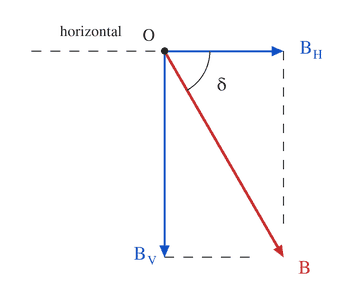
Therefore, the angle of dip at that place is .
- 21 mark
Board paper question 2
What is the angle of dip at a place where the horizontal component and the vertical component of the earth's magnetic field are equal to
Solve with AIAnswer
(A)
(B)
- Correct
(C)
(D)
Answer: (C)
Key idea: The angle of dip is the angle between the earth's total field and the horizontal, and .
Step 1 — Use the given condition.
The two components are equal, so their ratio is 1.
Step 2 — Find the angle.
The angle whose tangent is 1 is .
Note: Option (A) is printed as , probably meaning ; either way it is not the answer.
Why the others are wrong:
- (A) A dip lies between and , so is impossible; even would need to be about 0.58 times .
- (B) An angle of needs , so the vertical component would be the larger one.
- (D) An angle of means the field is vertical and , as at a magnetic pole.
Therefore, the correct option is (C): the angle of dip is .
- 32 marks
Board paper question 3
(i) Define angle of dip
(ii) State the relation between magnetic susceptibility () and Relative permeability () of a magnetic substance
Solve with AIWritten solution
Solution:
Key idea: (i) At most places the earth's magnetic field is not horizontal; a freely pivoted magnetic needle tilts from the horizontal. (ii) Susceptibility measures how easily a substance is magnetised, and relative permeability compares its permeability with that of free space; the two are linked.
Step 1 — Define the angle of dip (part i).
The angle of dip (or inclination) at a place is the angle that the earth's total magnetic field makes with the horizontal, measured in the magnetic meridian. It is the angle through which the north pole of a needle, free to turn in the vertical plane of the magnetic meridian, dips below the horizontal in the northern hemisphere (in the southern hemisphere the south pole dips).
Step 2 — State the relation (part ii).
The relative permeability and the magnetic susceptibility of a substance are related by
So a diamagnetic substance (small negative ) has slightly less than 1, and a paramagnetic one (small positive ) has slightly more than 1.
Therefore, (i) the angle of dip is the angle between the earth's total magnetic field and the horizontal in the magnetic meridian, and (ii) .
Class 12 Physics Ch 9 questions students ask
How many questions are there in Class 12 Physics Ch 9?
66 questions. Every one is solved step by step on this page.
Are these Class 12 Physics solutions free?
Yes. Every question and its full working is free to read, with no account needed.
Can I download the Class 12 Physics Ch 9 solutions as a PDF?
There is no PDF to download. Every solution is on this page instead, which means it is searchable, always the current syllabus, and readable on a phone. Use your browser's print option if you want it on paper.