
Opening your dashboard
Class 12 Physics Chapter 9 Magnetism and Matter: Practice Questions
92 questions on Chapter 9, each worked through on its own page with the AI tutor. Class 12 Physics, ICSE 2026-27.
92 questions
1–3 marks · Mixed difficulty
- 11 mark
Question 1
A uniform wire of length carries a steady current . It is bent first into a single circular loop and then into a single square loop. The ratio of the magnetic dipole moments of the two loops is
- 23 marks
Question 2
A flat rectangular coil of turns, , lies on a horizontal table. It carries a current of that flows clockwise as seen from above. (Hypothetical data.)
(i) Find the magnitude of the magnetic dipole moment of the coil.
(ii) State the direction of the dipole moment.
(iii) Which face of the coil, the upper or the lower, behaves as the north pole?
- 31 mark
Question 3
In a toy, a small bar magnet of magnetic moment is to be replaced by a flat circular coil of turns and radius that has the same magnetic moment. The current needed in the coil is about (Hypothetical data.)
- 43 marks
Question 4
A square loop of wire of side carries a current of . It is folded along the line joining the mid-points of two opposite sides, so that its two halves are at right angles to each other. The current is unchanged. (Hypothetical data.)
(i) Find the magnetic dipole moment of the loop before folding.
(ii) Find the magnitude of the dipole moment after folding, and its direction relative to the two halves.
(iii) By what factor has the moment changed?
- 52 marks
Question 5
A loop of wire is shaped as a semicircle of radius closed by its diameter. It lies in the plane of this page and carries a current of that flows anticlockwise as seen by the reader. (Hypothetical data.)
(i) Find the magnitude of its magnetic dipole moment.
(ii) State the direction of the dipole moment.
- 61 mark
Question 6
A plane coil of turns and area carries a current in a uniform magnetic field . The field makes an angle with the plane of the coil. The magnitude of the torque on the coil is
- 73 marks
Question 7
A bar magnet is free to rotate in a horizontal plane in a uniform horizontal magnetic field. When its axis makes with the field, the torque on it is . (Hypothetical data.)
(i) What is the largest torque the magnet can experience in this field, and in which position?
(ii) Find the torque when its axis makes with the field.
(iii) At what other angle between and is the torque again ?
- 81 mark
Question 8
A small current loop hangs in a uniform magnetic field, at rest with its magnetic moment along the field. The current in the loop is then suddenly reversed. Immediately afterwards, the loop
- 93 marks
Question 9
A light circular coil of turns and radius lies in a horizontal plane. It is free to turn about a horizontal north–south axis through its centre. A current of flows in it anticlockwise as seen from above. A uniform horizontal magnetic field of points towards the east. (Hypothetical data.)
(i) Find the magnitude and direction of the coil's magnetic dipole moment.
(ii) Find the magnitude and direction of the torque on the coil.
(iii) Which edge of the coil, the east edge or the west edge, starts to rise?
- 102 marks
Question 10
A bar magnet placed with its axis at to a uniform magnetic field experiences a torque . It is replaced by a second magnet of the same length but twice the pole strength, and the field is reduced to . The new magnet is placed with its axis perpendicular to the field. Find the new torque in terms of .
- 111 mark
Question 11
The gyromagnetic ratio of an electron revolving in a circular orbit has the value (Take and .)
- 123 marks
Question 12
An electron in an atom moves in a circular orbit with orbital angular momentum .
(i) Write the relation between its orbital magnetic moment and its angular momentum.
(ii) Calculate its orbital magnetic moment.
(iii) How is the direction of the magnetic moment related to that of the angular momentum?
(Take and .)
- 131 mark
Question 13
An electron revolving in a circular orbit of radius with frequency has an orbital magnetic moment . If the radius of the orbit is halved and the frequency is doubled, the new magnetic moment is
- 143 marks
Question 14
A thin insulating ring of radius and mass carries a charge of spread uniformly round it. The ring is spun about its own axis at revolutions per second. (Hypothetical data.)
(i) Find the equivalent current.
(ii) Find the magnetic dipole moment of the spinning ring.
(iii) Find the ratio of its magnetic moment to its angular momentum, and show that it equals , the same form as for a revolving electron.
- 151 mark
Question 15
An electron revolves in a horizontal circular orbit, moving clockwise as seen from above. Which is correct about its orbital magnetic moment and its angular momentum ?
- 162 marks
Question 16
A proton and an electron move in circular orbits with equal angular momenta.
(i) Find the ratio of the magnitude of the electron's orbital magnetic moment to that of the proton.
(ii) State the direction of each magnetic moment relative to its angular momentum.
(Take and .)
- 171 mark
Question 17
The magnetic field at a point on the axial line of a short bar magnet, from its centre, is equal in magnitude to the field at a point on its equatorial line at a distance from its centre. The value of is about
- 183 marks
Question 18
A bar magnet has magnetic length and magnetic moment . (Hypothetical data.)
(i) Find the magnetic field at a point on its axial line from its centre, using the full expression for a bar magnet.
(ii) Find the field at the same point using the short-magnet expression , and the percentage error this makes.
(iii) Repeat the comparison at from the centre and state when the short-magnet expression may be used.
(Take .)
- 193 marks
Question 19
A short bar magnet of magnetic moment lies on a table with its north pole pointing east. Small compasses are placed at three points, each from the centre of the magnet: P (due east), Q (due north) and R (due west). Ignore the Earth's magnetic field. (Hypothetical data.)
(i) Find the magnitude of the magnet's field at P and at Q.
(ii) In which direction does the north pole of each compass, at P, Q and R, point?
(Take .)
- 201 mark
Question 20
A magnetic field sensor is placed on the axial line of a short bar magnet. It is then moved farther from the centre of the magnet, still on the axial line. The reading of the sensor falls by about
- 211 mark
Question 21
A bar magnet produces a field at a point on its axial line. It is replaced by a magnet of the same material, magnetised in the same way, that is twice as large in every dimension (length, breadth and thickness), so that its magnetic moment is proportional to its volume. The field is measured at a point on its axial line twice as far from its centre. The new field is
- 223 marks
Question 22
Two short bar magnets X and Y lie on the same straight line (their common axis), with their centres apart and their north poles facing each other. Their magnetic moments are and . Ignore the Earth's magnetic field. (Hypothetical data.)
(i) Explain why the fields of the two magnets are opposite in direction at every point between them.
(ii) Locate the point between the magnets where the resultant field is zero.
(iii) Find the resultant field at the mid-point between their centres, and its direction.
(Take .)
- 231 mark
Question 23
Which one of the following statements about the magnetic field lines of a bar magnet is correct?
- 241 mark
Question 24
is a point on a curved magnetic field line. The arrow drawn on the line shows the direction of the field. A very small compass needle is placed at . It comes to rest
- 253 marks
Question 25
A student draws the magnetic field lines of a bar magnet as follows:
(i) every line starts on the N face of the magnet and stops on the S face, and no line is drawn inside the magnet;
(ii) two lines are shown crossing each other just outside the N pole;
(iii) the lines are drawn equally far apart near the poles and far from the magnet.
Point out what is wrong in each feature and say how it should be drawn.
- 263 marks
Question 26
A flat square frame of side is placed in a uniform magnetic field of .
(a) Find the magnetic flux through the frame when the normal to its plane makes an angle of with the field.
(b) What is the flux when the plane of the frame is parallel to the field? Explain in terms of field lines.
(c) Starting with the normal along the field, the frame is turned through . Find the change in flux.
(Hypothetical data.)
- 273 marks
Question 27
A thin hemispherical bowl of radius rests with its rim horizontal in a uniform vertical magnetic field of .
(a) The rim of the bowl is closed by an imaginary flat disc. What is the net magnetic flux through the closed surface (bowl + disc)? Give the reason.
(b) Hence find the magnitude of the flux through the curved surface of the bowl.
(c) The field is now turned so that it makes with the vertical, its magnitude unchanged. Find the new flux through the curved surface.
(Hypothetical data.)
- 281 mark
Question 28
Iron filings are sprinkled on a card placed over a bar magnet. When the card is tapped, the filings arrange themselves along curves. This happens because each filing
- 291 mark
Question 29
A long solenoid carrying a steady current behaves like a bar magnet. Inside the solenoid, away from its ends, the magnetic field lines are
- 301 mark
Question 30
Two identical solenoids and lie on the same axis, on the left and on the right, with the right end of facing the left end of . Seen by an observer on the far left looking along the axis, the current in both solenoids flows clockwise. The two solenoids
- 312 marks
Question 31
A light solenoid is hung by a thread tied to its middle so that it can turn freely in a horizontal plane. Only the Earth's field acts on it. Looking at end from outside, the current is seen to flow anticlockwise.
(a) Which end of the solenoid will point towards the north? Give the reason.
(b) What will happen if the current is reversed?
- 323 marks
Question 32
A solenoid long has turns, each of cross-sectional area , and carries a current of .
(a) Find its magnetic moment.
(b) Find the pole strength of the bar magnet, of the same magnetic length, to which this solenoid is equivalent.
(c) Show that, in general, this equivalent pole strength equals , where is the number of turns per unit length.
(Hypothetical data.)
- 333 marks
Question 33
A solenoid of turns is long and has a radius of . It carries a current of . Treating it as a short magnetic dipole, find
(a) its magnetic moment,
(b) the magnetic field at a point on its axis from its centre,
(c) the magnetic field at a point on its equatorial line from its centre.
State the direction of each field. (.) (Hypothetical data.)
- 341 mark
Question 34
The north pole of a compass needle points roughly towards the geographic north. This shows that near the Earth's geographic north pole there is
- 351 mark
Question 35
According to the present theory, the Earth's magnetic field is mainly due to
- 363 marks
Question 36
Model the Earth as a short magnetic dipole of moment at its centre. Take the radius of the Earth as and .
(a) Find the magnetic field at a point on the magnetic equator.
(b) Find the magnetic field at a magnetic pole.
(c) Why is an ordinary compass (needle pivoted to turn only in a horizontal plane) of no use at a magnetic pole?
- 373 marks
Question 37
A short bar magnet of magnetic moment lies on a horizontal table with its N pole pointing towards the magnetic north. The horizontal component of the Earth's field is . (, .)
(a) On which line of the magnet do the neutral points lie? Give the reason.
(b) Find the distance of each neutral point from the centre of the magnet.
(c) How will a small compass behave if it is placed at a neutral point?
(Hypothetical data.)
- 381 mark
Question 38
At most places on the Earth a compass needle does not point exactly towards the geographic north. The main reason is that
- 392 marks
Question 39
In a laboratory, a magnetic needle is pivoted so that it can turn only in a horizontal plane.
(a) Why does only the horizontal component of the Earth's field decide the direction in which it rests? What happens to the turning effect of the vertical component?
(b) Why can the Earth's magnetic field be taken as uniform over the whole laboratory?
- 402 marks
Question 40
Explain how a dip circle can be used to find the direction of the magnetic meridian at a place. Why does the needle stand vertical in one position of the circle?
- 411 mark
Question 41
At a place the horizontal component of the Earth's field is and the angle of dip is . A bar magnet of moment is pivoted at its centre so that it can turn in the vertical plane of the magnetic meridian. The torque needed to hold it horizontal is ()
- 423 marks
Question 42
A smartphone's magnetic sensor, held level at a place in India, reads the Earth's field as: towards geographic north, towards geographic east and vertically downwards. Find
(a) the horizontal component of the field and the angle of declination,
(b) the angle of dip,
(c) the total intensity of the Earth's field at the place.
(Hypothetical data.)
- 433 marks
Question 43
A long vertical wire carries a current of upwards. A small compass is placed on a horizontal table due magnetic north of the wire, as shown in the top view. With the current on, the compass needle settles at to the magnetic meridian.
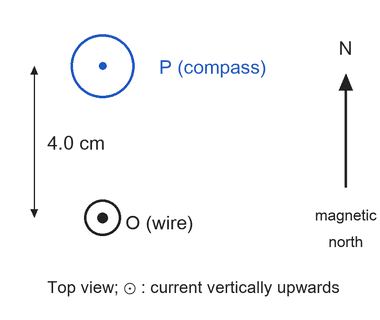
(a) In which direction is the field of the wire at ? Towards which side (east or west of north) does the needle turn?
(b) Find the horizontal component of the Earth's field.
(c) The angle of dip at the place is . Find the total intensity of the Earth's field.
(.) (Hypothetical data.)
- 441 mark
Question 44
A horizontal straight wire long carries a current of from west to east at a place where the horizontal component of the Earth's field is and the angle of dip is . The magnitude of the force on the wire due to the Earth's field is ()
- 451 mark
Question 45
At a place the angle of declination is west and the angle of dip is . A magnetised needle is supported at its centre of gravity so that it can turn freely in every direction. Its N pole points
- 461 mark
Question 46
Name different methods by which a magnetic field can be produced.
- 472 marks
Question 47
When a charged particle moves in a magnetic field the work done by the magnetic force on the charged particle is zero because the force is perpendicular to the velocity. But when an iron nail held near a magnet is released, the nail moves towards the magnet and clings to the magnet. There is an increase in the kinetic energy of the nail. How will you explain this?
- 482 marks
Question 48
A magnetised needle, in a uniform magnetic field, experiences a torque; but no net force. An iron nail, near a bar magnet, however, experiences a force of attraction, in addition to a torque. Why?
- 492 marks
Question 49
Must every magnetic field configuration have a north pole and a south pole? What about the field due to a toroid?
- 501 mark
Question 50
Do the magnetic field lines also represent the lines of force on a moving charged particle at every point?
- 512 marks
Question 51
Does a bar magnet exert a torque on itself due to its own field? Does one element of a current-carrying wire exert a force on another element of the same wire?
- 522 marks
Question 52
Magnetic field arises due to charges in motion. Can a system have magnetic moment even though its net charge is zero?
- 532 marks
Question 53
If the Earth's magnetic field is due to a large current loop within the Earth, then what is the plane of the loop and the direction of the loop?
- 542 marks
Question 54
Given that the horizontal and vertical components of the Earth's magnetic field are equal at a place. What is the angle of dip at that place?
- 551 mark
Question 55
How will a compass needle stay, if it is kept on the magnetic north pole of the Earth?
- 561 mark
Question 56
A vector needs three quantities for its specification. Name the three independent quantities conventionally used to specify the Earth's magnetic field.
- 571 mark
Question 57
The Earth's magnetic field varies from point to point in space. Does it also change with time? If so, on what time scale does it change appreciably?
- 582 marks
Question 58
Inter-stellar space has an extremely weak magnetic field of the order of T. Can such a weak field be of any significant consequence? Explain.
- 591 mark
Question 59
The angle of dip at two places on the surface of the Earth are respectively and . Where are these places located?
- 602 marks
Question 60
Which instrument is used to measure the angle of dip? How is the plane of rotation of the needle of this instrument set?
- 612 marks
Question 61
The value of the dip at a place in South India is . Will it be more or less in England?
- 623 marks
Question 62
The magnetic moment of a magnet is 0.5 A m. The force acting on each pole when placed in a uniform magnet field of strength T is N. Find the distance between the poles.
- 633 marks
Question 63
The magnetic dipole moment of the Earth is . If the same dipole moment is to be set up by passing a current through a single turn of wire going around the Earth at the magnetic equator, then find the current. Radius of the Earth is m.
- 643 marks
Question 64
The magnetic flux passing through an area 0.2 m is 0.20 Wb. Find the flux density at a point on the area.
- 651 mark
Question 65
Write in vector form, the defining equation for the vector field at a point.
- 662 marks
Question 66
An electric current of A flows in loop of radius cm. Calculate the magnitude of the magnetic dipole moment of the dipole formed.
- 672 marks
Question 67
A bar magnet placed in a uniform magnetic field of T with its axis at to the field experiences a torque of N m. Find the magnetic moment of the bar magnet.
- 681 mark
Question 68
The principle of deflection magnetometer is expressed by the formula . What is represented by and ?
- 691 mark
Question 69
A magnetic needle is kept in a non-uniform magnetic field. It experiences
- 701 mark
Question 70
Magnetic dipole moment is a
- 711 mark
Question 71
A coil in the shape of an equilateral triangle of side m is suspended from its vertex such that it is hanging in a vertical plane between the pole pieces of permanent magnet producing a uniform field of T. If a current of A is passed through the coil, what is the couple acting?
- 721 mark
Question 72
A small bar magnet of magnetic moment . The magnetic field at a distance m on its axis will be ()
- 731 mark
Question 73
If a magnet is hanged with its magnetic axis, then it stops in
- 741 mark
Question 74
A turn rectangular coil of length cm and width cm carries a current of and is subjected to a magnetic field of strength T. Work done for rotating the coil by against the torque is
- 751 mark
Question 75
Two short bar magnets of length cm each have magnetic moments and respectively. They are placed on a horizontal table parallel to each other with their N poles pointing towards the south. They have a common magnetic equator and are separated by a distance of cm. The value of the resultant horizontal magnetic induction at the mid-point O of the line joining their centres is close to (horizontal component of Earth's magnetic induction is )
- 761 mark
Question 76
At a place, if the Earth's horizontal and vertical components of magnetic field are equal, then the angle of dip will be
- 771 mark
Question 77
If the angles of dip at two places are and respectively, then the ratio of horizontal components of Earth's magnetic field at the two places will be
- 781 mark
Question 78
The angle of dip at a place is and the intensity of the vertical component of the Earth's magnetic field tesla. The total intensity of the Earth's magnetic field (I) at this place is
- 791 mark
Question 79
The value of angle of dip is zero at the magnetic equator because on it
- 801 mark
Question 80
Magnetic meridian is
- 811 mark
Question 81
The angle of dip at a certain place on Earth is and the magnitude of Earth's horizontal component of magnetic field is G. The magnetic field at the place on Earth is
- 821 mark
Question 82
The line on the Earth's surface joining the points where the field is horizontal is
- 831 mark
Question 83
Let and be the vertical and horizontal components of Earth's magnetic field at any point on Earth. Near the north pole
- 841 mark
Question 84
Isogonic lines on magnetic map will have
- 851 mark
Question 85
A magnet of magnetic moment is placed in a time varying magnetic field where tesla and rad/s. The work done for reversing the direction of the magnetic moment at second is
- 861 mark
Question 86
At some location on Earth the horizontal component of Earth's magnetic field is T. At this location, magnetic needle of length m and pole strength A m is suspended from its mid-point using a thread, it makes angle with horizontal in equilibrium. To keep this needle horizontal, the vertical force that should be applied at one of its ends is
- 871 mark
Question 87
An electric field of V/m is applied to an electric dipole at angle of . The value of electric dipole moment is C m. What is the potential energy of the electric dipole?
- 881 mark
Question 88
At a point A on the Earth's surface the angle of dip, . At a point B on the Earth's surface the angle of dip, . We can interpret that
- 891 mark
Question 89
An aeroplane, with its wings spread m, is flying at a speed of km/h in a horizontal direction. The total intensity of Earth's field at that part is and the angle of dip is . The emf induced between the tips of the plane wings will be
- 901 mark
Question 90
Choose the correct option.
- 911 mark
Question 91
S.I. unit of magnetic dipole moment is
- 921 mark
Question 92
A substance behaves like a magnet only if there are