
Question 32 marksAsked 2020Easy
(i) Define angle of dip
(ii) State the relation between magnetic susceptibility () and Relative permeability () of a magnetic substance
Confirming your payment
Sign up now and get 250 free tokens.
Previous Year Questions · Question 3 of 3
(i) Define angle of dip
(ii) State the relation between magnetic susceptibility () and Relative permeability () of a magnetic substance
Solution:
Key idea: (i) At most places the earth's magnetic field is not horizontal; a freely pivoted magnetic needle tilts from the horizontal. (ii) Susceptibility measures how easily a substance is magnetised, and relative permeability compares its permeability with that of free space; the two are linked.
Step 1 — Define the angle of dip (part i).
The angle of dip (or inclination) at a place is the angle that the earth's total magnetic field makes with the horizontal, measured in the magnetic meridian. It is the angle through which the north pole of a needle, free to turn in the vertical plane of the magnetic meridian, dips below the horizontal in the northern hemisphere (in the southern hemisphere the south pole dips).
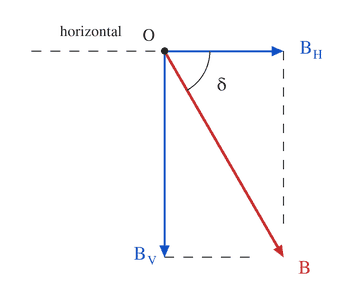
Step 2 — State the relation (part ii).
The relative permeability and the magnetic susceptibility of a substance are related by
So a diamagnetic substance (small negative ) has slightly less than 1, and a paramagnetic one (small positive ) has slightly more than 1.
Therefore, (i) the angle of dip is the angle between the earth's total magnetic field and the horizontal in the magnetic meridian, and (ii) .