
Opening your dashboard
Class 12 Physics Chapter 9 Magnetism and Matter: Previous Year Questions
3 questions on Chapter 9, each solved step by step. Class 12 Physics, ICSE 2026-27.
3 questions with solutions
1–2 marks · Easy difficulty
- 12 marks
Question 1
The horizontal component of earth's magnetic field at a place is times the vertical component. Determine the angle of dip at that place.
Solve with AIWritten solution
Solution:
Key idea: In the magnetic meridian the earth's field has a horizontal component and a vertical component . The angle of dip is the angle that makes with the horizontal, so
Step 1 — Write the given relation.
The horizontal component is times the vertical component.
Step 2 — Find .
We divide by .
Step 3 — Find the angle.
The angle whose tangent is is .
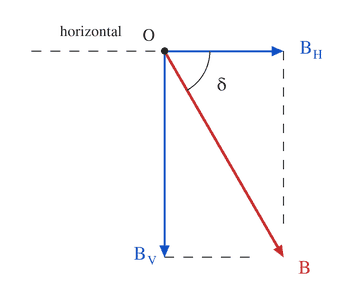
Therefore, the angle of dip at that place is .
- 21 mark
Question 2
What is the angle of dip at a place where the horizontal component and the vertical component of the earth's magnetic field are equal to
Solve with AIAnswer
(A)
(B)
- Correct
(C)
(D)
Answer: (C)
Key idea: The angle of dip is the angle between the earth's total field and the horizontal, and .
Step 1 — Use the given condition.
The two components are equal, so their ratio is 1.
Step 2 — Find the angle.
The angle whose tangent is 1 is .
Note: Option (A) is printed as , probably meaning ; either way it is not the answer.
Why the others are wrong:
- (A) A dip lies between and , so is impossible; even would need to be about 0.58 times .
- (B) An angle of needs , so the vertical component would be the larger one.
- (D) An angle of means the field is vertical and , as at a magnetic pole.
Therefore, the correct option is (C): the angle of dip is .
- 32 marks
Question 3
(i) Define angle of dip
(ii) State the relation between magnetic susceptibility () and Relative permeability () of a magnetic substance
Solve with AIWritten solution
Solution:
Key idea: (i) At most places the earth's magnetic field is not horizontal; a freely pivoted magnetic needle tilts from the horizontal. (ii) Susceptibility measures how easily a substance is magnetised, and relative permeability compares its permeability with that of free space; the two are linked.
Step 1 — Define the angle of dip (part i).
The angle of dip (or inclination) at a place is the angle that the earth's total magnetic field makes with the horizontal, measured in the magnetic meridian. It is the angle through which the north pole of a needle, free to turn in the vertical plane of the magnetic meridian, dips below the horizontal in the northern hemisphere (in the southern hemisphere the south pole dips).
Step 2 — State the relation (part ii).
The relative permeability and the magnetic susceptibility of a substance are related by
So a diamagnetic substance (small negative ) has slightly less than 1, and a paramagnetic one (small positive ) has slightly more than 1.
Therefore, (i) the angle of dip is the angle between the earth's total magnetic field and the horizontal in the magnetic meridian, and (ii) .