
Opening your dashboard
Class 12 Physics Chapter 9 Magnetism and Matter: Competency-Based Questions (CBQ)
45 questions on Chapter 9, each worked through on its own page with the AI tutor. Class 12 Physics, ICSE 2026-27.
45 questions
1–4 marks · Mixed difficulty
- 13 marks
Question 1
Competency: Application
On a circuit board, a current of goes out to a motor along one copper track and comes back along another. A designer compares two layouts:
- Layout 1: the two tracks run side by side, apart, for , so the current loop is a thin strip .
- Layout 2: the return track runs round the edge of the board, so the loop is a rectangle .
A magnetometer chip lies in the plane of the board, from the loop. It must not see a stray field larger than . Treat each loop as a short magnetic dipole. (Hypothetical data.) (Take .)
(a) Find the magnetic dipole moment of the loop in each layout.
(b) Find the stray field at the chip for each layout and say which layout is acceptable.
(c) Explain why wires carrying a current to a device and back are usually run close together or twisted round each other.
- 21 mark
Question 2
Competency: Analysis & Evaluation
A small circular coil and a small square coil, each of one turn, enclose equal areas and carry equal currents. They lie in parallel planes. A magnetometer placed several metres away cannot tell which coil is switched on.
Assertion (A): At large distances, a small circular loop and a small square loop of equal area carrying equal currents produce the same magnetic field.
Reason (R): The magnetic dipole moment of a plane current loop is directed perpendicular to the plane of the loop.
- 31 mark
Question 3
Competency: Application
To check the current in a small flat coil of turns and diameter , a student places a magnetic sensor on the axis of the coil, from its centre. After the Earth's field is subtracted, the sensor reads . Treating the coil as a short magnetic dipole, the current in the coil is about (Hypothetical data.) (Take .)
- 43 marks
Question 4
Competency: Application
A small satellite turns itself using a magnetorquer: a flat square coil of turns, each of area , fixed to the satellite. When a current of is passed, the coil reacts with the Earth's magnetic field, which at the satellite's height is . Treat this field as uniform over the satellite. (Hypothetical data.)
(a) Find the magnetic dipole moment of the coil and the largest torque it can produce.
(b) At what angle between the coil's moment and the field is the torque half its largest value?
(c) If the current is left on, in which orientation will the satellite finally come to rest? Explain why the magnetorquer can never give a torque about the direction of the Earth's field.
- 51 mark
Question 5
Competency: Analysis & Evaluation
A compass needle resting along the magnetic meridian is pushed to one side with a pencil and released. It swings to and fro about the north–south line several times before settling.
Assertion (A): A displaced compass needle swings back towards the north–south line and oscillates about it.
Reason (R): The torque on a compass needle in the Earth's field is greatest when the needle points along the north–south line.
- 61 mark
Question 6
Competency: Analysis & Evaluation
A compass needle on a horizontal table is held with its N end pointing towards magnetic east and then released. Considering only the horizontal component of the Earth's field, the torque on the needle at the moment of release points
- 73 marks
Question 7
Competency: Analysis & Evaluation
A simple "current balance" measures the current in a coil. A rectangular coil of turns, , is pivoted on a horizontal axis through its centre. It sits with its plane horizontal in a uniform horizontal magnetic field of that is perpendicular to the pivot axis. A light pointer arm fixed to the coil carries a rider of mass at from the axis. With the current on, the coil stays balanced with its plane horizontal. (Hypothetical data.) (Take .)
(a) Find the torque due to the rider and hence the magnetic dipole moment of the coil.
(b) Find the current in the coil.
(c) The coil is gently turned through about the pivot and let go. Show that it stays balanced in the new position.
- 81 mark
Question 8
Competency: Analysis & Evaluation
A technician slowly turns a small coil in a uniform magnetic field, starting with its moment along the field. She turns it first through , then through a further , and notes the work done in each step.
Assertion (A): The work needed to turn a magnetic dipole slowly from to with a uniform field is equal to the work needed to turn it from to .
Reason (R): The potential energy of a magnetic dipole in a uniform field is , which rises by in each of these two steps.
- 93 marks
Question 9
Competency: Application
In a synchrotron light source, a beam of electrons circulates in a ring of circumference at a speed very close to . The beam current is . Seen from above, the electrons go round clockwise. Treat the ring as a horizontal circle. (Hypothetical data.) (Take .)
(a) How many electrons are circulating in the ring?
(b) Find the magnetic dipole moment of the circulating beam.
(c) State the direction of this moment.
- 103 marks
Question 10
Competency: Analysis & Evaluation
In Bohr's model, the electron of a hydrogen atom in its ground state moves in a circle of radius with speed . For a one-electron ion of atomic number (such as , ), the ground-state radius is and the speed is . (Take , , .)
(a) Show that the equivalent current of the orbit grows as , while the orbital magnetic moment does not depend on .
(b) Find the equivalent current and the orbital magnetic moment for .
(c) Using and Bohr's rule for the ground state, explain the result of (a) and check the value of the moment.
- 111 mark
Question 11
Competency: Analysis & Evaluation
In a model of an atom, an electron goes round a circular orbit anticlockwise. A second model is set up with the electron going round the same orbit at the same speed, but clockwise.
Assertion (A): The electron going round the same circular orbit in the opposite sense, at the same speed, has the same orbital magnetic moment as before.
Reason (R): The magnitude of the orbital magnetic moment, , does not depend on the sense in which the electron revolves.
- 121 mark
Question 12
Competency: Analysis & Evaluation
Positronium is a short-lived "atom" made of an electron and a positron (same mass as the electron, charge ). In a simple picture they go round their common centre in the same circle, always at opposite ends of a diameter, with equal speeds and in the same sense. The total orbital magnetic moment of this system is
- 134 marks
Question 13
Competency: Analysis & Evaluation
A small cylindrical magnet is buried below a survey point to mark it. It stands vertically, so the point directly above it lies on its axial line. A magnetic sensor (with the Earth's field subtracted) reads when placed on the ground directly above the magnet, and when raised straight up. Treat the magnet as a short dipole. (Hypothetical data.) (Take .)
(a) Find the depth of the magnet below the ground.
(b) Find its magnetic dipole moment.
(c) At a second marker the same two readings are and . Find its depth, and its moment if it lies (i) vertical, (ii) horizontal.
- 141 mark
Question 14
Competency: Analysis & Evaluation
A student places a small plotting compass at a point on the equatorial line of a bar magnet, close to the magnet, and compares the direction of its needle with the direction of the magnet's moment (from its S pole to its N pole).
Assertion (A): At a point on the equatorial line of a bar magnet, the magnetic field of the magnet points in the same direction as its magnetic moment.
Reason (R): Outside a bar magnet, the magnetic field lines run from its N pole round to its S pole.
- 151 mark
Question 15
Competency: Analysis & Evaluation
A student measures the field of a small magnet at points on its axial line (Earth's field subtracted):
(cm) 10 15 20 25 (T) 400 119 50.0 25.6 (Hypothetical data.) (Take .) Which conclusion do the readings support?
- 163 marks
Question 16
Competency: Application
A dashboard compass sits from a magnetic phone mount. The mount contains a small magnet of moment whose axis points along the line joining it to the compass, and this line runs magnetic east–west. The horizontal component of the Earth's field there is . Treat the magnet as a short dipole. (Hypothetical data.) (Take .)
(a) Find the magnet's field at the compass and state its direction relative to the Earth's horizontal field.
(b) By what angle is the compass needle turned away from magnetic north?
(c) The maker wants the error to be at most . How far from the compass must the mount be placed, along the same line?
- 171 mark
Question 17
Competency: Analysis & Evaluation
A textbook diagram of a long bar magnet shows its field lines continuing through the inside of the magnet from S to N, and spreading out widely round the outside.
Assertion (A): The magnetic field inside a long bar magnet is stronger than the field at points just outside the middle of its side.
Reason (R): Every field line passes through the inside of the magnet, while outside the magnet the same lines spread out over a much larger area.
- 181 mark
Question 18
Competency: Analysis & Evaluation
In a region, the magnetic field lines all run from left to right and get steadily closer together towards the right. A small current loop is held at a point in this region with its magnetic moment pointing to the right, along the field, and is then released. The net magnetic force on the loop is
- 191 mark
Question 19
Competency: Analysis & Evaluation
A student magnetises a steel knitting needle and snaps it in half again and again. Every piece, however small, still has an N end and an S end.
Assertion (A): Breaking a bar magnet into smaller and smaller pieces never gives an isolated N pole or S pole.
Reason (R): A bar magnet behaves like a solenoid: its magnetism comes from tiny circulating currents in it, and each such current loop has an N face and an S face.
- 203 marks
Question 20
Competency: Analysis & Evaluation
A cylindrical neodymium magnet is long and in diameter, and its magnetic moment is . A student wants to make a solenoid of the same size and shape that is equivalent to it. (Hypothetical data.) (Take .)
(a) How many ampere-turns () must the solenoid carry?
(b) If turns of fine wire could be fitted on it, what current would be needed? Comment on whether this is practical.
(c) Use the long-solenoid formula to estimate the field inside the magnet. Why is the actual field somewhat smaller?
- 211 mark
Question 21
Competency: Application
A solenoid long behaves like a bar magnet of moment and pole strength . A technician joins an identical solenoid to its end, on the same axis, to make one coil long, with the same current flowing in the same sense through both. The longer coil behaves like a bar magnet of
- 223 marks
Question 22
Competency: Analysis & Evaluation
Lava rocks keep a record of the Earth's field at the time they cooled. In a layer of old lava in India, the recorded field points towards magnetic north and makes with the horizontal, pointing upwards out of the ground. Model the Earth's field as that of a dipole along its axis, for which the angle of dip at magnetic latitude satisfies . (Hypothetical data.)
(a) Find the magnetic latitude at which the lava cooled.
(b) Was that place in the northern or the southern hemisphere, if the Earth's field then had the same direction as today? Explain.
(c) Another layer shows the same angle, but pointing downwards into the ground. Give two possible explanations.
- 231 mark
Question 23
Competency: Analysis & Evaluation
Glowing curtains of light (auroras), caused by fast charged particles from the Sun striking the upper air, are seen often in northern Norway and Antarctica but almost never in India.
Assertion (A): Auroras are seen mostly in regions near the Earth's magnetic poles.
Reason (R): The Earth's magnetic axis is not along its axis of rotation but tilted to it.
- 243 marks
Question 24
Competency: Analysis & Evaluation
A survey team measures the magnetic elements at four points P, Q, R and S along a straight road that runs due (geographic) north. Each point is north of the one before it.
Point P Q R S Distance north of P (km) 0 250 500 750 Declination W W E E Angle of dip (Hypothetical data.)
(a) The line joining places of zero declination is called the agonic line. Assuming the declination changes uniformly between points, where does the road cross it?
(b) At S, does a compass needle point to the east or to the west of the road, and by how much?
(c) The total intensity of the Earth's field at S is . Find the horizontal and vertical components there.
- 251 mark
Question 25
Competency: Application
The same compass needle is used in four Indian cities. The table gives the total intensity of the Earth's field and the angle of dip in each. (Hypothetical data.)
City Leh Delhi Bhopal Thiruvananthapuram (T) 50.5 47.5 45.0 40.5 In which city is the needle pulled back towards magnetic north most strongly when it is turned slightly aside?
- 263 marks
Question 26
Two flat coils P and Q are fixed together with their axes at right angles. Their magnetic moments are and . The assembly can turn freely about an axis perpendicular to both coil axes, in a uniform magnetic field of that is perpendicular to that axis. (Hypothetical data.)
(i) Find the torque on the assembly when the axis of coil P points along the field.
(ii) In equilibrium, what angle does the axis of coil P make with the field?
(iii) Find the largest torque the assembly can experience.
- 273 marks
Question 27
An electron with kinetic energy moves at right angles to a uniform magnetic field of , so that it travels in a circle.
(i) Find its speed and the radius of its circular path.
(ii) Treating the circling electron as a current loop, find its magnetic dipole moment.
(iii) Is this moment along the field or opposite to it? Explain.
(Take and .)
- 283 marks
Question 28
Two short bar magnets A and B lie on a horizontal table, as shown. Magnet A, of moment , has its axis along the east–west line with its north pole facing east. Point P is east of the centre of A. Magnet B, of moment , has its centre east of P, with its axis north–south and its north pole facing north. Ignore the Earth's magnetic field. (Hypothetical data.)
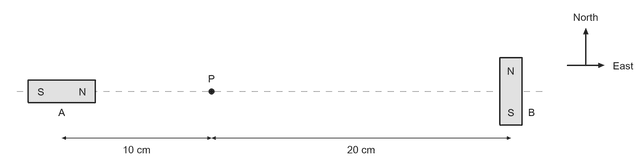
(i) Find the magnitude and direction of the field at P due to each magnet.
(ii) Find the magnitude and direction of the resultant field at P.
(Take .)
- 293 marks
Question 29
A solenoid of turns, length and radius carries a current . Show that at a point on its axis, at a distance from its centre with and , the magnetic field is
where is the area of each turn, and state what this result shows. (You may use the field of a circular loop on its axis, .)
- 304 marks
Question 30
At a place in the northern hemisphere, the horizontal component of the Earth's field is and the true dip is . A dip circle is set in the magnetic meridian. A short bar magnet of moment is now clamped vertically, N pole upwards, with its centre at the level of the needle's pivot and due magnetic east of it.
(a) Find the magnitude and direction of the magnet's field at the pivot.
(b) Find the vertical component of the Earth's field.
(c) What dip does the needle now show?
(d) What does the needle show if the magnet is turned over so that its N pole is downwards?
(, .) (Hypothetical data.)
- 313 marks
Question 31
The dipole moment of a bar magnet is 10 A m. Calculate the magnetic field at a point on the axis of the magnet at a distance 10 cm from the centre of the magnet.
- 323 marks
Question 32
A short bar magnet of moment 4 A m is placed in a uniform magnetic field of 0.5 T at an angle of with the direction of the field. What is the torque acting on the magnet?
- 333 marks
Question 33
A bar magnet of magnetic moment 2 J/T lying along the direction of a uniform magnetic field of 0.2 T. What is the work done to turn the magnet through ?
- 343 marks
Question 34
Calculate the dipole moment of a circular coil of 7 cm radius carrying a current of 10 A.
- 353 marks
Question 35
Calculate the magnetic moment associated with a solenoid of 1000 turns when a current of 10 A flows through it, if its area of cross-section is 1 cm.
- 363 marks
Question 36
A short bar magnet is placed with its axis at with a uniform external magnetic field of 0.3 T. It experiences a torque of magnitude of 0.3 J. Find the magnetic moment of the magnet.
- 373 marks
Question 37
A short bar magnet of magnetic moment placed with its axis at with a uniform external magnetic field experiences a torque of magnitude 0.063 J. Find the strength of the magnetic field.
- 383 marks
Question 38
In hydrogen atom, an electron is making rps around the nucleus in an orbit of radius 0.523 Å. Calculate the equivalent magnetic dipole moment.
- 393 marks
Question 39
The true dip at a place is . When the dip circle is rotated through an angle from the magnetic meridian the apparent angle of dip is . Obtain the relation connecting , and .
- 403 marks
Question 40
At a place the magnetic needle is along the magnetic meridian. The magnetic needle of the dip circle makes an angle of with the horizontal. If the horizontal component of the Earth's field is T, find the magnitude of the total Earth's field at the place.
- 414 marks
Question 41
A circular coil of radius 0.157 m has 50 turns. It is placed such that its axis is in magnetic meridian. A dip needle is supported at the centre of the coil with its axis of rotation horizontal and in the plane of the coil. The angle of dip is when a current flows through the coil. The angle of dip becomes on reversing the current. Find the current in the coil, assuming that the magnetic field due to the coil is smaller than the horizontal component of Earth's magnetic field. Given the horizontal component of Earth's magnetic field is T.
- 424 marks
Question 42
A coil of 100 turns and diameter 10 cm is made out of a wire of resistivity ohm cm and radius cm. What potential difference must be applied across the coil so as to nullify the horizontal component of Earth's magnetic field which is T, at the centre of the coil? How should the coil be placed to achieve this result?
- 433 marks
Question 43
A current-carrying planar loop suspended in a vertical plane normal to the magnetic meridian is in stable equilibrium. The horizontal component of the Earth's magnetic field is 0.32 G. Another horizontal magnetic field of magnitude 0.48 G parallel to the plane of the loop is set up along magnetic west to east. Specify the new stable equilibrium.
- 443 marks
Question 44
Derive an expression for the torque on a magnetic moment , when placed in a magnetic field at an angle to the direction of the field.
- 453 marks
Question 45
A small magnetic needle NS having magnetic dipole moment is kept in two uniform and perpendicular magnetic fields and as shown in the given figure.
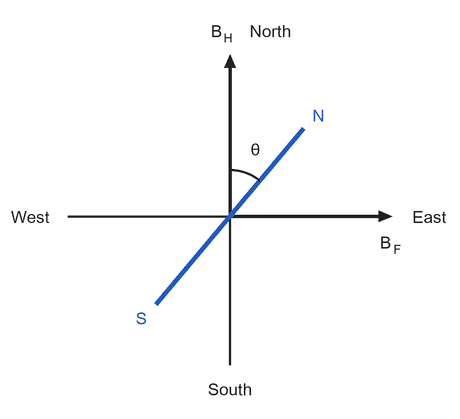
(i) What is the effect of each of the magnetic fields and on the needle?
(ii) When the needle is in equilibrium, obtain an expression for angle made by the needle with in terms of and only.