(a) What are the magnetic elements at a place? Define them.
(b) Obtain the relation connecting dip, vertical and horizontal components of intensity of magnetic field.
(c) If θ1 and θ2 are the angles of dip observed in two vertical planes at right angles to each other then show that cot2θ=cot2θ1+cot2θ2 where θ is the true angle of dip.
Solution:
Key idea: The Earth's field at a place is fixed by three magnetic elements. A dip needle in any vertical plane is set by the vertical component and by only that part of the horizontal component that lies in its plane.
Step 1 — Name and define the magnetic elements, part (a).
The magnetic elements are the three quantities that together specify the Earth's field at a place completely:
Declination δ: The angle between the geographic meridian and the magnetic meridian at the place.
Dip θ: The angle that the Earth's total field makes with the horizontal, measured in the magnetic meridian.
Horizontal component BH: The component of the Earth's total field along the horizontal in the magnetic meridian.
Step 2 — Resolve the total field, part (b).
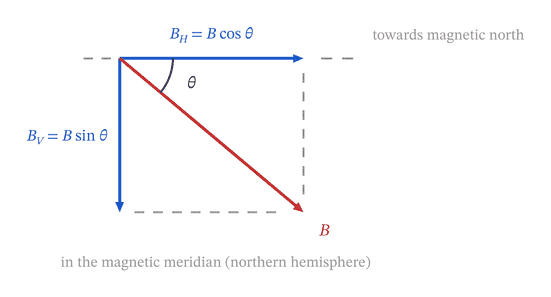
In the magnetic meridian the total field B makes the angle θ with the horizontal, as in the figure. Resolving it into horizontal and vertical parts:
BH=Bcosθ
BV=Bsinθ
Step 3 — Combine the two components, part (b).
Dividing the second relation by the first removes B:
tanθ=BHBV
Squaring and adding the two relations removes θ, because cos2θ+sin2θ is 1:
B=BH2+BV2
Step 4 — Set up the two vertical planes, part (c).
Let the first vertical plane make an angle α with the magnetic meridian. The second plane is at right angles to it, so it makes an angle 90∘−α with the meridian.
Step 5 — Write the apparent dip in each plane, part (c).
The vertical component BV lies in every vertical plane, so it acts fully on the needle. Only the part of BH along a plane acts in that plane. In the first plane this part is BHcosα:
cotθ1=BVBHcosα
In the second plane this part is BHsinα:
cotθ2=BVBHsinα
Step 6 — Square and add, part (c).
Squaring both relations and adding them, the angle α drops out because cos2α+sin2α is 1:
cot2θ1+cot2θ2=BV2BH2(cos2α+sin2α)
cot2θ1+cot2θ2=BV2BH2
Step 7 — Compare with the true dip, part (c).
The true dip obeys the relation of Step 3, which we write with the cotangent:
cotθ=BVBH
So the right-hand side of Step 6 is cot2θ.
Therefore, (a) the magnetic elements are the declination, the dip and the horizontal component; (b) tanθ=BHBV and B=BH2+BV2; and (c) the apparent dips in two perpendicular vertical planes satisfy cot2θ=cot2θ1+cot2θ2.