(a) Obtain an expression for the torque acting on a magnetic dipole kept in a uniform magnetic field.
Question 555 marksMedium
(a) Obtain an expression for the torque acting on a magnetic dipole kept in a uniform magnetic field. Hence define dipole magnetic moment.
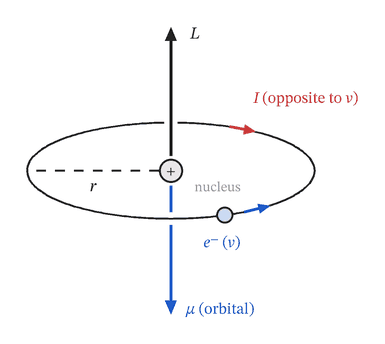
(b) Show that a revolving electron produces a magnetic field and obtain an expression for its dipole moment. Using a diagram show the direction of the magnetic dipole moment of a revolving electron.
Solution:
Key idea: In a uniform field the two poles of a magnet feel equal and opposite forces, which form a couple. An electron going round an orbit is a tiny current loop, and every current loop is a magnetic dipole.
Step 1 — Find the forces on the poles, part (a).
A bar magnet NS of length 2l and pole strength qm is placed in a uniform field B with its axis at an angle θ to B. The N-pole feels a force qmB along B, and the S-pole feels a force qmB opposite to B.
Step 2 — Show that the net force is zero, part (a).
The two forces have the same size and opposite directions, so they add up to zero. The magnet as a whole is not pushed along the field.
Step 3 — Find the torque of the couple, part (a).
The two forces act along different parallel lines, so they form a couple. The perpendicular distance between their lines of action is 2lsinθ, so the torque is:
τ=qmB×2lsinθ
τ=(qm×2l)Bsinθ
Since qm×2l is the magnetic moment m:
τ=mBsinθ
In vector form:
τ=m×B
This torque tends to turn the magnet into line with the field.
Step 4 — Define the dipole moment, part (a).
We take a field of 1 T and an angle of 90∘ in τ=mBsinθ, so that sinθ is 1:
τ=m
So the magnetic dipole moment is the torque acting on the dipole when it is held perpendicular to a uniform magnetic field of unit strength. Its SI unit is A m2 (or J T−1).
Step 5 — Show that the revolving electron is a current, part (b).
An electron of charge e going round the nucleus with speed v in an orbit of radius r passes each point once every T=v2πr. A charge going round again and again is a current loop:
I=Te
I=2πrev
A current loop produces a magnetic field, so the revolving electron produces a magnetic field.
Step 6 — Find the dipole moment of the electron, part (b).
The moment is the current times the area πr2 of the orbit:
μl=2πrev×πr2
μl=2evr
With the orbital angular momentum L=mevr, we replace vr by meL:
μl=−2meeL
Step 7 — Show the direction of the moment, part (b).
The electron is negative, so the current flows opposite to its motion. By the right-hand rule applied to this current, μl is perpendicular to the orbit and opposite to the orbital angular momentum L, as the figure shows.
Therefore, (a) the torque on a dipole is τ=m×B (size mBsinθ), and the dipole moment is the torque on the dipole held perpendicular to a uniform field of 1 T; (b) a revolving electron is a current loop with moment μl=2evr, directed perpendicular to the orbit and opposite to its angular momentum, μl=−2meeL.