
Question 543 marksMedium
Define declination, dip and horizontal component of the total intensity of Earth's magnetic field. What are (i) isogonic lines and (ii) isoclinic lines?
Confirming your payment
Sign up now and get 250 free tokens.
Magnetism and Matter · Question 54 of 66
Define declination, dip and horizontal component of the total intensity of Earth's magnetic field. What are (i) isogonic lines and (ii) isoclinic lines?
Solution:
Key idea: The Earth's field at a place is described by its magnetic elements: the declination, the dip and the horizontal component. Lines on a magnetic map join places where one element has the same value.
Step 1 — Define declination.
The angle of declination at a place is the angle between the geographic meridian and the magnetic meridian there. It is the angle between true north and the direction in which a compass needle points.
Step 2 — Define dip.
The angle of dip at a place is the angle that the Earth's total magnetic field makes with the horizontal, measured in the magnetic meridian.
Step 3 — Define the horizontal component.
The horizontal component is the component of the Earth's total field along the horizontal in the magnetic meridian. Resolving in the magnetic meridian, as in the figure:
The vertical component is .
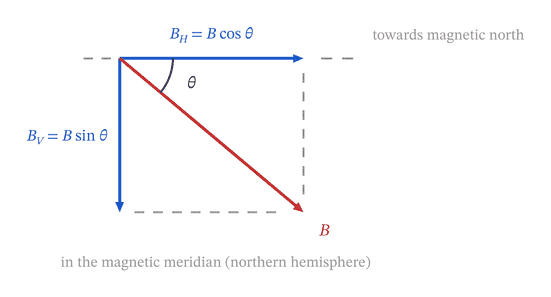
Step 4 — Define isogonic lines, part (i).
Isogonic lines are lines on a magnetic map that join places having the same angle of declination.
Step 5 — Define isoclinic lines, part (ii).
Isoclinic lines are lines on a magnetic map that join places having the same angle of dip.
Therefore, declination is the angle between the geographic and magnetic meridians, dip is the angle of the total field below or above the horizontal in the magnetic meridian, and the horizontal component is ; (i) isogonic lines join places of equal declination and (ii) isoclinic lines join places of equal dip.