
Question 533 marksMedium
What is (i) axial line and (ii) equatorial line of a magnetic dipole? Obtain an expression for the magnetic field due to a magnetic dipole at a point (a) on its axial line and (b) on its equatorial line.
Confirming your payment
Sign up now and get 250 free tokens.
Magnetism and Matter · Question 53 of 66
What is (i) axial line and (ii) equatorial line of a magnetic dipole? Obtain an expression for the magnetic field due to a magnetic dipole at a point (a) on its axial line and (b) on its equatorial line.
Solution:
Key idea: Treat the bar magnet as two poles of strength , a distance apart, with moment from S to N. A single pole at distance gives a field of size , away from a N-pole and towards a S-pole. The field of the magnet is the vector sum of the two.
Step 1 — Define the axial line, part (i).
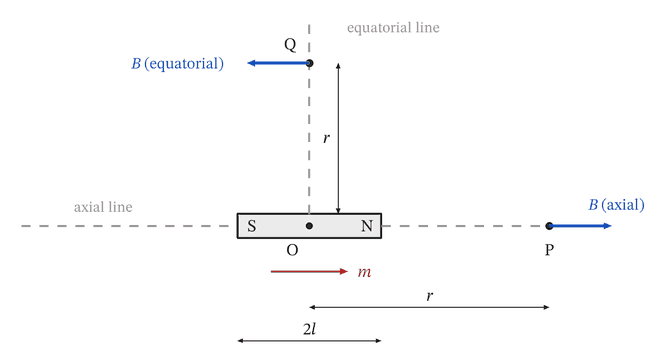
The axial line is the line through the two poles of the dipole, that is, its magnetic axis.
Step 2 — Define the equatorial line, part (ii).
The equatorial line is the line through the centre of the dipole, perpendicular to its axis.
The figure shows a bar magnet with centre , a point on the axial line and a point on the equatorial line, each at distance from .
Step 3 — Write the fields of the two poles at , part (a).
The N-pole is at distance from , and its field there points away from N:
The S-pole is at distance from , and its field there points towards S:
Step 4 — Add the two fields on the axial line, part (a).
The two fields act along the axis in opposite directions, and is larger because N is nearer. So the resultant is their difference:
Since is , the factor is :
Step 5 — Take the short-dipole limit on the axial line, part (a).
For a short dipole () we can neglect beside :
This field points along , from S to N.
Step 6 — Write the fields of the two poles at , part (b).
Both poles are at distance from , so their fields have the same size:
The field of N points away from N and the field of S points towards S.
Step 7 — Add the two fields on the equatorial line, part (b).
Their components along the equatorial line are equal and opposite, so they cancel. Their components parallel to the axis both point from the N side towards the S side, so they add. If is the angle each field makes with the axis direction:
From the right triangle formed by , a pole and :
So the resultant is:
Step 8 — Take the short-dipole limit on the equatorial line, part (b).
We again neglect beside for a short dipole ():
This field points opposite to , from N towards S. At the same distance the axial field is twice the equatorial field.
Therefore, (a) on the axial line , which becomes along for a short dipole, and (b) on the equatorial line , which becomes opposite to for a short dipole.