
Opening your dashboard
Class 12 Physics Chapter 5: Electric Current - Ohm's Law Solutions
128 textbook questions with step-by-step answers, free to read, for ISC 2026-27.
Get talked through Ch 5, not just shown the answer
Reading a finished solution is not the same as being able to do it. The AI tutor takes one question at a time and works it with you, in your own words, until you can.
- Ask it out loud, in your own words
- It gives you the next step, not the answer
- Stuck on part (ii)? Start there
128 questions with solutions
1–5 marks · Mixed difficulty
The first 35 solutions are on this page. This chapter is a long one, so the rest open on their own page to keep this one quick to load.
- 11 mark
Question 1
An electron (charge ) is moving in a circle of radius at a frequency of revolutions per second. The equivalent current is approximately
Solve with AIAnswer
(A)
(B)
- Correct
(C)
(D)
Answer: (C)
Key idea: A charge moving round a closed path is equivalent to a current. In each revolution the charge passes any chosen point of the orbit once, so the current is the charge per revolution times the number of revolutions per second.
Step 1 — Write the data.
The charge is .
The frequency is .
The radius is not needed, because the current depends only on how often the charge passes a point.
Step 2 — Find the current.
We multiply the charge by the frequency.
Why the other options are wrong:
- (A) is wrong: A current of A at this frequency would need about C to pass per revolution, nearly five electron charges; it simply copies the radius digits, which play no part in the current.
- (B) is wrong: A current of A would need C per revolution, over six electron charges; it copies the frequency digits as if each revolution carried C.
- (D) is wrong: A current of A is ; it counts the electron twice in each revolution.
Therefore, the equivalent current is about 1.1 × 10⁻³ A: option (C).
- 21 mark
Question 2
If there is an increase in length by 0.1% due to stretching, the percentage increase in its resistance will be
Solve with AIAnswer
(A) 0.1%
(B) 2%
(C) 1%
- Correct
(D) 0.2%
Answer: (D) 0.2%
Key idea: When a wire is stretched, its volume stays constant. A longer wire is therefore also thinner, so both changes raise the resistance.
Step 1 — Write the new length.
An increase of 0.1% means the new length is 1.001 times the old one.
Step 2 — Find the new area.
The volume is constant (), so the area falls in the same ratio as the length rises.
Step 3 — Find the ratio of resistances.
The resistivity does not change, so the resistance ratio is the length ratio times the inverse area ratio.
Step 4 — Convert to a percentage.
An increase from 1 to 1.002 is an increase of 0.2%. For small changes this is the rule .
Why the other options are wrong:
- (A) is wrong: An increase of 0.1% counts only the longer length and ignores that the area of cross-section falls by the same fraction.
- (B) is wrong: An increase of 2% comes from reading the 0.1% increase in length as 1% and then doubling it.
- (C) is wrong: An increase of 1% comes from reading 0.1% as 1% and also ignoring the fall in area.
Therefore, the resistance increases by 0.2%: option (D).
- 31 mark
Question 3
A rod of certain metal is 1.0 m long and 0.6 cm in diameter. Its resistance is . Another disc made of the same metal is 2.0 cm in diameter and 1.0 mm thick. What is the resistance between the round faces of the disc?
Solve with AIAnswer
(A)
- Correct
(B)
(C)
(D)
Answer: (B)
Key idea: The rod and the disc are of the same metal, so their resistivity is the same and is proportional to . For the disc the current flows between the round faces, so its "length" is its thickness and its area is the face area.
Step 1 — Write the data for the rod.
The rod's length is .
Its radius is (half of 0.6 cm).
Its resistance is .
Step 2 — Write the data for the disc.
The disc's thickness is (1.0 mm).
Its radius is (half of 2.0 cm).
Step 3 — Form the ratio of resistances.
With the same , the ratio is the length ratio times the inverse area ratio, and the factors of cancel.
Step 4 — Find the resistance of the disc.
We multiply the rod's resistance by this ratio.
Why the other options are wrong:
- (A) is wrong: A resistance of is 20 times too small; it would need a disc only 0.05 mm thick.
- (C) is wrong: A resistance of is 15 times too large; it would need a disc 15 mm thick.
- (D) is wrong: A resistance of is 300 times too large; it would need a disc 30 cm thick.
Therefore, the resistance between the round faces of the disc is 2.70 × 10⁻⁷ Ω: option (B).
- 41 mark
Question 4
At what temperature, the resistance of a copper wire will become three times its value at 0°C? Temperature coefficient of resistance for copper per °C.
Solve with AIAnswer
(A) 400°C
(B) 450°C
- Correct
(C) 500°C
(D) 550°C
Answer: (C) 500°C
Key idea: For a metal, the resistance at °C is related to the resistance at 0°C by the temperature coefficient (defined with 0°C as the reference).
Step 1 — Write the condition.
The resistance is to become three times its value at 0°C.
Step 2 — Put this into the formula.
We divide both sides by .
Step 3 — Solve for t.
We subtract 1 and divide by .
Why the other options are wrong:
- (A) is wrong: At 400°C the factor is 2.6, so the resistance is only .
- (B) is wrong: At 450°C the factor is 2.8, so the resistance is .
- (D) is wrong: At 550°C the factor is 3.2, so the resistance is already .
Therefore, the resistance becomes three times its 0°C value at 500°C: option (C).
- 51 mark
Question 5
A uniform wire of resistance is uniformly compressed along its length until its radius becomes times the original radius. Now resistance of the wire becomes
Solve with AIAnswer
- Correct
(A)
(B)
(C)
(D)
Answer: (A)
Key idea: Compressing a wire along its length keeps its volume constant. If the wire gets thicker it must also get shorter, and both changes lower the resistance.
Step 1 — Find the new area.
The radius becomes , so the area becomes times larger.
Step 2 — Find the new length.
The volume is constant, so the length falls by the same factor .
Step 3 — Find the new resistance.
The resistivity is unchanged, so we multiply the length ratio by the inverse area ratio.
Why the other options are wrong:
- (B) is wrong: The value allows only for the larger area and forgets that the length also falls by .
- (C) is wrong: The value would need the resistance to vary as ; at constant volume it varies as .
- (D) is wrong: The value is larger than , but a shorter, thicker wire () has less resistance, not more.
Therefore, the new resistance is R/n⁴: option (A).
- 61 mark
Question 6
A wire of resistance is cut into equal parts. These parts are then connected in parallel. The equivalent resistance of the combination will be
Solve with AIAnswer
(A)
(B)
(C)
- Correct
(D)
Answer: (D)
Key idea: Resistance is proportional to length, so each of equal pieces has of the resistance. For equal resistors in parallel, the equivalent is one resistor divided by .
Step 1 — Find the resistance of one piece.
Each piece is of the length of the wire, with the same area.
Step 2 — Combine the n pieces in parallel.
For equal resistances in parallel, the reciprocals add, giving one resistance divided by .
Why the other options are wrong:
- (A) is wrong: The value is what whole wires, each of resistance , would give in series.
- (B) is wrong: The value is the resistance of one piece only, before they are joined in parallel.
- (C) is wrong: The value has the unit , the unit of conductance, so it cannot be a resistance.
Therefore, the equivalent resistance is R/n²: option (D).
- 71 mark
Question 7
A flow of electrons per second in a conducting wire constitutes a current of
Solve with AIAnswer
(A)
(B)
- Correct
(C)
(D)
Answer: (C)
Key idea: Current is the charge passing a cross-section per second. If electrons pass in time , the charge is .
Step 1 — Write the data.
The number of electrons passing in one second is .
Each electron carries a charge of magnitude .
Step 2 — Find the current.
We multiply the number of electrons by the charge on each and divide by the time.
Why the other options are wrong:
- (A) is wrong: The value A is : it divides the electron charge by the number of electrons instead of multiplying.
- (B) is wrong: A current of A would need about electrons per second, far more than .
- (D) is wrong: The value A comes from writing the electron charge as C, with the wrong sign of the power of ten.
Therefore, 10⁷ electrons per second make a current of 1.6 × 10⁻¹² A: option (C).
- 81 mark
Question 8
If a wire is melted and recasted to half of its length, then the new resistance is
Solve with AIAnswer
- Correct
(A)
(B)
(C)
(D)
Answer: (A)
Key idea: Melting and recasting keeps the volume of metal the same. A shorter wire must therefore be thicker.
Step 1 — Find the new length and area.
The length is halved, so to keep the volume fixed the area doubles.
Step 2 — Find the new resistance.
The resistivity is unchanged, so we multiply the length ratio by the inverse area ratio.
Why the other options are wrong:
- (B) is wrong: The value halves the length but forgets that the area doubles.
- (C) is wrong: The value assumes nothing changes, but both the length and the area change.
- (D) is wrong: The value is larger than , but a shorter, thicker wire has less resistance, not more.
Therefore, the new resistance is R/4: option (A).
- 91 mark
Question 9
Two electric bulbs have tungsten filament of same length. If one of them gives 60 W and the other 100 W, then
Solve with AIAnswer
(A) 60 W bulb has thicker filament
(B) both filaments are of same thickness
- Correct
(C) 100 W bulb has thicker filament
(D) none of these
Answer: (C) 100 W bulb has thicker filament
Key idea: Household bulbs are rated for the same supply voltage. At a fixed voltage the power is inversely proportional to the resistance.
Step 1 — Compare the resistances.
With the same , the bulb with the larger power has the smaller resistance, so the 100 W filament has less resistance than the 60 W filament.
Step 2 — Relate resistance to thickness.
Both filaments are tungsten (same ) and of the same length . From , a smaller resistance means a larger area of cross-section.
Step 3 — Conclude.
The 100 W filament has the larger area, so it is the thicker one.
Why the other options are wrong:
- (A) is wrong: The 60 W bulb has the larger resistance, so with the same length its filament is the thinner one.
- (B) is wrong: Equal thickness and equal length would give equal resistance, and hence equal power at the same voltage.
- (D) is wrong: "None of these" fails because option (C) is true.
Therefore, the 100 W bulb has the thicker filament: option (C).
- 101 mark
Question 10
The resistance of a coil is at 100°C and temperature coefficient of resistance is . Its resistance at 0°C is
Solve with AIAnswer
(A)
(B)
- Correct
(C)
(D)
Answer: (C)
Key idea: For a metal, the resistance at °C is related to the resistance at 0°C by the temperature coefficient .
Step 1 — Find the factor at 100°C.
We put in the temperature coefficient and the temperature .
Step 2 — Write the equation.
The resistance at 100°C is 4.2 Ω.
Step 3 — Solve for R₀.
We divide both sides by 1.4.
Why the other options are wrong:
- (A) is wrong: A value of 6.5 Ω is more than 4.2 Ω, but with a positive the resistance at 0°C must be less than at 100°C.
- (B) is wrong: A value of 5 Ω is also more than 4.2 Ω, which is impossible for a positive .
- (D) is wrong: A value of 2.5 Ω is too small: multiplying it by the factor 1.4 gives only 3.5 Ω at 100°C, not 4.2 Ω.
Therefore, the resistance of the coil at 0°C is 3 Ω: option (C).
- 111 mark
Question 11
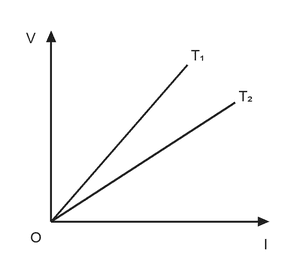
The voltage V and current I graph for a conductor at two different temperatures and is shown in the given figure. The relation between and is
 Solve with AI
Answer
(A)
- Correct
(B)
(C)
(D) none of the above
Answer: (B)
Key idea: On a graph with on the vertical axis and on the horizontal axis, the slope of each line is the resistance at that temperature.
Step 1 — Compare the slopes.
The line marked is steeper than the line marked , so the conductor has a larger resistance at .
Step 2 — Use how a conductor's resistance depends on temperature.
The resistance of a metallic conductor rises as its temperature rises, because its ions vibrate more and the electrons collide more often.
Step 3 — Conclude.
The larger resistance belongs to the higher temperature, so is higher than .
Why the other options are wrong:
- (A) is wrong: Equal temperatures would give the same resistance, so the two lines would coincide.
- (C) is wrong: This would put the larger resistance at the lower temperature, which is not true for a metallic conductor.
- (D) is wrong: "None of the above" fails because option (B) is true.
Therefore, T₁ is greater than T₂: option (B).
- 121 mark
Question 12
A 100 W, 220 V bulb is connected across 110 V supply. The actual power consumed by the bulb will be
Solve with AIAnswer
- Correct
(A) 25 W
(B) 50 W
(C) 100 W
(D) 200 W
Answer: (A) 25 W
Key idea: The rating fixes the filament's resistance. Treating that resistance as constant, the power at another voltage follows from .
Step 1 — Find the resistance from the rating.
We rearrange using the rated values 100 W and 220 V.
Step 2 — Find the power at 110 V.
We use the same resistance with the new voltage.
Halving the voltage makes the power one-fourth, since .
Note: a real filament runs cooler at 110 V, so its resistance is lower and it draws a little more than 25 W; 25 W is the value for a constant resistance. India's declared mains voltage is now 230 V.
Why the other options are wrong:
- (B) is wrong: A power of 50 W assumes , but for a fixed resistance .
- (C) is wrong: The bulb takes 100 W only at its rated 220 V.
- (D) is wrong: A lower voltage lowers the power, so it cannot rise to 200 W.
Therefore, the power consumed at 110 V is 25 W: option (A).
- 131 mark
Question 13
When a wire is stretched and its radius becomes , then its resistance will be
Solve with AIAnswer
- Correct
(A)
(B)
(C)
(D)
Answer: (A)
Key idea: Stretching keeps the volume of the wire constant. A thinner wire must therefore also be longer, and both changes raise the resistance.
Step 1 — Find the new area.
The radius becomes , so the area becomes one-fourth.
Step 2 — Find the new length.
The volume is constant, so the length becomes four times.
Step 3 — Find the new resistance.
The resistivity is unchanged, so we multiply the length ratio by the inverse area ratio.
Why the other options are wrong:
- (B) is wrong: The value allows for only one of the two changes, the longer length or the smaller area.
- (C) is wrong: The value would need the resistance to vary as ; at constant volume it varies as .
- (D) is wrong: The value is smaller than , but a longer, thinner wire has more resistance, not less.
Therefore, the new resistance is 16R: option (A).
- 141 mark
Question 14
Iron and silicon wires are heated from 30°C to 50°C. The correct statement is that
Solve with AIAnswer
(A) resistance of both the wires increases
(B) resistance of both the wires decreases
- Correct
(C) resistance of iron wire increases and that of silicon wire decreases
(D) resistance of iron wire decreases and that of silicon wire increases
Answer: (C) resistance of iron wire increases and that of silicon wire decreases
Key idea: Metals have a positive temperature coefficient of resistance. Semiconductors have a negative one.
Step 1 — Decide what happens to iron.
Iron is a metal. On heating, its ions vibrate more strongly, the electrons collide more often and the relaxation time falls, so its resistance rises.
Step 2 — Decide what happens to silicon.
Silicon is a semiconductor. On heating, many more electrons are freed to conduct; this rise in the number of carriers outweighs the extra collisions, so its resistance falls.
Step 3 — Match with the options.
Iron's resistance increases and silicon's decreases, which is option (C).
Why the other options are wrong:
- (A) is wrong: The resistance rises for iron only; silicon's resistance falls on heating.
- (B) is wrong: The resistance falls for silicon only; iron's resistance rises on heating.
- (D) is wrong: This swaps the behaviour of the metal and the semiconductor.
Therefore, the resistance of the iron wire increases and that of the silicon wire decreases: option (C).
- 151 mark
Question 15
In current electricity, Ohm's law is obeyed by all
Solve with AIAnswer
(A) solids
- Correct
(B) metals
(C) liquids
(D) gases
Answer: (B) metals
Key idea: A conductor obeys Ohm's law when, at constant temperature, its current is proportional to the potential difference, so its – graph is a straight line through the origin.
Step 1 — Check metals.
For metallic conductors at constant temperature the ratio stays constant over a wide range of currents, so metals obey Ohm's law.
Step 2 — Check the other groups.
Each of the other groups contains common examples whose – graph is not a straight line through the origin, so the word "all" fails for them.
Why the other options are wrong:
- (A) is wrong: Not all solids obey it: semiconductor devices such as a junction diode do not.
- (C) is wrong: Not all liquids obey it: in an electrolytic cell a back e.m.f. at the electrodes means the current is not proportional to the applied voltage.
- (D) is wrong: A gas in a discharge tube does not obey Ohm's law; the current rises sharply once the gas breaks down.
Therefore, Ohm's law is obeyed by all metals (at constant temperature): option (B).
- 161 mark
Question 16
If and are the filament resistances of a 200 W and 100 W bulb respectively designed to operate on the same voltage, then
Solve with AIAnswer
(A)
- Correct
(B)
(C)
(D)
Answer: (B)
Key idea: Both bulbs are designed for the same voltage. At a fixed voltage, power is inversely proportional to resistance.
Step 1 — Write the resistance of each bulb.
We rearrange for each bulb.
Step 2 — Divide the two resistances.
The cancels, leaving the inverse ratio of the powers.
Why the other options are wrong:
- (A) is wrong: Equal resistances at the same voltage would give equal powers, not 200 W and 100 W.
- (C) is wrong: A factor of 4 would need the power to vary as ; at fixed voltage it varies as .
- (D) is wrong: This makes the 200 W filament the larger resistance, which would give it the smaller power.
Therefore, R₂ = 2R₁: option (B).
- 171 mark
Question 17
The carbon resistor has coloured bands as shown in the given figure. The resistance of the resistor is
 Solve with AI
Answer
(A)
(B)
- Correct
(C)
(D)
Answer: (C)
Key idea: In the colour code of a carbon resistor, the first two bands give the significant figures, the third band gives the power of ten (the multiplier) and the fourth band gives the tolerance. Gold means ±5% and silver means ±10%.
Step 1 — Read the bands in order.
Reading from the end nearer the bands, red stands for 2, blue for 6, brown for the multiplier , and gold for a tolerance of ±5%.
Step 2 — Find the resistance.
The first two figures make 26, which we multiply by .
Step 3 — Add the tolerance.
The gold band gives ±5%, so the value is 260 Ω ± 5%.
Why the other options are wrong:
- (A) is wrong: A value of 26 Ω ± 10% leaves out the brown multiplier and also takes the tolerance as silver.
- (B) is wrong: A value of 26 Ω ± 5% reads the tolerance correctly but leaves out the brown multiplier ().
- (D) is wrong: A value of 260 Ω ± 10% has the right value but takes the gold tolerance band as silver.
Therefore, the resistance is 260 Ω ± 5%: option (C).
- 181 mark
Question 18
The order of coloured ring in a carbon resistor is red, yellow, blue and silver. The resistance of the carbon resistor is
Solve with AIAnswer
(A)
- Correct
(B)
(C)
(D)
Answer: (B)
Key idea: In the colour code, the first two bands give the significant figures, the third band gives the multiplier and the fourth band gives the tolerance. Red stands for 2, yellow for 4 and blue for 6. Silver means ±10%.
Step 1 — Read the first two bands.
Red stands for 2 and yellow for 4, so the significant figures are 24.
Step 2 — Read the multiplier.
The third band is blue, which stands for 6, so the multiplier is .
Step 3 — Read the tolerance.
The fourth band is silver, so the tolerance is ±10%.
Why the other options are wrong:
- (A) is wrong: This has the right value but takes the tolerance as gold (±5%); the band is silver (±10%).
- (C) is wrong: This reads red as 3 (the orange figure) and the blue multiplier as (the yellow multiplier).
- (D) is wrong: This reads the second and third bands as blue and yellow, the wrong way round, and takes the silver band as gold.
Therefore, the resistance is 24 × 10⁶ Ω ± 10%: option (B).
- 191 mark
Question 19
Define unit of current.
Solve with AIWritten solution
Solution:
Key idea: Electric current is the rate of flow of charge. Since 2019 the S.I. fixes the elementary charge exactly at C, and the ampere is defined from it.
Step 1 — Name the unit.
The S.I. unit of current is the ampere (A), one of the seven S.I. base units.
Step 2 — Define it.
One ampere is the current when charge flows at the rate of one coulomb per second through any cross-section of the conductor. With fixed exactly, this is a flow of about elementary charges per second.
Therefore, one ampere is the current when one coulomb of charge (about 6.24 × 10¹⁸ elementary charges) passes any cross-section in one second.
- 201 mark
Question 20
The potential difference across a given copper wire is increased. What happens to the drift velocity of the charge carriers?
Solve with AIWritten solution
Solution:
Key idea: The drift velocity is set by the electric field inside the wire. For a wire of length with a potential difference across it, the field is .
Here and are the charge and mass of an electron and is the relaxation time.
Step 1 — Write the field in terms of V.
The field along a uniform wire is the potential difference divided by the length.
Step 2 — Put this into the drift-velocity formula.
We replace by .
Step 3 — Decide how the drift velocity changes.
For the same wire at the same temperature, , , and are fixed, so is proportional to .
Therefore, the drift velocity of the charge carriers increases in proportion to the potential difference.
- 211 mark
Question 21
How does the drift velocity of electrons in a metallic conductor vary with increase in temperature?
Solve with AIWritten solution
Solution:
Key idea: The drift velocity depends on the relaxation time , the average time between collisions of an electron with the vibrating ions of the metal.
Step 1 — Say what heating does to the ions.
On heating, the positive ions of the metal vibrate with larger amplitude, so the free electrons collide with them more often.
Step 2 — Say what happens to the relaxation time.
More frequent collisions mean a shorter time between collisions, so decreases.
Step 3 — Apply this to the drift velocity.
For the same applied field , a smaller gives a smaller .
Therefore, the drift velocity of electrons in a metal decreases as the temperature rises (for the same applied field).
- 221 mark
Question 22
State Ohm's law.
Solve with AIWritten solution
Solution:
Key idea: Ohm's law links the current through a conductor to the potential difference across it, as long as the physical conditions do not change.
Step 1 — State the law in words.
The current flowing through a conductor is directly proportional to the potential difference across its ends, provided the physical conditions (temperature, strain and so on) remain the same.
Step 2 — Write it as an equation.
The constant of proportionality is the resistance of the conductor.
Therefore, Ohm's law: at constant physical conditions the current through a conductor is proportional to the potential difference across it (V = IR).
- 231 mark
Question 23
What is a non-Ohmic device? Give one example.
Solve with AIWritten solution
Solution:
Key idea: An ohmic conductor has a – graph that is a straight line through the origin, so is constant. A device that breaks this rule is non-ohmic.
Step 1 — Define a non-ohmic device.
A non-ohmic device is one that does not obey Ohm's law: its – graph is not a straight line through the origin, so its resistance changes with the current or with the direction of the current.
Step 2 — Give an example.
A semiconductor junction diode conducts easily in one direction and hardly at all in the other, and its current rises steeply (not in proportion) once the forward voltage passes about 0.7 V for silicon.
Therefore, a non-ohmic device does not obey Ohm's law; an example is a semiconductor diode.
- 241 mark
Question 24
Define resistivity of the material of a wire. State its S.I. unit.
Solve with AIWritten solution
Solution:
Key idea: The resistance of a wire depends on its length , its area of cross-section and its material. Resistivity is the part that depends only on the material (at a given temperature).
Step 1 — Define resistivity.
Rearranging the formula gives .
Taking a length of 1 m and an area of shows that resistivity is the resistance of a conductor of that material of unit length and unit area of cross-section.
Step 2 — Find its S.I. unit.
The unit of is ohm × square metre per metre, which is ohm metre.
Therefore, resistivity is the resistance of a conductor of unit length and unit area of cross-section of the material, and its S.I. unit is the ohm metre (Ω m).
- 251 mark
Question 25
What is the order of resistivity of an insulator?
Solve with AIWritten solution
Solution:
Key idea: Materials are grouped by resistivity. Metals are about m, semiconductors lie in a wide middle range, and insulators are many orders of magnitude higher.
Step 1 — Recall typical insulator values.
Glass has a resistivity of about to m; hard rubber, mica and quartz are higher still, up to about m.
Step 2 — Compare with a metal.
Copper is about m, so an insulator's resistivity is roughly to times larger.
Therefore, the resistivity of an insulator is of the order of 10¹⁰ to 10¹⁶ Ω m.
- 261 mark
Question 26
Name the units of conductance and conductivity.
Solve with AIWritten solution
Solution:
Key idea: Conductance is the reciprocal of resistance, and conductivity is the reciprocal of resistivity.
Step 1 — Find the unit of conductance.
Conductance has the unit , which is named the siemens (S); the older name is the mho.
Step 2 — Find the unit of conductivity.
Conductivity has the unit , which is the siemens per metre ().
Therefore, conductance is measured in siemens (S, or mho) and conductivity in siemens per metre (S m⁻¹).
- 271 mark
Question 27
Why is manganin used for making standard resistors? Give two reasons.
Solve with AIWritten solution
Solution:
Key idea: A standard resistor must keep a known, steady value, and should not be bulky.
Step 1 — Give the first reason.
Manganin has a high resistivity (about m, roughly 25 times that of copper), so a short length of wire gives a large resistance and the coil stays compact.
Step 2 — Give the second reason.
Manganin has a very low temperature coefficient of resistance, so its resistance hardly changes when the room warms or when the current heats the coil.
Therefore, manganin is used for standard resistors because of its high resistivity and its very low temperature coefficient of resistance.
- 281 mark
Question 28
What is a thermistor?
Solve with AIWritten solution
Solution:
Key idea: A thermistor is a resistor designed so that its resistance changes strongly with temperature (the name comes from "thermal resistor").
Step 1 — Say what it is made of.
A thermistor is usually made of semiconducting oxides of metals such as nickel, manganese, cobalt or copper.
Step 2 — Describe its behaviour.
The common type has a large negative temperature coefficient of resistance: its resistance falls sharply as the temperature rises. Positive-coefficient types are also made.
Step 3 — Give a use.
Because a small change in temperature gives a large change in resistance, thermistors are used as temperature sensors, for example in thermometers and fire alarms.
Therefore, a thermistor is a heat-sensitive semiconductor resistor whose resistance changes greatly with temperature (usually falling as it warms).
- 291 mark
Question 29
A wire of resistivity is stretched to double its length. What will be its new resistivity?
Solve with AIWritten solution
Solution:
Key idea: Resistivity depends only on the material and its temperature, not on the length or thickness of the wire.
Step 1 — Decide what stretching changes.
Stretching changes only the shape of the wire, so its resistivity is unchanged.
Step 2 — Note what does change.
The volume stays constant, so a length of gives an area of , and the resistance becomes times.
Therefore, the new resistivity is still ρ; only the resistance changes, to 4 times its old value.
- 301 mark
Question 30
Draw a graph to show the variation of resistance of a metal wire as a function of its diameter, keeping length and temperature constant.
Solve with AIWritten solution
Solution:
Key idea: For a wire of diameter the area of cross-section is .
Step 1 — Write R in terms of D.
We put into the formula.
Step 2 — Decide the shape of the graph.
With (fixed temperature) and fixed, is proportional to . The graph of against is a curve that falls steeply at small diameters and then flattens out, approaching the -axis without touching it.
Step 3 — Draw the graph.
The graph below shows on the vertical axis and on the horizontal axis.
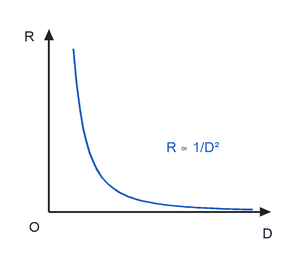
Therefore, R varies as 1/D², so the graph is a falling curve that flattens out as the diameter increases.
- 311 mark
Question 31
What is a superconductor?
Solve with AIWritten solution
Solution:
Key idea: The resistance of most metals falls as they are cooled. In some materials it drops suddenly to zero below a definite temperature.
Step 1 — Describe the effect.
When certain metals, alloys or compounds are cooled below a particular temperature, called the critical (transition) temperature , their resistance suddenly falls to zero. This is called superconductivity.
Step 2 — Give an example.
Mercury becomes superconducting below about 4.2 K. Some ceramic compounds stay superconducting up to above 77 K, so they can be cooled with liquid nitrogen.
Therefore, a superconductor is a material whose resistance becomes zero when it is cooled below its critical temperature.
- 321 mark
Question 32
State two applications of superconductors.
Solve with AIWritten solution
Solution:
Key idea: A superconductor carries current with zero resistance, so it wastes no energy as heat and can carry very large steady currents.
Step 1 — Give the first application.
Superconducting coils carry very large currents without heating, so they produce very strong magnetic fields, as in MRI scanners in hospitals and in magnetically levitated (maglev) trains.
Step 2 — Give the second application.
Superconducting cables can carry electric power with very low loss; a few short underground links in cities already use them.
Therefore, two applications of superconductors are strong electromagnets (MRI scanners, maglev trains) and low-loss power cables.
- 331 mark
Question 33
A wire has a resistance of and it is cut into three pieces having equal lengths. If these are now connected in parallel, find the resistance of the combination so formed.
Solve with AIWritten solution
Solution:
Key idea: Resistance is proportional to length, so cutting a wire into equal pieces divides its resistance equally. For equal resistors in parallel, the equivalent is one resistor divided by .
Step 1 — Find the resistance of each piece.
Each piece is one-third of the wire, so it has one-third of the resistance.
Step 2 — Combine the three pieces in parallel.
Three equal resistances in parallel give one of them divided by 3.
Therefore, the resistance of the parallel combination is 10 Ω.
- 341 mark
Question 34
If the current supplied to a variable resistor is a constant, draw a graph between voltage and resistance.
Solve with AIWritten solution
Solution:
Key idea: By Ohm's law the voltage across a resistor is the product of the current and the resistance.
Step 1 — Decide the relation between V and R.
The current is kept constant, so is directly proportional to .
Step 2 — Decide the shape of the graph.
A direct proportion gives a straight line through the origin, and its slope equals the constant current .
Step 3 — Draw the graph.
The graph below shows on the vertical axis and on the horizontal axis.
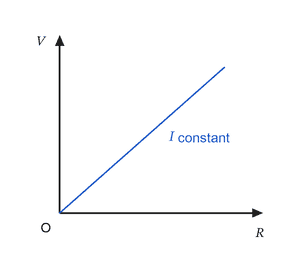
Therefore, the V–R graph is a straight line through the origin whose slope is the constant current I.
- 351 mark
Question 35
A wire of resistance 1 ohm is stretched to double its length. What is the new resistance?
Solve with AIWritten solution
Solution:
Key idea: Stretching keeps the volume constant, so doubling the length halves the area of cross-section.
Step 1 — Find the new length and area.
The new length is , and to keep the volume fixed the new area is .
Step 2 — Find the ratio of resistances.
The resistivity is unchanged, so we multiply the length ratio by the inverse area ratio.
Step 3 — Put in the value.
The original resistance is 1 Ω.
Therefore, the new resistance is 4 Ω.
- 361 mark
Question 36
Two wires of equal lengths, one of copper and the other of manganin have the same resistance. Which wire is thicker?
- 371 mark
Question 37
A given wire having resistance is stretched so as to reduce its diameter to half of its previous value. What will be its new resistance?
- 381 mark
Question 38
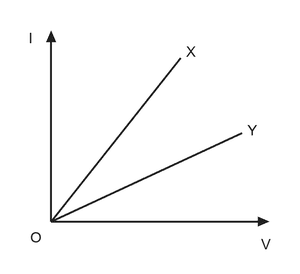
The voltage current variation of two metallic wires X and Y at constant temperature is shown in the given figure. Assuming that the wires have the same length and the same diameter, explain which wire will have a larger resistivity and why?
- 391 mark
Question 39
What is the effect of temperature on the conductivity of an electrolyte?
- 401 mark
Question 40
A steady current is flowing through a cylindrical conductor. Is there any electric field within the conductor?
- 411 mark
Question 41
The potential difference across a given copper wire is increased. What happens to the drift velocity of the charge carrier?
- 421 mark
Question 42
Is electric current a vector or scalar?
- 431 mark
Question 43
“The connecting wires in an electric circuit are made of copper”. Why?
- 441 mark
Question 44
Without a source of emf, electric current is not possible. Why?
- 451 mark
Question 45
Mention two characteristics of a standard resistance.
- 461 mark
Question 46
Mention two reasons why manganin or constantan is selected for making standard resistance.
- 471 mark
Question 47
Name the constituents of
(i) constantan and
(ii) manganin.
- 481 mark
Question 48
How does relaxation time vary with temperature?
- 491 mark
Question 49
What is the effect of temperature on drift speed?
- 501 mark
Question 50
When a wire is stretched to three times what is its new resistivity?
- 511 mark
Question 51
Give examples for materials whose resistivity decreases with rise in temperature.
- 521 mark
Question 52
If the temperature of a good conductor decreases, how does the relaxation time of electrons in the conductor change?
- 531 mark
Question 53
A current flowing in a copper wire is passed through another copper wire of the same length but of double the radius of the first one. How would the drift velocity of free electrons change?
- 541 mark
Question 54
Explain how does the resistivity of a conductor depend upon
(i) the number density of free electrons and
(ii) relaxation time .
- 551 mark
Question 55
Draw - graph for ohmic and non-ohmic materials. Give one example each.
- 561 mark
Question 56
The resistivity of semiconductors decreases with increase in temperature. Why?
- 571 mark
Question 57
The coil used for making standard resistance, like manganin, is double folded and is wound over non-conducting frame. Why?
- 582 marks
Question 58
Name the charge carriers in
(i) Ge and
(ii) ionised gases.
- 592 marks
Question 59
To show the direction of current we put an arrow mark opposite to the flow of electrons. Why?
- 602 marks
Question 60
Define current density. Give its S.I. unit.
- 612 marks
Question 61
Which is vector, current or current density? Why?
- 622 marks
Question 62
A current flows through
(i) a uniform conductor and
(ii) a non-uniform conductor.
Will the current density be the same for both the conductors?
- 632 marks
Question 63
Define drift velocity.
- 642 marks
Question 64
State Ohm's law.
- 652 marks
Question 65
What is an Ohmic conductor?
- 662 marks
Question 66
Give examples for conductors which do not obey Ohm's law.
- 672 marks
Question 67
What are non-ohmic devices? Give examples.
- 682 marks
Question 68
Draw a graph to show the variation of with , for a non-ohmic device.
- 692 marks
Question 69
What is meant by resistance of a conductor? How does it arise?
- 702 marks
Question 70
Name the factors affecting the resistance of a conductor.
- 712 marks
Question 71
Define resistivity. Give its S.I. unit.
- 722 marks
Question 72
What is the difference between conductance and conductivity? Give their S.I. units.
- 732 marks
Question 73
Define temperature coefficient of resistance.
- 742 marks
Question 74
Mention two examples for substances with zero temperature coefficient.
- 752 marks
Question 75
Draw a graph to show the variation of resistance with temperature for substances having positive, zero and negative temperature coefficients.
- 762 marks
Question 76
Define mean free path of a conduction electron. What is relaxation time?
- 772 marks
Question 77
What is meant by the mobility of the electron?
- 782 marks
Question 78
Write down the expression for the conductivity of conductor in terms of the relaxation time.
- 792 marks
Question 79
Explain the variation of resistivity with temperature.
- 802 marks
Question 80
How is electric energy and power related?
- 812 marks
Question 81
Mention the colour code used to indicate the value of the resistance.
- 822 marks
Question 82
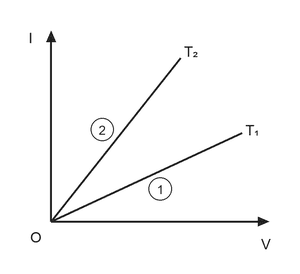
The variation of current with voltage of substance is as shown in the given figure. What can you say about the temperature and if the substance is
(i) silicon and
(ii) copper?
- 832 marks
Question 83
A steady current is flowing in a cylindrical conductor. Is there any electric field within the conductor?
- 842 marks
Question 84
“The connecting wires are made of copper”. Why?
- 852 marks
Question 85
Water gets slowed down when flows through a bent pipe. Does a bent wire offer higher resistance than a straight wire to the flow of electric current through it?
- 862 marks
Question 86
Manganin or Eureka is used for making standard resistance coils. Why?
- 872 marks
Question 87
Two wires of equal length one of copper and the other of manganin have the same resistance. Which wire is thicker?
- 882 marks
Question 88
Which has greater temperature coefficient of resistance, an alloy or its constituent metals?
- 892 marks
Question 89
The resistance of our body is about . Still one gets a severe shock on touching a 240 volt a.c. supply. Why?
- 902 marks
Question 90
Give the composition of the alloys constantan and manganin.
- 912 marks
Question 91
What is meant by a linear resistor?
- 922 marks
Question 92
Obtain the dimensional formula of
(i) Conductance and
(ii) Conductivity.
- 932 marks
Question 93
Will the drift speed of free electrons in a metallic conductor increase or decrease with the increase in temperature?
- 943 marks
Question 94
Name the factors on which the resistance of a conductor depends. Define resistivity, conductivity and conductance.
- 953 marks
Question 95
Obtain an equation for the electric power. Give its S.I. unit and commercial unit. What is electric energy? Give its commercial unit.
- 963 marks
Question 96
Write down simple relationship to show the variation of resistance with temperature. Define temperature coefficient of resistance. In what way, the temperature coefficient of carbon is different from that of common conductors.
- 973 marks
Question 97
Ohm's law may also be stated by the equation . What do the symbols , and stand for? Show that the combinations of units on the two sides are identical.
- 983 marks
Question 98
The current flowing through a conductor is given by .
(i) Identify each term in the equation.
(ii) Obtain an equation for , if the current flowing through the conductor of length has its ends maintained at a potential difference of volt.
- 993 marks
Question 99
What is current density? Write the vector equation connecting current density with electric field intensity , for an ohmic conductor.
- 1003 marks
Question 100
Define resistivity of a conductor. Explain the variation of resistance with temperature in
(i) metallic wire
(ii) a piece of carbon.
- 1015 marks
Question 101
(a) Define electric current and current density.
(b) “Current is scalar but current density is vector.” Why?
(c) Define drift velocity. Derive an expression for it.
- 1025 marks
Question 102
(a) Explain Ohm's law. What is resistance?
(b) Name the factors affecting the resistance of a conductor. Hence define resistivity.
(c) Give two examples of circuit elements which do not obey Ohm's law.
- 1035 marks
Question 103
(a) Explain the dependence of resistance on temperature.
(b) Draw a graph to show the variation of resistance of a thermistor with temperature.
(c) Define temperature coefficient of resistance.
- 1045 marks
Question 104
(a) Explain Lorentz-Drude theory of metallic conduction.
(b) Obtain an expression for the drift velocity in terms of relaxation time.
(c) Derive Ohm's law using electron theory.
- 1053 marks
Question 105
The current flowing through a lamp is mA. How many electrons flow through the lamp in one minute? Charge on an electron is C.
- 1063 marks
Question 106
The quantity of charge in coulomb passing through a surface of area varies with time as where is in second.
(a) Find the instantaneous current through the surface at s.
(b) Calculate the current density.
- 1073 marks
Question 107
How long will it take a total charge of C to pass through a conductor if a steady current of A is flowing?
- 1083 marks
Question 108
In a neon gas discharge tube, ions move to the right through a cross-section of the tube each second while electrons move to the left in the same time. Find the magnitude and the direction of current.
- 1093 marks
Question 109
What should be the potential difference across an aluminium wire of length m and cross-section area such that a current of A passes through it?
- 1103 marks
Question 110
Current of A is passing through a metallic wire of cross-section area . If the density of charge carrier in the wire is . Find the drift speed of the electrons.
- 1113 marks
Question 111
A current of A flows through a wire of length of m and cross-sectional area , under a potential difference of V. Find the current density and conductivity of the metal.
- 1123 marks
Question 112
Calculate the resistivity of the material of a wire m long, mm in diameter and having a resistance of ohm.
- 1133 marks
Question 113
A metal wire of resistivity ohm-m and length m has a resistance of ohm. Calculate its radius.
- 1143 marks
Question 114
Calculate the resistivity as well as the conductivity of a wire of resistance , area of cross-section and length cm.
- 1153 marks
Question 115
A wire has a resistance of . Find the resistance of another wire of the same material with double the length and half the radius as that of the first wire.
- 1163 marks
Question 116
The resistance of a wire is ohm. If the wire is stretched times to its original length, find the new resistance.
- 1173 marks
Question 117
Find the percentage increase in the resistance of cylindrical wire if it is stretched to increase its length by .
- 1183 marks
Question 118
The resistance of a resistance wire is . It is drawn out so that its new length is times its original length. What is the resistance of the longer wire? Assume that the resistivity and the density of the material are not changed while drawing.
- 1193 marks
Question 119
The length of an aluminium bar of square cross-section is cm. Calculate the resistance between its ends, if its thickness is mm. What must be the diameter of a circular cm copper rod if its resistance is to be the same? Given resistivities of aluminium and copper are ohm-m and ohm-m.
- 1203 marks
Question 120
The current passing through a straight wire of length m is A. Calculate the total momentum of the electrons.
- 1213 marks
Question 121
The electron density in copper is and the resistivity of copper at room temperature is ohm-m. What is the relaxation time of the free electrons in copper? Given that the charge on the electron is C and its mass is kg.
- 1223 marks
Question 122
A silver wire has resistance of ohm at C and its temperature coefficient of resistance is per C. To what temperature must the wire be raised to double the resistance?
- 1233 marks
Question 123
A copper coil has a resistance of at C and at C. Find the temperature coefficient of resistance of copper.
- 1243 marks
Question 124
The temperature of a copper wire changes by C. By what percentage do the length, area and resistance of the wire change? Given the temperature coefficient of resistance of copper is per C and the coefficient of linear expansion is per C.
- 1253 marks
Question 125
The resistance of a wire of iron is ohm and the temperature coefficient of resistivity is C. At C it carries mA of current. Keeping constant potential difference between its ends, the temperature of the wire is raised to C. Find the current in milliampere that flows in the wire.
- 1263 marks
Question 126
A given resistor has colour scheme, brown, black, green and gold. What is the value of the resistance?
- 1273 marks
Question 127
A carbon resistor of k is to be marked with rings of different colours for its identification. Write the sequence of colours.
- 1283 marks
Question 128
On a resistor the colour bands are given in the sequence green, violet and red. What is its resistance?
What Class 12 Physics Ch 5 covers
The sections of the chapter, in the order the book takes them. Every question above comes from one of these.
- 01Electric Current and Current Density
- 02Drift Velocity, Relaxation Time and Mobility
- 03Ohm's Law and Resistance
- 04Resistivity and Conductivity
- 05Limitations of Ohm's Law
- 06Temperature Dependence of Resistance
- 07Electric Energy and Power
More ways to study this chapter
The same chapter asked three other ways. Practise it, revise it, and see what the board has set on Ch 5 before.
- Competency-Based Questions (CBQ)Case study questions: a situation, and the part of the chapter that answers it.40questionsOpen
- Previous Year QuestionsQuestions that have actually appeared in board papers, each tagged with its year.19questionsOpen
- Practice QuestionsExtra questions per chapter, for when one attempt at a method is not enough.153questionsOpen
Ch 5 in past ISC papers
The same chapter as the board has actually asked it. These are worded differently from the textbook exercise, which is the point of reading them.
- 12 marks
Board paper question 1
Draw labelled graphs to show how electrical resistance varies with temperature for:
(i) a metallic wire.
(ii) a piece of carbon.
Solve with AIWritten solution
Solution:
Key idea: The resistance of a metal rises with temperature, almost linearly over the usual range, because its ions vibrate more strongly and the free electrons collide more often. Carbon behaves like a semiconductor: heating frees more charge carriers, so its resistance falls.
Step 1 — Draw the graph for the metallic wire.
For a metal, the resistance at temperature is close to , where is the resistance at and , the temperature coefficient of resistance, is positive. So the graph of against is a rising, nearly straight line that cuts the -axis at (graph (i) below).
Step 2 — Draw the graph for the piece of carbon.
Carbon has a negative temperature coefficient of resistance. As it is heated, more electrons become free to carry current, and this effect is stronger than the extra collisions. So its resistance falls as the temperature rises, and the graph slopes downwards (graph (ii) below).
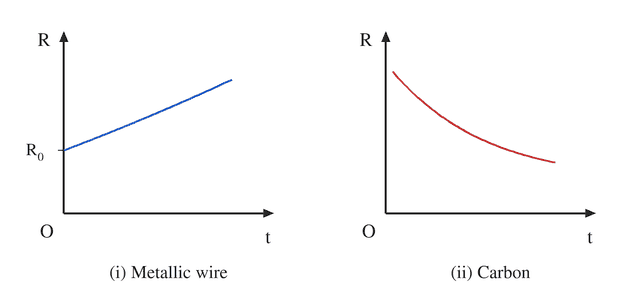
Watch out: The metal graph does not start at the origin; at the wire still has resistance .
Therefore, the resistance of the metallic wire increases almost linearly with temperature, while the resistance of carbon decreases as the temperature rises.
- 22 marks
Board paper question 2
Two resistors and are connected in parallel to a battery. If heating power developed in is , find the heating power developed in .
Solve with AIWritten solution
Solution:
Key idea: Resistors in parallel have the same potential difference across them. With fixed, the heating power in a resistor is , so the power is inversely proportional to the resistance.
Step 1 — Write the power in each resistor.
Both resistors have the same voltage of the battery across them, so we write the power in each one.
Step 2 — Divide the two equations.
Dividing removes the unknown .
Step 3 — Substitute the values.
We use , and .
The smaller resistor takes the larger power, as expected for a parallel connection.
Therefore, the heating power developed in is .
- 31 mark
Board paper question 3
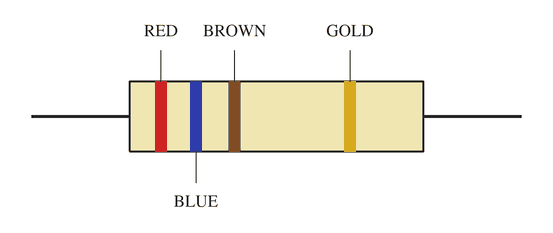
A carbon resistor has coloured bands as shown in Figure 2 below. The resistance of the resistor is:
 Solve with AI
Answer
(A)
(B)
- Correct
(C)
(D)
Answer: (C)
Key idea: In the colour code, the first two bands give the first two digits, the third band gives the power of ten (the multiplier), and the separate fourth band gives the tolerance. Black 0, brown 1, red 2, orange 3, yellow 4, green 5, blue 6, violet 7, grey 8, white 9; gold means and silver .
Step 1 — Read the two digit bands.
The first band is red, which stands for 2, and the second band is blue, which stands for 6. So the first two digits are 26.
Step 2 — Apply the multiplier band.
The third band is brown, which stands for 1, so the multiplier is .
Step 3 — Read the tolerance band.
The fourth band is gold, which means a tolerance of .
Why the others are wrong:
- (A) It forgets the brown multiplier (×10) and also takes the tolerance as ±10 %, which is silver, not gold.
- (B) The tolerance is right, but the brown multiplier (×10) has been left out, so the value is ten times too small.
- (D) The value is right, but ±10 % belongs to a silver band; the band here is gold.
Therefore, the correct option is (C): the resistance is .
- 41 mark
Board paper question 4
For a metallic conductor, what is the relation between current density (J), conductivity () and electric field intensity E?
Solve with AIWritten solution
Solution:
Key idea: Ohm's law can be written for a point inside a conductor: the current density there is proportional to the electric field there, and the constant is the conductivity of the material.
Step 1 — State the relation.
For a metallic conductor, the current density (current per unit area), the conductivity and the electric field intensity are linked by
In vector form , so the current density points along the field.
Step 2 — Say what it means.
This is Ohm's law in microscopic form. Since , where is the resistivity, it can also be written .
Therefore, (or ).
- 52 marks
Board paper question 5
A metallic wire has a resistance of at and at . Find the temperature coefficient of resistance of its material.
Solve with AIWritten solution
Solution:
Key idea: For a metal, , where is the resistance at , the resistance at and the temperature coefficient of resistance. Rearranging gives .
Step 1 — Write down the data.
The data are , and .
Step 2 — Find the rise in resistance.
We subtract the resistance at from the resistance at .
Step 3 — Divide by .
We use the rearranged formula for .
Therefore, the temperature coefficient of resistance of the material is .
- 61 mark
Board paper question 6
What is meant by drift speed of free electrons ?
Solve with AIWritten solution
Solution:
Key idea: Free electrons in a metal move randomly at high speeds, but with no field their average velocity is zero. An applied electric field adds a small, steady motion opposite to the field.
Step 1 — State the meaning.
Drift speed is the average speed with which the free electrons of a conductor move, opposite to the applied electric field, when a potential difference is applied across it.
Step 2 — Give its formula and size.
It is given by
where is the electron charge, the electric field, the relaxation time and the electron mass. It is very small, typically about to .
Therefore, drift speed is the small average speed acquired by free electrons, opposite to the field, when a potential difference is applied.
All 19 board paper questions for this chapter, solved the same way.
Class 12 Physics Ch 5 questions students ask
How many questions are there in Class 12 Physics Ch 5?
128 questions. Every one is solved step by step on this page.
Are these Class 12 Physics solutions free?
Yes. Every question and its full working is free to read, with no account needed.
Can I download the Class 12 Physics Ch 5 solutions as a PDF?
There is no PDF to download. Every solution is on this page instead, which means it is searchable, always the current syllabus, and readable on a phone. Use your browser's print option if you want it on paper.