
Question 1015 marksMedium
(a) Define electric current and current density.
(b) “Current is scalar but current density is vector.” Why?
(c) Define drift velocity. Derive an expression for it.
Confirming your payment
Sign up now and get 250 free tokens.
Electric Current - Ohm's Law · Question 101 of 128
(a) Define electric current and current density.
(b) “Current is scalar but current density is vector.” Why?
(c) Define drift velocity. Derive an expression for it.
Solution:
Key idea: A current is a flow of charge. When a field acts on a conductor, the free electrons gain a small average velocity, the drift velocity, on top of their random motion.
Step 1 — Part (a): define electric current.
Electric current is the rate of flow of charge through any cross-section of a conductor.
Its S.I. unit is the ampere, where 1 A is 1 coulomb per second.
Step 2 — Part (a): define current density.
Current density at a point is the current per unit area of cross-section, the area being normal to the direction of the current.
Its unit is .
Step 3 — Part (b): explain why current is a scalar.
A current has a sense along the wire, but currents do not add by the law of vector addition. At a junction they simply add as numbers (Kirchhoff's junction rule), whatever the angles between the wires. So current is a scalar.
Step 4 — Part (b): explain why current density is a vector.
Current density has a definite direction at every point, the direction of flow of positive charge there. The current through an area is found from its dot product with the area vector, so current density is a vector.
Step 5 — Part (c): define drift velocity.
Drift velocity is the average velocity with which the free electrons drift, opposite to the applied electric field, in a conductor.
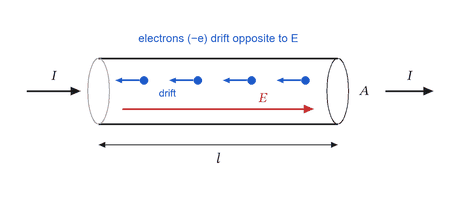
Step 6 — Part (c): find the acceleration of an electron.
In a field , each free electron of charge and mass feels a force , so its acceleration is as below.
Step 7 — Part (c): write the velocity of one electron.
Just after a collision, the -th electron has a random thermal velocity . A time later, before its next collision, its velocity has grown by .
Step 8 — Part (c): average over all electrons.
The drift velocity is the average of these velocities over all free electrons.
The thermal velocities point in random directions, so their average is zero. The average time since the last collision is the relaxation time .
Step 9 — Part (c): write the result.
Only the second term is left, so the drift velocity is the acceleration times the relaxation time.
The negative sign shows that the electrons drift opposite to . Its magnitude is .
Therefore, and ; current is a scalar but current density is a vector; and the drift velocity is .