
Opening your dashboard
Class 12 Physics Chapter 5 Electric Current - Ohm's Law: Previous Year Questions
19 questions on Chapter 5, each solved step by step. Class 12 Physics, ICSE 2026-27.
19 questions with solutions
1–3 marks · Mixed difficulty
- 12 marks
Question 1
Draw labelled graphs to show how electrical resistance varies with temperature for:
(i) a metallic wire.
(ii) a piece of carbon.
Solve with AIWritten solution
Solution:
Key idea: The resistance of a metal rises with temperature, almost linearly over the usual range, because its ions vibrate more strongly and the free electrons collide more often. Carbon behaves like a semiconductor: heating frees more charge carriers, so its resistance falls.
Step 1 — Draw the graph for the metallic wire.
For a metal, the resistance at temperature is close to , where is the resistance at and , the temperature coefficient of resistance, is positive. So the graph of against is a rising, nearly straight line that cuts the -axis at (graph (i) below).
Step 2 — Draw the graph for the piece of carbon.
Carbon has a negative temperature coefficient of resistance. As it is heated, more electrons become free to carry current, and this effect is stronger than the extra collisions. So its resistance falls as the temperature rises, and the graph slopes downwards (graph (ii) below).
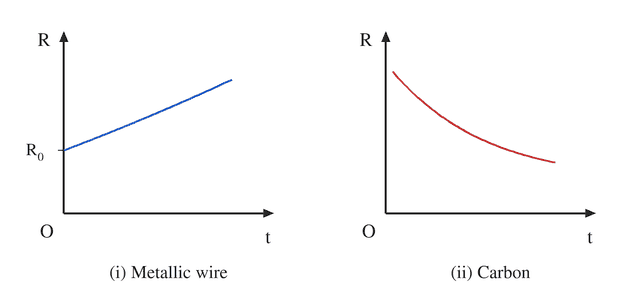
Watch out: The metal graph does not start at the origin; at the wire still has resistance .
Therefore, the resistance of the metallic wire increases almost linearly with temperature, while the resistance of carbon decreases as the temperature rises.
- 22 marks
Question 2
Two resistors and are connected in parallel to a battery. If heating power developed in is , find the heating power developed in .
Solve with AIWritten solution
Solution:
Key idea: Resistors in parallel have the same potential difference across them. With fixed, the heating power in a resistor is , so the power is inversely proportional to the resistance.
Step 1 — Write the power in each resistor.
Both resistors have the same voltage of the battery across them, so we write the power in each one.
Step 2 — Divide the two equations.
Dividing removes the unknown .
Step 3 — Substitute the values.
We use , and .
The smaller resistor takes the larger power, as expected for a parallel connection.
Therefore, the heating power developed in is .
- 31 mark
Question 3
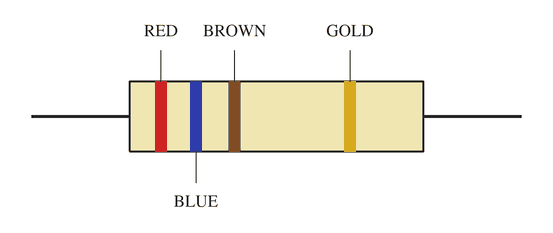
A carbon resistor has coloured bands as shown in Figure 2 below. The resistance of the resistor is:
 Solve with AI
Answer
(A)
(B)
- Correct
(C)
(D)
Answer: (C)
Key idea: In the colour code, the first two bands give the first two digits, the third band gives the power of ten (the multiplier), and the separate fourth band gives the tolerance. Black 0, brown 1, red 2, orange 3, yellow 4, green 5, blue 6, violet 7, grey 8, white 9; gold means and silver .
Step 1 — Read the two digit bands.
The first band is red, which stands for 2, and the second band is blue, which stands for 6. So the first two digits are 26.
Step 2 — Apply the multiplier band.
The third band is brown, which stands for 1, so the multiplier is .
Step 3 — Read the tolerance band.
The fourth band is gold, which means a tolerance of .
Why the others are wrong:
- (A) It forgets the brown multiplier (×10) and also takes the tolerance as ±10 %, which is silver, not gold.
- (B) The tolerance is right, but the brown multiplier (×10) has been left out, so the value is ten times too small.
- (D) The value is right, but ±10 % belongs to a silver band; the band here is gold.
Therefore, the correct option is (C): the resistance is .
- 41 mark
Question 4
For a metallic conductor, what is the relation between current density (J), conductivity () and electric field intensity E?
Solve with AIWritten solution
Solution:
Key idea: Ohm's law can be written for a point inside a conductor: the current density there is proportional to the electric field there, and the constant is the conductivity of the material.
Step 1 — State the relation.
For a metallic conductor, the current density (current per unit area), the conductivity and the electric field intensity are linked by
In vector form , so the current density points along the field.
Step 2 — Say what it means.
This is Ohm's law in microscopic form. Since , where is the resistivity, it can also be written .
Therefore, (or ).
- 52 marks
Question 5
A metallic wire has a resistance of at and at . Find the temperature coefficient of resistance of its material.
Solve with AIWritten solution
Solution:
Key idea: For a metal, , where is the resistance at , the resistance at and the temperature coefficient of resistance. Rearranging gives .
Step 1 — Write down the data.
The data are , and .
Step 2 — Find the rise in resistance.
We subtract the resistance at from the resistance at .
Step 3 — Divide by .
We use the rearranged formula for .
Therefore, the temperature coefficient of resistance of the material is .
- 61 mark
Question 6
What is meant by drift speed of free electrons ?
Solve with AIWritten solution
Solution:
Key idea: Free electrons in a metal move randomly at high speeds, but with no field their average velocity is zero. An applied electric field adds a small, steady motion opposite to the field.
Step 1 — State the meaning.
Drift speed is the average speed with which the free electrons of a conductor move, opposite to the applied electric field, when a potential difference is applied across it.
Step 2 — Give its formula and size.
It is given by
where is the electron charge, the electric field, the relaxation time and the electron mass. It is very small, typically about to .
Therefore, drift speed is the small average speed acquired by free electrons, opposite to the field, when a potential difference is applied.
- 72 marks
Question 7
Two resistors and are connected in parallel. If electric power consumed by the resistor is , calculate the power consumed by the resistor .
Solve with AIWritten solution
Solution:
Key idea: Resistors in parallel share the same potential difference . With the same, , so the power is inversely proportional to the resistance.
Step 1 — Write the ratio of the powers.
Both resistors have the same across them. Each power is divided by that resistance, so dividing by removes .
Step 2 — Substitute the values.
We use , and .
The larger resistor takes the smaller power, as expected in parallel.
Therefore, the power consumed by is .
- 81 mark
Question 8
The order of coloured rings in a carbon resistor is red, yellow, blue and silver. The resistance of the carbon resistor is:
Solve with AIAnswer
(A)
- Correct
(B)
(C)
(D)
Answer: (B)
Key idea: The first two rings give the two digits, the third ring the power of ten, and the fourth ring the tolerance. Red is 2, yellow is 4, blue is 6, and silver means .
Step 1 — Read the digits.
The first ring is red (2) and the second ring is yellow (4), so the digits are 24.
Step 2 — Apply the multiplier.
The third ring is blue (6), so the multiplier is .
Step 3 — Read the tolerance.
The fourth ring is silver, which means .
Why the others are wrong:
- (A) The value is right, but ±5 % is the tolerance of a gold ring; the ring here is silver.
- (C) It reads the first ring as 3 (the code for orange) and the multiplier as (the code for yellow); red stands for 2 and blue gives .
- (D) It reads blue as the second digit and yellow as the multiplier, which swaps the order of the rings, and it uses the gold tolerance.
Therefore, the correct option is (B): the resistance is .
- 92 marks
Question 9
Define current density. Write an expression which connects current density with drift speed.
Solve with AIWritten solution
Solution:
Key idea: Current density tells us how much current flows through each unit area of a conductor's cross-section. It depends on how many free electrons there are and how fast they drift.
Step 1 — Define current density.
Current density at a point in a conductor is the current flowing per unit area of cross-section, the area being taken perpendicular to the direction of current:
It is a vector along the direction of current, and its S.I. unit is .
Step 2 — Link the current with the drift speed.
Let be the number of free electrons per unit volume, the electron charge and the drift speed. In time the electrons in a length of the wire pass a cross-section, so the charge passing is . Dividing by gives the current.
Step 3 — Write the expression for .
We divide the current by the area .
Therefore, current density is the current per unit cross-sectional area, , and it is related to drift speed by .
- 103 marks
Question 10
An electrical bulb is marked 200V, 100W. Calculate electrical resistance of its filament. If five such bulbs are connected in series to a 200V supply, how much current will flow through them?
Solve with AIWritten solution
Solution:
Key idea: A bulb's rating gives its power at its rated voltage , so the filament resistance is . Resistances in series add, and the current is then the supply voltage divided by the total resistance.
Step 1 — Find the resistance of one filament.
The bulb is rated , .
Step 2 — Find the total resistance of five bulbs in series.
In series the resistances add.
Step 3 — Find the current from the supply.
We use Ohm's law with the supply.
Note: We take the filament resistance as constant. In reality each bulb gets only V, so its filament runs much cooler than at its rated V. A cooler tungsten filament has a much lower resistance, so the actual current is noticeably more than A.
Therefore, the filament resistance is , and a current of flows through the five bulbs in series.
- 112 marks
Question 11
A uniform copper wire having a cross sectional area of carries a current of 5A. Calculate the drift speed of free electrons in it.
(Free electron number density of copper .)
Solve with AIWritten solution
Solution:
Key idea: The current in a wire is , where is the free electron number density, the electron charge, the cross-sectional area and the drift speed. So .
Step 1 — Write the data in S.I. units.
The current is .
The free electron density is .
The electron charge is .
The area is ; since , we convert it:
Step 2 — Work out the product .
We multiply the three quantities in the denominator first.
Step 3 — Find the drift speed.
We divide the current by .
The exact value is , about 1.6 mm per second.
Therefore, the drift speed of the free electrons is about .
- 122 marks
Question 12
An electric bulb is rated as 250V, 750W. Calculate the:
(i) Electric current flowing through it. when it is operated on a 250V supply.
(ii) Resistance of its filament.
Solve with AIWritten solution
Solution:
Key idea: Electric power is . When the bulb works at its rated voltage it takes its rated power, so , and Ohm's law then gives .
Step 1 — Find the current (part i).
The bulb is rated at and is used on a supply.
Step 2 — Find the filament resistance (part ii).
We use Ohm's law with this current.
As a check, gives the same .
Therefore, (i) the current is and (ii) the filament resistance is about .
- 131 mark
Question 13
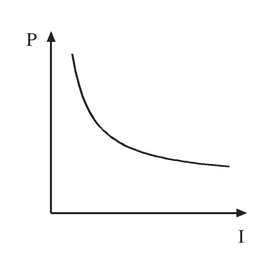
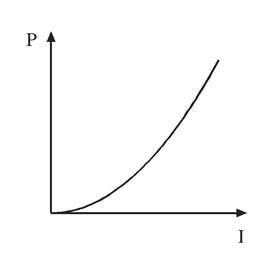
An electric current (I) flowing through a metallic wire is gradually increased. The graph of heating power (P) developed in it versus the current (I) is:
A.

B.
C.
D.
 Solve with AI
Answer
(A) Graph A
(B) Graph B
- Correct
(C) Graph C
(D) Graph D
Answer: (C) Graph C
Key idea: By Joule's law, the heating power in a resistor is . For a fixed resistance, is proportional to the square of the current.
Step 1 — Find the shape of the graph.
With fixed, Joule's law has the form , with in place of and in place of . This is a parabola that starts at the origin (no current, no heat) and gets steeper as grows: doubling makes four times as large.
Step 2 — Match it with the graphs.
Graph C starts at the origin and curves upwards more and more steeply, which is exactly this parabola.
Note: In a real wire the resistance also rises a little as it heats up, which makes rise even faster; the curve stays the upward-bending kind shown in graph C.
Why the others are wrong:
- (A) A straight line through the origin would mean , which ignores the square in .
- (B) This curve shows falling as rises, like ; heating power grows with current.
- (D) This line falls as rises and gives a large power at zero current, which is impossible.
Therefore, the correct option is (C): graph C, a parabola from the origin.
- 141 mark
Question 14
In case of metals, what is the relation between current density (J), electrical conductivity and electric field intensity (E)?
Solve with AIWritten solution
Solution:
Key idea: Ohm's law at a point inside a metal says that the current density is proportional to the electric field, and the constant is the electrical conductivity.
Step 1 — State the relation.
For metals, the current density , the conductivity and the electric field intensity are related by
In vector form ; the current density is along the field.
Step 2 — Say what it means.
This is the microscopic form of Ohm's law. Since , it can also be written , where is the resistivity.
Therefore, .
- 151 mark
Question 15
If potential difference between the two ends of a metallic wire is doubled, drift speed of free electrons in the wire ______.
Solve with AIAnswer
(A) Remains same.
- Correct
(B) Becomes double.
(C) Becomes four times
(D) Becomes half
Answer: (B) Becomes double.
Key idea: The drift speed of free electrons is , where is the electric field in the wire, the relaxation time and the electron mass. For a wire of length with potential difference , the field is .
Step 1 — Write in terms of .
We put into the drift speed formula.
Step 2 — See how changes when doubles.
For the same wire, , , and do not change (taking the temperature as unchanged), so . Doubling doubles the field and therefore doubles the drift speed.
Why the others are wrong:
- (A) The drift speed would stay the same only if the field stayed the same; doubling doubles .
- (C) Four times would need , but is directly proportional to .
- (D) Halving would need ; a larger field drives the electrons faster, not slower.
Therefore, the correct option is (B): the drift speed becomes double.
- 161 mark
Question 16
Three bulbs (230V, 40W), (230V, 60W) and (230V, 100W) are connected in series to a 230V supply. Which bulb glows the brightest?
Solve with AIWritten solution
Solution:
Key idea: The rating gives each filament's resistance, , so the bulb with the smallest rated power has the largest resistance. In series the same current flows through every bulb, and the power each one gives out is , so the bulb with the largest resistance glows the brightest.
Step 1 — Compare the resistances.
All three bulbs are rated , so .
In the same way and , so has the largest resistance.
Step 2 — Compare the powers in series.
The same current, about , flows through all three. With , the actual powers come out as about for , for and for , so gives out the most power.
Watch out: In parallel (normal house wiring) the bulb is brightest; in series it is the other way round.
Therefore, the bulb (230 V, 40 W) glows the brightest.
- 173 marks
Question 17
The graph below shows the variation of current density (J) with electric field (E) applied to two different metallic wires A and B.

(a) Which one of the wires, A or B, has higher resistivity?
(b) For a certain value of electric field (E), in which wire 'A' or 'B' is drift velocity greater? Give a reason for your answer.
Solve with AIWritten solution
Solution:
Key idea: Ohm's law in microscopic form is , where is the conductivity. So on a – graph the slope of each line is the conductivity of that wire.
The resistivity is the reciprocal of the conductivity, .
Current density is also , where is the free electron density and the drift velocity.
Step 1 — Read the slopes (part a).
Both graphs are straight lines through the origin, and the line for B is steeper than the line for A. So B has the larger conductivity.
Step 2 — Compare the resistivities (part a).
Resistivity is the reciprocal of conductivity, so the wire with the smaller slope has the larger resistivity.
Since , we get . So wire A has the higher resistivity.
Step 3 — Compare the current densities at the same field (part b).
Draw a vertical line at any one value of . It meets line B higher than line A, so at that field .
Step 4 — Compare the drift velocities (part b).
We rearrange for the drift velocity.
Taking the two metallic wires to have the same free electron density , the drift velocity is proportional to . Since at the same , the drift velocity is greater in wire B.
Note: The comparison of drift velocities needs the free electron densities to be equal (or not too different). In general , so for metals with very different both and would be needed.
Therefore, (a) wire A has the higher resistivity, and (b) at the same electric field the drift velocity is greater in wire B, because it has the larger current density .
- 181 mark
Question 18
A fish called an electric eel can generate a voltage up to . If it can supply a current of , the maximum power it can deliver is:
Solve with AIAnswer
(A)
(B)
(C)
- Correct
(D)
Answer: (D)
Key idea: Electric power is the product of the voltage and the current, .
The current must be in amperes, and .
Step 1 — Convert the current to amperes.
We write the current of in amperes.
Step 2 — Multiply the voltage by the current.
We use the largest voltage, , to get the maximum power.
Why the others are wrong:
- (A) This is , taking the current as instead of ; it is 1000 times too large.
- (B) This takes the current as , a current 100 times too large.
- (C) This takes the current as , a current 10 times too large.
Therefore, the correct option is (D): the maximum power is .
- 192 marks
Question 19
What is the effect of doubling the current flowing through a metallic wire on:
(a) drift speed of free electrons?
(b) relaxation time of free electrons?
Solve with AIWritten solution
Solution:
Key idea: The current in a wire is , so for a given wire the drift speed is proportional to the current. The relaxation time is the average time between collisions of a free electron with the ions; it depends on the material and its temperature, not on the current.
Step 1 — Find the effect on drift speed (part a).
For the same wire, (free electrons per unit volume), and (cross-sectional area) do not change.
So , and doubling the current doubles the drift speed.
Step 2 — Find the effect on relaxation time (part b).
The relaxation time is set by how often the electrons collide with the vibrating ions, which depends on the temperature of the metal. Taking the temperature of the wire as unchanged, stays the same when the current is doubled.
Note: If the larger current heats the wire noticeably, the ions vibrate more strongly and becomes slightly smaller.
Therefore, (a) the drift speed becomes double, and (b) the relaxation time remains unchanged (at constant temperature).