
Question 131 markMCQAsked 2023Easy
An electric current (I) flowing through a metallic wire is gradually increased. The graph of heating power (P) developed in it versus the current (I) is:
A. 
B. 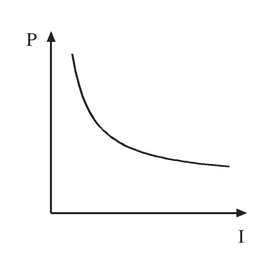
C. 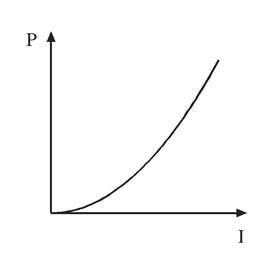
D. 
Confirming your payment
Sign up now and get 250 free tokens.
Previous Year Questions · Question 13 of 19
An electric current (I) flowing through a metallic wire is gradually increased. The graph of heating power (P) developed in it versus the current (I) is:
A.
B.
C.
D.
(A) Graph A
(B) Graph B
(C) Graph C
(D) Graph D
Answer: (C) Graph C
Key idea: By Joule's law, the heating power in a resistor is . For a fixed resistance, is proportional to the square of the current.
Step 1 — Find the shape of the graph.
With fixed, Joule's law has the form , with in place of and in place of . This is a parabola that starts at the origin (no current, no heat) and gets steeper as grows: doubling makes four times as large.
Step 2 — Match it with the graphs.
Graph C starts at the origin and curves upwards more and more steeply, which is exactly this parabola.
Note: In a real wire the resistance also rises a little as it heats up, which makes rise even faster; the curve stays the upward-bending kind shown in graph C.
Why the others are wrong:
Therefore, the correct option is (C): graph C, a parabola from the origin.