Solution:
Key idea: The current in a wire is the charge carried per second by the free electrons drifting through any cross-section.
I=neAvd
The figure shows a wire of length l and cross-section A, with the electrons drifting opposite to the field E.
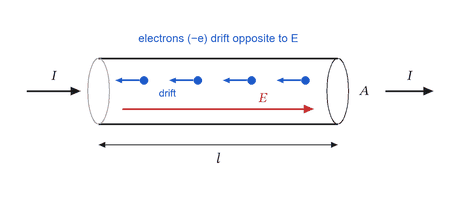
Step 1 — Part (i): identify each term.
Each symbol in the equation stands for one property of the wire or its electrons.
I is the current in the conductor.
n is the number of free electrons per unit volume (the number density).
e is the magnitude of the charge of an electron.
A is the area of cross-section of the conductor.
vd is the drift speed of the free electrons.
Step 2 — Part (ii): find the current from Ohm's law.
The resistance of the wire is given by its resistivity ρ, length l and area A.
R=Aρl
With a potential difference V across its ends, Ohm's law gives the current.
I=ρlVA
Step 3 — Part (ii): equate the two expressions for the current.
The current found from Ohm's law must equal neAvd.
neAvd=ρlVA
Step 4 — Part (ii): solve for the drift speed.
Dividing both sides by neA, the area cancels.
vd=neρlV
Step 5 — Part (ii): write it with the relaxation time.
The free-electron model gives the resistivity in terms of the relaxation time τ and the electron mass m.
ρ=ne2τm
Putting this into the result of Step 4 gives the drift speed in terms of τ.
vd=mleVτ
So the drift speed is proportional to V and inversely proportional to l.
Therefore, vd=neρlV, which is the same as mleVτ.
