
Question 1045 marksMedium
(a) Explain Lorentz-Drude theory of metallic conduction.
(b) Obtain an expression for the drift velocity in terms of relaxation time.
(c) Derive Ohm's law using electron theory.
Confirming your payment
Sign up now and get 250 free tokens.
Electric Current - Ohm's Law · Question 104 of 128
(a) Explain Lorentz-Drude theory of metallic conduction.
(b) Obtain an expression for the drift velocity in terms of relaxation time.
(c) Derive Ohm's law using electron theory.
Solution:
Key idea: The Lorentz–Drude (free-electron) theory treats the free electrons in a metal like the molecules of a gas. Their small average drift in an applied field is the current, and their collisions with the ions cause resistance.
Step 1 — Part (a): describe the structure of a metal.
A metal contains a lattice of fixed positive ions and a large number of free electrons that move about inside it, like the molecules of a gas (an "electron gas").
Step 2 — Part (a): describe the motion with no field.
The free electrons move at random with large thermal speeds (about in this classical model) and keep colliding with the ions. The average time between two collisions is the relaxation time , and the average distance is the mean free path.
With no field the random velocities average to zero, so there is no current.
Step 3 — Part (a): describe the motion in a field.
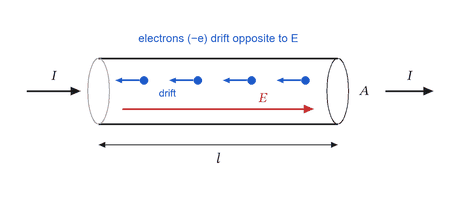
When a field is applied, each electron is accelerated opposite to between collisions. It gains a small average drift velocity on top of its random motion, and this drift is the current.
At each collision the electron gives the energy it gained from the field to the ions. This appears as heat and is the origin of resistance.
Step 4 — Part (b): find the acceleration of an electron.
An electron of charge and mass in the field feels a force , so its acceleration is as below.
Step 5 — Part (b): write the velocity of one electron.
The -th electron starts with a random thermal velocity after its last collision. A time later its velocity is as below.
Step 6 — Part (b): average over all electrons.
The random thermal velocities average to zero, and the average of the times is the relaxation time . So the drift velocity is the acceleration times .
Its magnitude is , directed opposite to the field.
Step 7 — Part (c): write the current in terms of the drift speed.
Take a conductor of length and area with a potential difference across it, so the field inside is . The charge crossing a section per second is that held in a length of the wire.
Step 8 — Part (c): substitute the drift speed.
Putting and into the current gives the relation below.
Step 9 — Part (c): find the ratio .
Dividing by this current gives the ratio below.
For a given conductor at a given temperature, , , , , and are all constant, so is a constant. This constant is the resistance , and is Ohm's law.
Step 10 — Part (c): identify the resistivity.
Comparing with gives the resistivity in terms of the electron properties.
Therefore, the drift velocity is , and since is constant, Ohm's law follows, with .