
Question 1035 marksMedium
(a) Explain the dependence of resistance on temperature.
(b) Draw a graph to show the variation of resistance of a thermistor with temperature.
(c) Define temperature coefficient of resistance.
Confirming your payment
Sign up now and get 250 free tokens.
Electric Current - Ohm's Law · Question 103 of 128
(a) Explain the dependence of resistance on temperature.
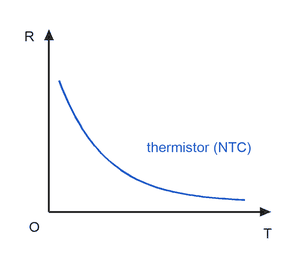
(b) Draw a graph to show the variation of resistance of a thermistor with temperature.
(c) Define temperature coefficient of resistance.
Solution:
Key idea: The resistivity of a material depends on the number of charge carriers per unit volume and on the relaxation time . Heating changes one or both of these.
Step 1 — Part (a): explain the change for metals.
In a metal, is practically fixed. As the temperature rises the ions vibrate more, the electrons collide more often and decreases, so the resistance increases.
Over ordinary ranges the rise is nearly linear, with a positive temperature coefficient .
Step 2 — Part (a): explain the change for semiconductors.
In semiconductors such as silicon, germanium and carbon, heating frees many more charge carriers. The rise in outweighs the fall in , so the resistance decreases and is negative.
Step 3 — Part (a): explain the change for alloys.
For alloys such as manganin and constantan the resistance changes very little with temperature, so is nearly zero. This is why they are used for standard resistors.
The graph below shows the three kinds of behaviour.

Step 4 — Part (b): draw the graph for a thermistor.
A thermistor of the usual negative temperature coefficient (NTC) type is a semiconductor resistor. Its resistance falls steeply, roughly exponentially, as the temperature rises, as the graph shows.
Step 5 — Part (c): define the temperature coefficient of resistance.
Rearranging gives in terms of measured resistances.
It is the increase in resistance per unit resistance (at ) per degree Celsius rise in temperature. Its unit is (or ).
Therefore, a metal's resistance rises with temperature, a semiconductor's falls and an alloy's hardly changes; an NTC thermistor's resistance falls steeply on heating; and .