Solution:
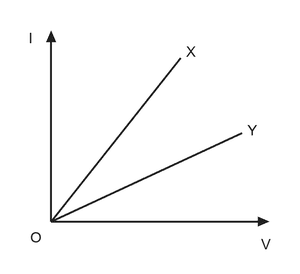
Key idea: On a graph with I on the vertical axis and V on the horizontal axis, the slope I/V of each line is 1/R. A less steep line means a larger resistance.
Step 1 — Compare the slopes.
The line for Y is less steep than the line for X, so Y has the larger resistance.
Step 2 — Relate resistance to resistivity.
From R=ρl/A, with the same length l and the same diameter (same A), the resistance is proportional to the resistivity.
Step 3 — Conclude.
The wire with the larger resistance has the larger resistivity, so Y has the larger resistivity.
Therefore, wire Y has the larger resistivity, because its I–V line has the smaller slope (larger R) and the wires have the same length and area.