
Opening your dashboard
Class 12 Physics Chapter 5 Electric Current - Ohm's Law: Practice Questions
153 questions on Chapter 5, each worked through on its own page with the AI tutor. Class 12 Physics, ICSE 2026-27.
153 questions
1–3 marks · Mixed difficulty
- 11 mark
Question 1
A uniform current density exists in the electrolyte of an electrolytic cell. A small flat surface of area is placed in the liquid so that its normal makes an angle of with . The current through the surface is (Hypothetical data.)
- 21 mark
Question 2
A beam of alpha particles (each of charge ) in an accelerator constitutes a steady current of . The number of alpha particles crossing any cross-section of the beam per second is () (Hypothetical data.)
- 32 marks
Question 3
A mobile phone battery is rated . (Hypothetical data.)
(i) Find the total charge, in coulomb, that the battery can deliver when fully charged.
(ii) For how many hours can it supply an average current of ?
- 41 mark
Question 4
In a horizontal metal wire carrying a steady current, the free electrons drift towards the north. The directions of the current density and of the electric field inside the wire are
- 52 marks
Question 5
For safety, an electrician follows the rule that the current density in the copper conductor of a house circuit must not exceed . (Hypothetical data.)
(i) Find the least diameter of copper conductor for a circuit that must carry .
(ii) If a conductor of cross-section is used for this circuit, find the current density in it in .
- 61 mark
Question 6
The dimensional formula of the mobility of a charge carrier is
- 73 marks
Question 7
An aluminium wire of cross-sectional area carries a current of . The drift speed of its free electrons is found to be . (Hypothetical data.) The density of aluminium is and its atomic mass is . Take and Avogadro number .
(i) Find the number density of free electrons in the wire.
(ii) Find the number of aluminium atoms per cubic metre.
(iii) Hence find how many free electrons each aluminium atom contributes.
- 81 mark
Question 8
For two metal samples and , graphs of the drift speed of the free electrons against the applied electric field are straight lines through the origin, with slopes for and for . The ratio of the relaxation times of the electrons in and is (Hypothetical data.)
- 93 marks
Question 9
The mobility of free electrons in a metal is . (Hypothetical data.) Take and .
(i) Find the relaxation time of the electrons.
(ii) Find their drift speed when the electric field in the metal is .
(iii) Estimate the average number of collisions an electron makes in one second.
- 101 mark
Question 10
A potential difference of is applied across a uniform metal wire of length . The mobility of the free electrons in the metal is . The drift speed of the electrons is (Hypothetical data.)
- 112 marks
Question 11
A copper wire and an aluminium wire of the same cross-sectional area are joined end to end and carry the same steady current. The free-electron densities are in copper and in aluminium.
(i) In which wire do the electrons drift faster? Find the ratio of the drift speeds.
(ii) Compare the current densities in the two wires.
- 122 marks
Question 12
In a pure metal the relaxation time of the free electrons is . A small amount of impurity is added; the number density of free electrons does not change, but the relaxation time falls to . (Hypothetical data.)
(i) By what percentage does the resistivity change?
(ii) By what percentage does the conductivity change?
- 131 mark
Question 13
Which one of the following is not a unit of electrical resistance?
- 143 marks
Question 14
In an experiment to verify Ohm's law for a resistance wire, a student records the readings below. (Hypothetical data.)
(V) 0.40 0.80 1.20 1.60 2.00 (A) 0.10 0.20 0.34 0.40 0.50 (i) One reading does not fit Ohm's law. Identify it, giving a reason.
(ii) Find the resistance of the wire.
(iii) What current should the student have recorded at , and what current is expected at if the temperature stays the same?
- 152 marks
Question 15
When the potential difference across a metallic conductor is increased by , the current through it rises from to . The temperature remains constant. (Hypothetical data.)
(i) Find the resistance of the conductor.
(ii) Find the potential difference that was applied at first.
- 161 mark
Question 16
A uniform wire of length has a resistance of and carries a current of . The potential difference between two points on the wire apart is (Hypothetical data.)
- 172 marks
Question 17
Two students plot the same Ohm's-law readings for a resistor. Student X plots current (on the -axis) against potential difference and finds a straight line through the origin of slope . Student Y plots (on the -axis) against . (Hypothetical data.)
(i) What is the slope of Y's graph? What physical quantity does it give?
(ii) What physical quantity does the slope of X's graph give? State its value with its SI unit.
- 183 marks
Question 18
A copper wire is long and has a cross-sectional area of . It contains free electrons per , and their relaxation time is . (Hypothetical data.) Take and .
(i) Use the free-electron model to find the resistance of the wire.
(ii) Find the potential difference needed to send a current of through it.
- 191 mark
Question 19
A metal has free electrons per , and their relaxation time is . Its electrical conductivity is close to (, ) (Hypothetical data.)
- 202 marks
Question 20
A copper conductor of cross-sectional area in a house circuit carries a current of . The resistivity of copper is . (Hypothetical data.)
(i) Find the electric field inside the conductor.
(ii) Hence find the potential drop along of this conductor.
- 213 marks
Question 21
A student measures the resistance of different lengths of a uniform wire of diameter . (Hypothetical data.)
(m) 0.50 1.00 1.50 2.00 () 1.99 3.98 5.97 7.96 (i) Describe the graph of against and find its slope.
(ii) Use the slope to find the resistivity of the material.
(iii) Find its conductivity.
- 221 mark
Question 22
A copper wire and an iron wire of the same cross-sectional area are joined end to end and carry a steady current. The resistivities are for copper and for iron. The ratio of the electric field in the iron wire to that in the copper wire is
- 233 marks
Question 23
A thin-film resistor is a rectangular metal film deposited on a ceramic base. The film is long, wide and thick, and its resistivity is . (Hypothetical data.)
(i) Find its resistance when the current flows along its length.
(ii) Find the resistance of the same film if the current were to flow through its thickness, from one large face to the other.
(iii) Explain why the two values differ so greatly although the material is the same.
- 243 marks
Question 24
A heating element of resistance is to be made from wire of diameter . Two materials are considered: nichrome () and copper ().
(i) Find the length of nichrome wire needed.
(ii) Find the length of copper wire needed.
(iii) Use your answers to explain why nichrome is chosen for heating elements.
- 253 marks
Question 25
A student records the current through a small two-terminal device X at room temperature.
Applied p.d. Current (a) Find the ratio for each of the three positive values of p.d.
(b) Find when the p.d. is reversed ().
(c) Does X obey Ohm's law? Give two reasons from the data, and name the kind of device X behaves like.
(Hypothetical data.)
- 261 mark
Question 26
A torch-bulb filament carries when the p.d. across it is , and when the p.d. is . Which statement is correct? (Hypothetical data.)
- 273 marks
Question 27
Two platinum plates dip in dilute sulphuric acid, forming an electrolytic cell. Almost no current flows until the p.d. across the plates exceeds about . Above that, a current of flows at and at .
(a) Find at and at . Is Ohm's law obeyed?
(b) Above the cell behaves as , where is a back e.m.f. Find and .
(c) Why does the – graph of this electrolytic cell not pass through the origin?
(Hypothetical data.)
- 283 marks
Question 28
A copper wire has a resistance of at . Its temperature coefficient of resistance (referred to ) is . A p.d. of is kept across it for a long time, and the wire warms up to .
(a) Find the resistance of the wire at .
(b) Find the steady current, and compare it with the current predicted from the resistance at .
(c) Does this show that Ohm's law is wrong? Explain.
(Hypothetical data.)
- 291 mark
Question 29
In which case will doubling the p.d. not double the current, even approximately?
- 301 mark
Question 30
A platinum resistance thermometer has a resistance of at . Platinum's temperature coefficient of resistance is . When the thermometer is put in a hot liquid its resistance is . The temperature of the liquid is
- 313 marks
Question 31
At an aluminium wire has a resistance of and an iron wire has a resistance of . The temperature coefficients of resistance are for aluminium and for iron.
(a) At what temperature will the two wires have equal resistance?
(b) What is that common resistance?
(c) Which wire has the larger resistance at ?
(Hypothetical data.)
- 321 mark
Question 32
A metal wire has a temperature coefficient of resistance (referred to ). If the relation were valid at all temperatures, the resistance of the wire would become zero at
- 333 marks
Question 33
The resistance of a coil of wire is measured at two temperatures.
Temperature Resistance Assuming the resistance varies linearly with temperature, find
(a) the resistance of the coil at ,
(b) the temperature coefficient of resistance of the wire (referred to ),
(c) the resistance at .
(Hypothetical data.)
- 341 mark
Question 34
When a metal wire is heated, its resistivity increases by . The number of free electrons per unit volume does not change. The relaxation time of the free electrons becomes (Hypothetical data.)
- 353 marks
Question 35
In a simple fire-alarm sensor, a thermistor is connected directly across a supply of negligible internal resistance; the current detector that triggers the alarm is in series with it and has negligible resistance. The thermistor's resistance is at and at .
(a) Find the current at each temperature.
(b) The alarm sounds when the current reaches . Find the resistance of the thermistor at that moment.
(c) Why is a thermistor used here rather than a copper wire?
(Hypothetical data.)
- 363 marks
Question 36
The temperature coefficient of resistance of a metal, referred to , is .
(a) Show that the coefficient referred to , defined by , is .
(b) Find for this metal.
(c) Check your answer by finding both ways.
- 371 mark
Question 37
A geyser is used for minutes every day. Electrical energy costs Rs per unit. The cost of running it for days is (Hypothetical data.)
- 383 marks
Question 38
An electric kettle connected to a supply heats of water from to in minutes. Assume all the electrical energy goes into the water (specific heat capacity of water ). Find
(a) the power of the kettle,
(b) the current it draws,
(c) the resistance of its heating element.
(Hypothetical data.)
- 391 mark
Question 39
The current through a fixed resistor is increased by . The power dissipated in it increases by
- 403 marks
Question 40
A mobile-phone charger delivers a steady current of at for hours. Find
(a) the charge that flows,
(b) the number of electrons that pass (),
(c) the energy supplied, in joule and in kWh.
(Hypothetical data.)
- 411 mark
Question 41
A water pump is driven by a electric motor working on a supply. Assuming the motor converts all the electrical power it draws into mechanical power (), the current it draws is
- 423 marks
Question 42
A small generating station sends of power to a village through cables of total resistance .
(a) Find the current in the cables and the power wasted as heat in them if the power is sent at .
(b) Repeat for transmission at .
(c) What do you conclude?
(Hypothetical data.)
- 432 marks
Question 43
An electric iron is rated , . It is used at its rated voltage for minutes. Find
(a) the charge that flows through it,
(b) the energy it consumes, in kWh and in joule.
(Hypothetical data.)
- 442 marks
Question 44
A family's electricity bill for days is Rs at Rs per unit. All of this energy was used by an air conditioner that ran for hours every day. Find the power rating of the air conditioner. (Hypothetical data.)
- 451 mark
Question 45
A carbon resistor has the bands yellow, violet, black and gold, read from the left. Its value is
- 463 marks
Question 46
A circuit needs a carbon resistor of tolerance.
(a) Write the colours of its four bands, in order.
(b) Find the lowest and highest resistance such a resistor may have.
(c) A resistor with these bands measures . Is it within its tolerance?
(Hypothetical data.)
- 471 mark
Question 47
A carbon resistor has the bands red, red, brown, gold. It carries a current of . The power dissipated in it is
- 482 marks
Question 48
Gold and silver can also be used as the third (multiplier) band of a carbon resistor. Find the value and tolerance of the resistors with these bands, read from the left:
(a) yellow, violet, gold, gold
(b) brown, black, silver, silver
- 492 marks
Question 49
A resistor taken from an old kit has only three bands: grey, red, black. A student measures its resistance as and says it is faulty because it should be within of its marked value. Is the student right? Explain with calculation. (Hypothetical data.)
- 501 mark
Question 50
What is the charge on a wire, when a current flows through the wire?
- 511 mark
Question 51
A metal contains a large number of free electrons and they are in motion. Then why is there no current in a piece of wire which is not connected to a cell?
- 521 mark
Question 52
Why manganin is preferred for making standard resistance?
- 531 mark
Question 53
In a resistance box there is a resistance marked infinity. What is the length of the wire used for making this infinite resistance?
- 541 mark
Question 54
The electron drift speed is estimated to be only a few for currents in the range of a few A. How then is current established almost the instant, a circuit is closed?
- 551 mark
Question 55
If the electron drift is so small and the electron's charge is small, how can we still obtain large amount of current in a conductor?
- 561 mark
Question 56
When electrons drift in a metal from a lower to a higher potential, does it mean that all the free electrons of the metal are moving in the same direction?
- 571 mark
Question 57
Are the paths of electrons straight lines between successive collisions with the positive ions of the metal in the
(i) absence of electric field,
(ii) presence of electric field?
- 581 mark
Question 58
Name the carriers of electric current in
(a) a bar made of silver.
(b) a hydrogen discharge tube.
(c) a voltaic cell.
(d) a lead accumulator being charged by an external supply.
(e) a germanium semiconductor.
(f) a wire made of the alloy nichrome.
(g) a superconductor.
- 591 mark
Question 59
A steady current flows in a metallic conductor of non-uniform cross-section. Say which of these quantities is constant along the conductor: current, current density or drift speed?
- 601 mark
Question 60
Is Ohm's law universally applicable for all conducting elements? If not, give examples of elements which do not obey Ohm's law.
- 611 mark
Question 61
It is easier to start a car engine on a warm day than on a chilly day. Why?
- 621 mark
Question 62
A high tension supply of say 6 kV must have a very large internal resistance. Why?
- 631 mark
Question 63
What is the dimensional formula for the resistance of a metal?
- 641 mark
Question 64
Give the dimensional formula of specific resistance:
- 651 mark
Question 65
The light from a bathroom bulb gets dimmer for a moment when the geyser is switched on. Why?
- 661 mark
Question 66
Two wires of equal lengths, one of copper and the other of manganin, have the same resistance. Which wire is thicker?
- 673 marks
Question 67
How many electrons pass through a lamp in one minute, if the current is mA? Given, charge on electron C.
- 683 marks
Question 68
Calculate the resistivity of the material of a wire m long, mm in diameter and having a resistance of ohm.
- 693 marks
Question 69
A wire of resistance ohm is drawn out so that its length is increased to twice its original length. Calculate its new resistance.
- 703 marks
Question 70
Find out the resistivity of a conductor in which a current density is found to exist, when an electric field is applied on it.
- 713 marks
Question 71
Calculate the conductance and conductivity of a wire of resistance , area of cross-section and length m.
- 723 marks
Question 72
A charge of C moves at revolutions per second in a circle of diameter m. Find the current linked with the circuit.
- 733 marks
Question 73
An electron beam has an aperture of . The total number of electrons moving through any perpendicular cross-section per second is . Calculate the current density on the beam.
- 743 marks
Question 74
The external diameter of a m long hollow tube is m and the thickness of the wall is m. Determine its resistance. Given, resistivity of copper m.
- 753 marks
Question 75
A carbon resistor is marked in coloured bands in the sequence blue, green, orange and gold. What is the resistance and tolerance value of the resistor?
- 763 marks
Question 76
A voltage of V is applied across a colour coded carbon resistor with first, second and third rings of blue, black and yellow colours. What is the current flowing through the resistor?
- 773 marks
Question 77
Voltmeters and are connected in series across a DC line. reads V and has a per volt resistance of . has a total resistance of k. What is the line voltage?
- 783 marks
Question 78
A cylindrical copper rod has a resistance of . The rod is reformed to twice its original length without any change in volume. Find the resistance of the newly formed cylinder.
- 792 marks
Question 79
If the p.d. applied across a variable resistor is constant, draw a graph between the current and the resistance.
- 801 mark
Question 80
What would be the resistance of a resistor that is colour coded red, red, orange?
- 811 mark
Question 81
What would be the resistance of resistor colour coded brown-red-orange?
- 821 mark
Question 82
State the physical condition in which Ohm's law is not valid for a conductor.
- 832 marks
Question 83
A given length of a conductor of rectangular cross-section has a resistance . If every linear dimension (length, breadth and height) are halved, what would be the new resistance?
- 842 marks
Question 84
A p.d. of volt is applied across a copper wire of length and diameter . How will the drift velocity be affected if (i) is doubled and (ii) is doubled?
- 852 marks
Question 85
Calculate the electric current density in a uniform wire connected to a battery of emf V and negligible internal resistance. The resistance of the wire is and its area of cross section is .
- 861 mark
Question 86
A wire of resistivity is stretched uniformly so that its length becomes four times. What is its new resistivity?
- 872 marks
Question 87
Two wires and of equal mass and the same material are taken. The diameter of the wire is half the diameter of wire . If the resistance of wire is , calculate the resistance of the wire .
- 882 marks
Question 88
Ohm's law may also be stated as . What do the symbols , and stand for? Show that the combination of the units on the two sides are identical.
- 891 mark
Question 89
What is current density? Write the vector equation connecting the current density with electric field intensity for an ohmic conductor.
- 901 mark
Question 90
Name one material whose resistivity decreases with temperature.
- 911 mark
Question 91
The electric resistance of a certain wire of iron is . If its length and radius are both doubled, then
- 921 mark
Question 92
Across a metallic conductor of non-uniform cross-section a constant potential difference is applied. The quantity which remains constant along the conductor is
- 931 mark
Question 93
When a wire of uniform cross-section , length and resistance is bent into a complete circle, resistance between any two of diametrically opposite point will be
- 941 mark
Question 94
The resistance of a wire is ohm. If it is melted and stretched to times it original length, its new resistance will be
- 951 mark
Question 95
Which of the following relation is called as current density?
- 961 mark
Question 96
In a neon discharge tube electron move to the left per second, electron charge is . The current in the discharge tube is
- 971 mark
Question 97
An electric bulb marked and , is used in a circuit of supply voltage . Now its power is
- 981 mark
Question 98
Given a current carrying wire of non-uniform cross-section, which of the following is constant throughout the length of the wire?
- 991 mark
Question 99
A wire of length is drawn such that its diameter is reduced to half of its original diameter. If the initial resistance of the wire were , its new resistance would be
- 1001 mark
Question 100
If the length and area of cross-section of a conductor are doubled, then it resistance will be
- 1011 mark
Question 101
Specific resistance of a conductor increases with
- 1021 mark
Question 102
Ohm's law is not obeyed by
- 1031 mark
Question 103
Which of the following has negative temperature coefficient of resistance?
- 1041 mark
Question 104
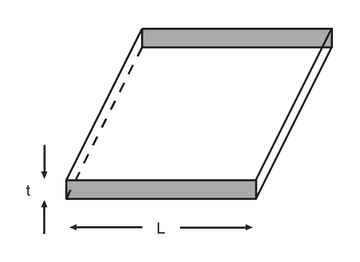
Consider a thin square sheet of side and thickness , made of a material of resistivity . The resistance between two opposite faces, shown by the shaded areas in the given figure is
- 1051 mark
Question 105
A straight conductor of uniform cross-section carries a current . Let be the specific charge of an electron. The momentum of all the free electron per unit length of the conductor due to their drift velocity only, is
- 1061 mark
Question 106
A resistor has a certain colour code. If one replaces the red colour by green in the code, the new resistance will be
- 1071 mark
Question 107
A copper wire is stretched to make it longer. The percentage change in its electrical resistance if its volume remains unchanged is
- 1081 mark
Question 108
Drift speed of electrons, when of current flows in a copper wire of cross section , is . If the electron density in copper is . The value of in mm/s is close to (take charge of electron to be )
- 1091 mark
Question 109
A carbon resistor is colour coded with green, black, red and brown respectively. The maximum current which can be passed through the resistor is
- 1101 mark
Question 110
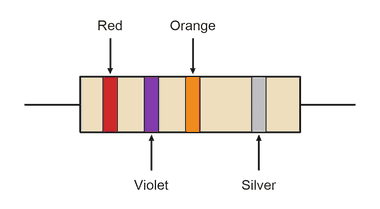
A resistance is shown in the figure. Its value and tolerance are given respectively by
- 1111 mark
Question 111
In a conductor, if the number of conduction electrons per unit volume is and mean free time is (femto second), its approximate resistivity is ()
- 1121 mark
Question 112
A current of passes through a copper conductor (resistivity ) of radius of cross-section . Find the mobility of the charges if their drift velocity is .
- 1131 mark
Question 113
Consider four conducting materials copper, tungsten, mercury and aluminium with resistivity , , and respectively. Then
- 1141 mark
Question 114
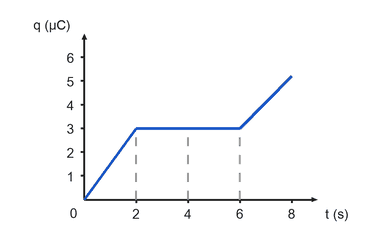
The charge on a capacitor plate in a circuit, as a function of time, is shown in the given figure. What is the value of current at ?
- 1151 mark
Question 115
When the current is flowing through a conductor, the drift velocity is . If current is flowed through the same metal but having double the area of cross-section, then the drift velocity will be
- 1161 mark
Question 116
Pick out the wrong feature about carbon resistors.
- 1171 mark
Question 117
Ohm's law is valid if
- 1181 mark
Question 118
The current flowing through a wire depends on time as . The charge flowing through the cross-section of the wire in time from to is
- 1191 mark
Question 119
When potential difference is applied across a wire of length , the drift speed of electron is . If the electron density in the wire is , the resistivity of the material is close to
- 1201 mark
Question 120
A material 'B' has twice the specific resistance of 'A'. A circular wire made of 'B' has twice the diameter of a wire made of 'A'. Then for the two wires to have the same resistance, the ratio of their respective lengths must be
- 1211 mark
Question 121
Which of the following is vector quantity?
- 1221 mark
Question 122
By increasing the temperature, the specific resistance of a conductor and a semiconductor
- 1231 mark
Question 123
Which of the following statements is correct?
- 1241 mark
Question 124
An electric cell of e.m.f is connected across a copper wire of diameter and length . The drift velocity of electrons in the wire is . If the length of the wire is changed to , the new drift velocity of electrons in the copper wire will be
- 1251 mark
Question 125
In a conductor if Coulomb of charge enters and Coulomb of charge exits in time minutes, then the current is
- 1261 mark
Question 126
electrons per second are flowing through a wire of area of cross-section , the value of current flowing will be
- 1271 mark
Question 127
When a piece of aluminium wire of finite length is drawn through a series of dies to reduce its diameter to half its original value, its resistance will become
- 1281 mark
Question 128
The carbon resistor has orange bands. The maximum value of resistance offered by the resistor will be
- 1291 mark
Question 129
A wire of length and radius has a resistance of . What length of the wire of the same material at the same temperature and of radius will also have a resistance of .
- 1301 mark
Question 130
On increasing the temperature of a conductor, its resistance increases because the
- 1311 mark
Question 131
A wire is bent in the form of circle of radius . Resistance per unit length of wire is . Battery of is connected between A and B. . Find the current through the battery.

- 1321 mark
Question 132
If a wire is stretched to make it longer, its resistance will
- 1331 mark
Question 133
Two identical conductors maintained at same temperatures are given potential differences in the ratio . Then the ratio of their drift velocities is
- 1341 mark
Question 134
Find the True statement.
- 1351 mark
Question 135
The graph between resistivity and temperature, for a limited range of temperatures, is a straight line for a material like
- 1361 mark
Question 136
If the resistance of a conductor is at and at then the mean temperature coefficient of resistance of the material is
- 1371 mark
Question 137
Masses of three wires of copper are in the ratio of and their lengths are in the ratio of . The ratio of their electrical resistance are
- 1381 mark
Question 138
A carbon resistor is to be marked with rings of different colours for its identification. The colour code sequence will be
- 1391 mark
Question 139
A copper wire is stretched to make it longer. The percentage change in its electrical resistance if its volume remains unchanged is
- 1401 mark
Question 140
Drift speed of electrons, when of current flows in a copper wire of cross-section , is . If the electron density in copper is . The value of in mm/s is close to (take charge of electron to be )
- 1411 mark
Question 141
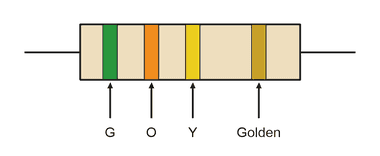
A carbon resistance has a following colour code. What is the value of the resistance?
- 1421 mark
Question 142
A uniform metallic wire has a resistance of is bent into an equilateral triangle. Then, the resistance between any two vertices of the triangle is
- 1431 mark
Question 143
A resistor has a certain color code. If one replaces the red color by green in the code, the new resistance will be
- 1441 mark
Question 144
The resistance of a conductor at is and at is . What will be the temperature coefficient of resistance of the conductor?
- 1451 mark
Question 145
If , , and respectively represent the mass, charge, average relaxation time and density of the electron, then what will be the resistance of a wire of length and area of cross-section ?
- 1461 mark
Question 146
The solids which have the negative temperature coefficient of resistance are
- 1471 mark
Question 147
A charged particle having drift velocity of in an electric field of , has a mobility in of
- 1481 mark
Question 148
A current through a wire depends on time as where and . Find the charge crossed through a section of the wire in .
- 1491 mark
Question 149
A current of exists in a wire of cross-sectional area of with a drift velocity of . The number of free electrons in each cubic metre of the wire is
- 1501 mark
Question 150
A conducting wire of length '', area of cross-section and electric resistivity is connected between the terminals of a battery. A potential difference is developed between its end, causing an electric current. If the length of the wire of the same material is doubled and the area of cross-section is halved, the resultant current would be
- 1511 mark
Question 151
In the given figure, a battery of emf is connected across a conductor PQ of length '' and different area of cross-sections having radii and . Choose the correct option as one moves from P to Q.

- 1521 mark
Question 152
Column-I gives certain physical terms associated with flow of current through a metallic conductor. Column-II gives some mathematical relations involving electrical quantities. Match Column-I and Column-II with appropriate relations.
Column-I Column-II (1) Drift Velocity (P) (2) Electrical resistivity (Q) (3) Relaxation period (R) (4) Current density (S) - 1531 mark
Question 153
The drift velocity of a current carrying conductor is . What will be the drift velocity if the current flowing through the wire is doubled?