
Opening your dashboard
Class 12 Physics Chapter 25: X-Rays Solutions
50 textbook questions with step-by-step answers, free to read, for ISC 2026-27.
Get talked through Ch 25, not just shown the answer
Reading a finished solution is not the same as being able to do it. The AI tutor takes one question at a time and works it with you, in your own words, until you can.
- Ask it out loud, in your own words
- It gives you the next step, not the answer
- Stuck on part (ii)? Start there
50 questions with solutions
1–5 marks · Mixed difficulty
The first 42 solutions are on this page. This chapter is a long one, so the rest open on their own page to keep this one quick to load.
- 11 mark
Question 1
X-rays were discovered by
Solve with AIAnswer
(A) Becquerel
- Correct
(B) Roentgen
(C) Marie Curie
(D) Von Laue
Answer: (B) Roentgen
Concept: X-rays were discovered in 1895 by the German physicist Wilhelm Conrad Roentgen while he was studying electric discharge through gases at very low pressure.
Step 1 — Recall the discovery. Roentgen saw that a fluorescent screen coated with barium platinocyanide glowed even when the discharge tube was covered with black paper. He concluded that an unknown, penetrating radiation came from the tube and named it X-rays. He received the first Nobel Prize in Physics in 1901 for this discovery.
Step 2 — Check the other options. Each of the other scientists is known for a different discovery:
- (A) Becquerel discovered radioactivity in uranium salts in 1896, a year after X-rays were found.
- (C) Marie Curie studied radioactivity and discovered polonium and radium in 1898; she did not discover X-rays.
- (D) Von Laue showed in 1912 that crystals diffract X-rays, which proved that X-rays are waves; by then X-rays had been known for 17 years.
Therefore, the answer is (B).
- 21 mark
Question 2
In radio therapy, X-rays are used to
Solve with AIAnswer
(A) detect bone fractures
- Correct
(B) treat cancer by controlled exposure
(C) detect heart diseases
(D) detect fault in radio receiving circuits
Answer: (B) Treat cancer by controlled exposure
Concept: Radiotherapy means treatment of disease with radiation. X-rays ionise the atoms they pass through and damage the DNA of living cells; cancer cells divide quickly and repair this damage less well than healthy cells.
Step 1 — Describe the use. In radiotherapy a carefully measured (controlled) dose of high-energy X-rays is aimed at a tumour, often from several directions, so that the cancer cells receive a large dose while the healthy tissue around them receives as little as possible.
Step 2 — Check the other options. The other options are not therapy:
- (A) Detecting bone fractures is X-ray imaging (radiography), a way of diagnosing, not of treating.
- (C) Chest X-rays and angiograms do help doctors to diagnose heart disease, but that is again diagnosis, not radiotherapy.
- (D) Checking circuits has nothing to do with treating patients; X-ray inspection of circuit boards in factories is an industrial imaging use, not radiotherapy.
Therefore, the answer is (B).
- 31 mark
Question 3
X-rays are
Solve with AIAnswer
(A) stream of electrons
(B) stream of positively charged particles
- Correct
(C) electromagnetic radiation of high frequency
(D) stream of uncharged particles
Answer: (C) Electromagnetic radiation of high frequency
Concept: X-rays are electromagnetic waves of very short wavelength, about to , and therefore of very high frequency.
Step 1 — Use the evidence about charge. X-rays are not deflected by electric or magnetic fields, so they carry no charge.
Step 2 — Use the evidence about waves. X-rays are diffracted by crystals and show interference and polarisation, which are properties of transverse electromagnetic waves.
Step 3 — Check the other options. Each of the other options fails one of these tests:
- (A) A stream of electrons is cathode rays; electrons are deflected by electric and magnetic fields, while X-rays are not.
- (B) A stream of positively charged particles, such as alpha particles, would also be deflected by electric and magnetic fields.
- (D) X-rays do carry no charge, and their energy does come in packets (photons); but photons are quanta of electromagnetic radiation, not material particles, so option (C) is the correct description of their nature.
Therefore, the answer is (C).
- 41 mark
Question 4
In vacuum, an electron of energy 10 keV hits tungsten target, then emitted radiation will be
Solve with AIAnswer
(A) cathode rays
- Correct
(B) X-rays
(C) infrared rays
(D) visible spectrum
Answer: (B) X-rays
Concept: When fast electrons are suddenly stopped by a target, part of their kinetic energy is given out as X-rays. The shortest wavelength produced is , where in volts is the potential difference that gives the electrons their energy.
Step 1 — Find the shortest wavelength. An electron of energy has the energy gained by falling through , so:
Step 2 — Identify the radiation. Wavelengths from upwards lie in the X-ray range (about to ), so the radiation produced by stopping these electrons is X-rays.
Step 3 — Check the other options. The other options do not fit:
- (A) Cathode rays are the fast electrons themselves; they cause the radiation, they are not the radiation emitted.
- (C) Most of the electrons' energy turns into heat, so the target does get hot and gives out some heat radiation; but the radiation produced by stopping electrons, which the question asks about, is X-radiation.
- (D) A photon of visible light carries only about to ; is several thousand times as much.
Therefore, the answer is (B).
- 51 mark
Question 5
According to Moseley’s law of X-rays, the frequency of a particular characteristic X-ray and atomic number of the element depend on each other as
Solve with AIAnswer
(A)
(B)
(C)
- Correct
(D)
Answer: (D) , the square root of the frequency proportional to
Concept: Moseley's law states that the square root of the frequency of a characteristic X-ray line is proportional to the atomic number of the element, more exactly , where and are constants for that line (for lines, ).
Step 1 — Compare with the options. When is small compared with , the law becomes , which is option (D). Squaring it shows that the frequency grows as about .
Step 2 — Check the other options. The other relations disagree with the measured frequencies:
- (A) would make grow as , far faster than Moseley found.
- (B) This would make the frequency fall as rises, but heavier elements give lines of higher frequency (harder X-rays).
- (C) This makes the frequency itself proportional to ; it is , not , that is proportional to .
Therefore, the answer is (D).
- 61 mark
Question 6
In X-ray experiment, , denote
Solve with AIAnswer
- Correct
(A) characteristics
(B) continuous wavelength
(C) , -emissions respectively
(D) none of these
Answer: (A) Characteristics (characteristic X-ray lines)
Concept: Characteristic X-ray lines are named by a capital letter for the shell in which a vacancy is filled (K, L, M, …) and a Greek letter for the shell from which the electron comes ( from the next shell out, from the one after that).
Step 1 — Name the two lines. is emitted when an electron falls from the L shell into a vacancy in the K shell, and when it falls from the M shell into the K shell.
Step 2 — Say which spectrum they belong to. These lines have definite wavelengths that depend on the target element, so they belong to the characteristic (line) spectrum.
Step 3 — Check the other options. The other options misread the symbols:
- (B) The continuous spectrum contains all wavelengths above ; it has no separate named lines such as and .
- (C) Alpha and beta emissions are radioactive decays of nuclei; here and are only labels for electron jumps in the inner shells.
- (D) Since option (A) is correct, “none of these” is wrong.
Therefore, the answer is (A).
- 71 mark
Question 7
For the production of characteristic X-ray, the electron transition is
Solve with AIAnswer
(A) to
(B) to
(C) to
- Correct
(D) to
Answer: (D) A jump from the fourth shell (N) to the first shell (K)
Concept: K-series lines are emitted when an electron falls into a vacancy in the K shell, the first shell. A fall from the L shell (second) gives , from the M shell (third) gives , and from the N shell (fourth) gives .
Step 1 — Find the starting shell for . The third line of the K series, , comes from the third shell above K, which is the N shell, with principal quantum number 4.
Step 2 — Write the transition. The electron goes from the shell with down to the K shell.
Step 3 — Check the other options. The other transitions give other lines:
- (A) A jump from the second shell to the first gives .
- (B) A jump from the third shell to the second ends in the L shell, so it gives an L-series line (), not a K line.
- (C) A jump from the third shell to the first gives .
Therefore, the answer is (D).
- 81 mark
Question 8
The nature of X-ray spectrum is
Solve with AIAnswer
(A) continuous
(B) line
- Correct
(C) continuous and line
(D) none of these
Answer: (C) Continuous and line
Concept: The X-rays from a tube contain a continuous spectrum (bremsstrahlung) of all wavelengths above , with sharp characteristic lines of the target element on top of it when the voltage is high enough.
Step 1 — Describe the two parts. The continuous part comes from the braking of electrons in the target. The line part comes from electron jumps into vacancies in the inner shells of the target atoms.
Step 2 — Check the other options. Each of the other options misses a part:
- (A) “Continuous” alone leaves out the sharp characteristic lines.
- (B) “Line” alone leaves out the continuous background on which the lines sit.
- (D) Since option (C) is correct, “none of these” is wrong.
Therefore, the answer is (C).
- 91 mark
Question 9
If be the accelerating voltage, then the maximum frequency of continuous X-rays is given by
Solve with AIAnswer
(A)
(B)
- Correct
(C)
(D)
Answer: (C)
Concept: An electron accelerated from rest through a potential difference gains kinetic energy . When it is stopped in the target, the most it can give to a single X-ray photon is all of this energy, so the photon of highest frequency (shortest wavelength ) has
Step 1 — Solve for the maximum frequency. We divide both sides of by :
Step 2 — Check the other options. The other expressions do not even have the unit of frequency ():
- (A) The unit of works out to , not , so it is not a frequency.
- (B) The unit of works out to , not , so it is not a frequency either.
- (D) is the reciprocal of the correct expression; it is the time period of the highest-frequency wave, measured in seconds.
Therefore, the answer is (C).
- 101 mark
Question 10
Intensity of X-rays depend upon the number of
Solve with AIAnswer
- Correct
(A) electrons
(B) protons
(C) neutrons
(D) positrons
Answer: (A) Electrons
Concept: The intensity of an X-ray beam is the X-ray energy falling on unit area in unit time; it depends mainly on how many electrons strike the target each second. The quality of X-rays means their penetrating power; it depends on the energy of each photon, that is, on the accelerating voltage.
Step 1 — Link intensity to electrons. Each electron that strikes the target can produce an X-ray photon, so the more electrons that strike the target each second, the more photons are produced and the greater the intensity. The number of electrons is set by the filament temperature, that is, by the filament current.
Step 2 — Check the other options. The other particles are not part of the beam in an X-ray tube:
- (B) No protons are accelerated in an X-ray tube; the heated filament gives out only electrons.
- (C) Neutrons are not produced or used in an X-ray tube.
- (D) Positrons are not present in an X-ray tube; they come from some radioactive decays and from pair production at much higher photon energies.
Therefore, the answer is (A).
- 111 mark
Question 11
X-ray beam can be deflected by
Solve with AIAnswer
(A) magnetic field
(B) electric field
(C) both (A) and (B)
- Correct
(D) none of these
Answer: (D) None of these
Concept: An electric field exerts a force and a magnetic field a force only on a charged particle. X-rays are electromagnetic waves (uncharged photons), so .
Step 1 — Find the force on X-rays. With , both and are zero, so neither field can deflect an X-ray beam.
Step 2 — Check the other options. Each of the other options needs a non-zero charge:
- (A) A magnetic field deflects only moving charges, and X-rays carry no charge.
- (B) An electric field pushes only on charges, so it cannot deflect X-rays either.
- (C) Since neither field alone deflects X-rays, both together cannot.
Therefore, the answer is (D).
- 121 mark
Question 12
For the production of X-rays, the target should be made of
Solve with AIAnswer
(A) steel
(B) copper
(C) aluminium
- Correct
(D) tungsten
Answer: (D) Tungsten
Concept: A good target needs a high atomic number, because heavy nuclei slow the electrons sharply and the efficiency of X-ray production grows with . It also needs a very high melting point, because about 99% of the energy of the electron beam turns into heat in the target.
Step 1 — Test tungsten. Tungsten has atomic number 74 and melts at about , the highest melting point of any metal, so it meets both needs.
Step 2 — Check the other options. Each of the other metals is lighter and melts far lower:
- (A) Steel is mostly iron () and melts at about to , so it would give fewer X-rays and would melt under a strong beam.
- (B) Copper () melts at . It conducts heat very well, so it is used as the body of the anode that carries the heat away (some crystal-diffraction tubes also use a copper target for its line); for producing X-rays in general, a heavy, high-melting metal such as tungsten is far better.
- (C) Aluminium () melts at only and produces X-rays very poorly.
Therefore, the answer is (D).
- 131 mark
Question 13
If the voltage of X-ray tube is doubled, the intensity of X-rays will become
Solve with AIAnswer
(A) half
- Correct
(B) unchanged
(C) double
(D) four times
Answer: (B) Unchanged
Concept: In this chapter the intensity of X-rays is taken to depend on the number of electrons striking the target per second. That number is set by the filament temperature, that is, by the filament current (the tube current), and not by the voltage across the tube.
Step 1 — Note what the voltage changes. Doubling the voltage doubles the energy of each electron, so the X-ray photons have higher frequencies and is halved. This changes the quality (penetrating power) of the X-rays.
Step 2 — Note what the voltage does not change. The filament current is not changed, so the filament gives out the same number of electrons per second, and the same number of electrons strikes the target each second.
Step 3 — Apply the rule for intensity. Since the intensity depends on the number of electrons striking the target per second, and that number is unchanged, the intensity stays the same by this rule.
Step 4 — Check the other options. The other options do not fit the rule:
- (A) Halving would need half as many electrons to strike the target each second, but the filament current, and so the number of electrons, is unchanged.
- (C) Doubling would need twice as many electrons per second, which only a change in the filament current can give.
- (D) Four times would need four times as many electrons per second; a rise of about four times does occur in the total X-ray energy output of a real tube at fixed current, but that is not the intensity as this rule defines it.
Note: in a real tube the total X-ray output at fixed current also rises with voltage, roughly as (Kramers' rule), because each electron brings more energy and also turns a larger share of it into X-rays; this chapter's rule treats intensity as set by the tube current alone.
Therefore, the answer is (B): the intensity stays unchanged.
- 141 mark
Question 14
What are X-rays?
Solve with AIWritten solution
Solution:
Concept: X-rays are part of the electromagnetic spectrum; they lie between ultraviolet rays and gamma rays.
Step 1 — State their nature. X-rays are electromagnetic waves of very short wavelength, about to ( to ), and so of very high frequency (about to ).
Step 2 — State how they arise. They are produced when fast-moving electrons are suddenly stopped by a metal target.
Therefore, X-rays are electromagnetic radiations of very short wavelength (very high frequency), produced when fast electrons strike a target.
- 151 mark
Question 15
How are X-rays produced?
Solve with AIWritten solution
Solution:
Concept: A charged particle that is suddenly slowed down gives out electromagnetic radiation; very fast electrons stopped suddenly give out X-rays.
Step 1 — Accelerate electrons. Electrons emitted by a heated filament are accelerated through a high potential difference (tens of kilovolts) in an evacuated tube.
Step 2 — Stop them suddenly. The fast electrons strike a target of a heavy metal such as tungsten and are suddenly stopped. A small part (about 1%) of their kinetic energy is converted into X-rays; the rest becomes heat.
Therefore, X-rays are produced when fast-moving electrons are suddenly stopped by a target, and part of their kinetic energy is converted into X-rays.
- 161 mark
Question 16
Draw a labelled diagram of Coolidge tube to produce X-rays.
Solve with AIWritten solution
Solution:
Concept: In a Coolidge tube the electrons come from a heated filament (thermionic emission) and are accelerated in a very high vacuum towards a target of a heavy metal.
Step 1 — Draw the tube. The labelled diagram is shown below.
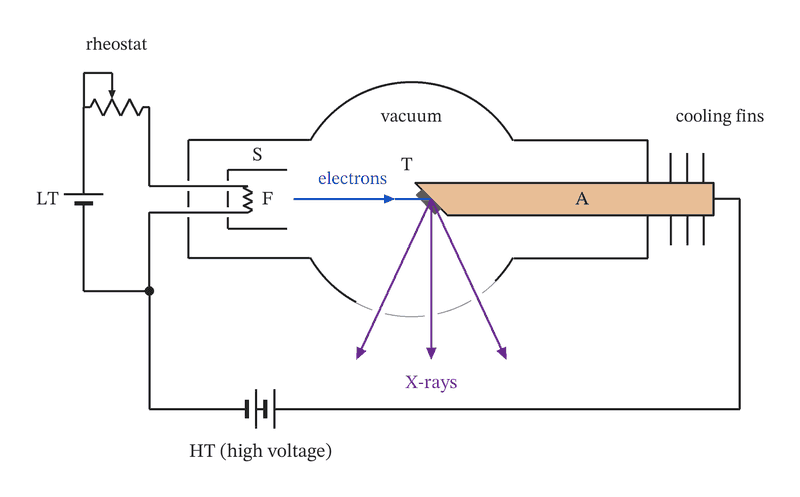
Step 2 — Name the parts. The parts marked in the figure are:
- F is the tungsten filament (cathode), heated by a low-voltage (LT) supply through a rheostat.
- S is the focusing cup, a cylindrical shield that focuses the electrons on the target.
- T is the target of tungsten (or molybdenum), set at to the electron beam on the end of the copper anode A.
- The cooling fins (or circulating water or oil) carry away the heat produced in the anode.
- The high-voltage (HT) supply keeps the anode at a high positive potential with respect to the filament.
- The glass bulb is evacuated to a very low pressure (about of mercury), and the X-rays leave through a thin window.
Therefore, the figure shows a Coolidge tube with its filament F, focusing cup S, tungsten target T on the copper anode A, cooling fins, LT and HT supplies, and the X-rays leaving the tube.
- 171 mark
Question 17
Distinguish between intensity and quality of X-rays.
Solve with AIWritten solution
Solution:
Concept: The intensity of an X-ray beam is the X-ray energy falling on unit area in unit time; it depends mainly on how many electrons strike the target each second. The quality of X-rays means their penetrating power; it depends on the energy of each photon, that is, on the accelerating voltage.
Step 1 — Describe intensity. Intensity tells how much X-radiation there is. It depends on the number of X-ray photons produced each second, hence on the number of electrons striking the target, and it is controlled by the filament current.
Step 2 — Describe quality. Quality tells how penetrating the X-rays are. It depends on the energy (frequency) of each photon, and it is controlled by the potential difference between the anode and the cathode.
Therefore, intensity is the amount of X-radiation (set by the number of electrons, controlled by the filament current), while quality is the penetrating power (set by the photon energy, controlled by the accelerating voltage).
- 181 mark
Question 18
Name two materials used as target in X-ray tube.
Solve with AIWritten solution
Solution:
Concept: A target must have a high atomic number (to produce X-rays efficiently) and a high melting point (to stand the heat produced).
Step 1 — Name the materials. Molybdenum (, melting point about ) and tungsten (, melting point about ) are commonly used.
Step 2 — Give the reason. Both are heavy metals with very high melting points, so they produce X-rays well and do not melt when struck by the intense electron beam.
Therefore, two target materials are (i) molybdenum and (ii) tungsten.
- 191 mark
Question 19
Which series in X-rays are called soft X-rays?
Solve with AIWritten solution
Solution:
Concept: Soft X-rays are X-rays of longer wavelength (lower photon energy) and low penetrating power.
Step 1 — Compare the energies of the series. K-series lines end in the innermost K shell, where the energy differences are largest. L-series lines end in the L shell, where the energy differences are much smaller. For tungsten, for example, has an energy of about () while has about ().
Step 2 — Decide which are soft. The L-series lines have much longer wavelengths and lower energies than the K-series lines of the same element, so they are the soft X-rays (the M-series lines are softer still).
Therefore, the L-series lines are called soft X-rays, while the K-series lines are hard X-rays.
- 201 mark
Question 20
State Moseley’s law.
Solve with AIWritten solution
Solution:
Concept: Moseley measured the frequencies of the characteristic X-ray lines of many elements used as targets.
Step 1 — State the law. The square root of the frequency of a characteristic X-ray line (for example ) emitted by an element is directly proportional to its atomic number (more exactly, to ):
Step 2 — Name the constants. Here and are constants for a given line; is the screening constant ( for lines).
Therefore, Moseley's law states that (more exactly ), so the frequency of a characteristic line varies as the square of the atomic number.
- 211 mark
Question 21
Mention two importance of Moseley’s law.
Solve with AIWritten solution
Solution:
Concept: Moseley's law, , links the X-ray lines of an element to its atomic number, so X-ray lines measure directly.
Step 1 — Give the first importance. It showed that the atomic number, not the atomic weight, decides an element's properties and its place in the periodic table. This put pairs such as argon and potassium, cobalt and nickel, and tellurium and iodine in the right order, although their atomic weights are in the reverse order.
Step 2 — Give the second importance. It showed exactly where elements were missing, at and . These were later found: hafnium (1923), rhenium (1925), technetium (1937) and promethium (1945). It also fixed the number and order of the rare-earth elements.
Therefore, (i) Moseley's law made atomic number the basis of the periodic table, and (ii) it predicted missing elements and fixed their places, such as hafnium and rhenium.
- 221 mark
Question 22
What are hard X-rays?
Solve with AIWritten solution
Solution:
Concept: The photon energy of X-rays is ; higher frequency means higher energy and greater penetrating power.
Step 1 — Describe hard X-rays. Hard X-rays are X-rays of high frequency (short wavelength, roughly below , with photon energies above about ). They have high energy and high penetrating power, and they are produced when the tube is run at a high voltage.
Step 2 — Note the boundary. The boundary between hard and soft X-rays is not sharp.
Therefore, hard X-rays are high-frequency X-rays with high energy and high penetrating power.
- 231 mark
Question 23
What are soft X-rays?
Solve with AIWritten solution
Solution:
Concept: The photon energy of X-rays is ; lower frequency means lower energy and less penetrating power.
Step 1 — Describe soft X-rays. Soft X-rays are X-rays of low frequency (longer wavelength, roughly to , with photon energies below about ). They have low energy and low penetrating power, so they are absorbed easily, even by a few centimetres of air for the softest of them.
Step 2 — Note the boundary. The boundary between soft and hard X-rays is not sharp.
Therefore, soft X-rays are low-frequency X-rays with low energy and low penetrating power.
- 242 marks
Question 24
What is meant by intensity of X-rays? How will you control it?
Solve with AIWritten solution
Solution:
Concept: The intensity of an X-ray beam is the X-ray energy falling on unit area in unit time. It depends mainly on the number of X-ray photons, and so on the number of electrons striking the target each second.
Step 1 — Define intensity. Intensity measures how much X-radiation there is: a more intense beam blackens a photographic film faster, but it is not more penetrating.
Step 2 — Explain the control. The number of electrons given out by the filament each second depends on its temperature. Increasing the filament current (by lowering the resistance of the rheostat in the filament circuit) raises the temperature, more electrons strike the target, and the intensity increases; decreasing the current lowers it.
Therefore, intensity is the X-ray energy per unit area per second, and it is controlled by adjusting the filament current.
- 252 marks
Question 25
What is meant by quality of X-rays? How will you control it?
Solve with AIWritten solution
Solution:
Concept: The quality of X-rays means their penetrating power. It depends on the energy of each photon, which in turn depends on the energy of the electrons striking the target.
Step 1 — Define quality. X-rays of high quality (hard X-rays) have high frequency and pass through thick or dense matter; X-rays of low quality (soft X-rays) are absorbed easily.
Step 2 — Explain the control. Increasing the potential difference between the anode and the cathode makes the electrons faster, so the X-ray photons have higher energy and shorter wavelength () and the X-rays are more penetrating. Decreasing makes them softer.
Therefore, quality is the penetrating power of X-rays, and it is controlled by adjusting the potential difference across the X-ray tube.
- 262 marks
Question 26
“X-rays cannot be deflected in electric or magnetic field”. Why?
Solve with AIWritten solution
Solution:
Concept: An electric field exerts a force and a magnetic field a force only on a charged particle.
Step 1 — State the nature of X-rays. X-rays are electromagnetic waves (a stream of photons); they do not contain any charged particles, so for them .
Step 2 — Find the force. With , both forces are zero, so the fields cannot change the direction of an X-ray beam.
Therefore, X-rays are not deflected because they are electromagnetic waves carrying no charge, so electric and magnetic fields exert no force on them.
- 272 marks
Question 27
Which property of X-ray is used in medicine?
Solve with AIWritten solution
Solution:
Concept: X-rays are highly penetrating, but different materials absorb them by different amounts: substances of higher atomic number and density, such as the calcium in bones, absorb them much more than soft tissue does.
Step 1 — Explain X-ray imaging. X-rays pass easily through flesh but are absorbed strongly by bones, so a film or detector placed behind the body records a shadow picture of the bones and organs. This is used to find fractures, to check teeth and lungs, and in CT scans.
Step 2 — Explain radiotherapy. X-rays also ionise the atoms they pass through; controlled doses of high-energy X-rays are used to destroy cancer cells.
Step 3 — Note the safety need. Because this ionisation can also damage healthy cells, doses are kept as low as possible and lead aprons and screens are used to shield the parts of the body not being examined.
Therefore, the high penetrating power of X-rays (together with their different absorption by bone and flesh) is the property used in medicine.
- 282 marks
Question 28
Draw a diagram showing the variation of intensity of X-rays emitted with wavelength with different accelerating potentials applied to the tube.
Solve with AIWritten solution
Solution:
Concept: The continuous X-ray spectrum starts at a shortest wavelength , about with in volts, so becomes shorter as the accelerating potential is raised.
Step 1 — Draw the graph. The figure shows the intensity of the continuous X-rays against wavelength for 10, 15, 20 and 25 kV (the characteristic lines are not shown).

Step 2 — Read off the cut-off wavelengths. The values of for the four voltages are:
Step 3 — Describe the features. Each curve starts sharply at its own , rises to a maximum and then falls slowly. As the voltage increases, and the peak both move to shorter wavelengths, and the intensity at every wavelength increases.
Therefore, the graphs show that a higher accelerating potential gives a shorter cut-off wavelength , a peak at a shorter wavelength and a greater intensity.
- 292 marks
Question 29
What is the relationship connecting the minimum wavelength of the X-ray emitted and the accelerating potential?
Solve with AIWritten solution
Solution:
Concept: An electron accelerated from rest through a potential difference gains kinetic energy . When it is stopped in the target, the most it can give to a single X-ray photon is all of this energy, so the photon of highest frequency (shortest wavelength ) has
Step 1 — Write the energy in terms of wavelength. We use :
Step 2 — Solve for the minimum wavelength. We rearrange for :
Step 3 — Write the practical form. Putting in the values of , and gives , so with in volts:
Therefore, (about Å): the minimum wavelength is inversely proportional to the accelerating potential.
- 302 marks
Question 30
Draw an energy level diagram to show the formation of -series and -series in characteristic X-ray spectra.
Solve with AIWritten solution
Solution:
Concept: A characteristic X-ray line is emitted when an electron from an outer shell falls into a vacancy in an inner shell, created when a fast electron knocks an inner electron out of a target atom. The photon energy equals the energy difference between the two shells.
Step 1 — Draw the diagram. The energy levels K (), L (), M () and N () are drawn as horizontal lines, and each line of the spectrum as a downward arrow.
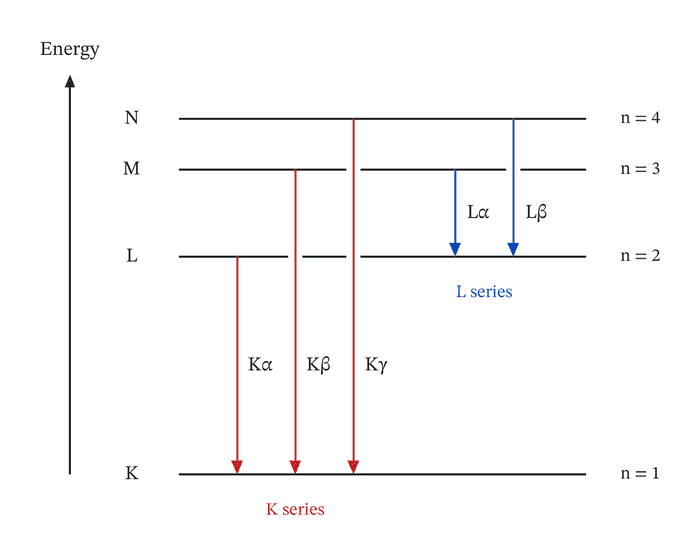
Step 2 — Explain the K series. If the vacancy is in the K shell, it is filled by an electron from the L shell (), the M shell () or the N shell (). These lines form the K series.
Step 3 — Explain the L series. If the vacancy is in the L shell, it is filled by an electron from the M shell () or the N shell (). These lines form the L series; their energies are smaller, so their wavelengths are longer than those of the K series.
Therefore, the diagram shows the K series as transitions ending on the K level (, , ) and the L series as transitions ending on the L level (, ).
- 312 marks
Question 31
State any one difference between characteristic X-rays and continuous X-rays.
Solve with AIWritten solution
Solution:
Concept: Continuous X-rays come from the braking of electrons in the target; characteristic X-rays come from electron jumps into vacancies in the inner shells of the target atoms.
Step 1 — Describe characteristic X-rays. Their wavelengths are fixed by the energy levels of the target atoms, so they depend on the material of the target (its atomic number) and not on the tube voltage.
Step 2 — Describe continuous X-rays. They contain all wavelengths down to a cut-off , which depends only on the potential difference applied to the tube, not on the target material.
Therefore, the characteristic X-rays depend upon the material of the target used, whereas the continuous X-rays (their cut-off wavelength) depend upon the potential difference applied to the X-ray tube.
- 322 marks
Question 32
State the effect of the following changes on the X-rays emitted by the Coolidge X-ray tube.
(i) High voltage between the cathode and anode is increased.
(ii) Filament temperature is increased.
Solve with AIWritten solution
Solution:
Concept: The intensity of an X-ray beam is the X-ray energy falling on unit area in unit time; it depends mainly on how many electrons strike the target each second. The quality of X-rays means their penetrating power; it depends on the energy of each photon, that is, on the accelerating voltage.
Step 1 — Answer part (i). A higher voltage gives each electron more energy , so the X-ray photons have higher frequencies and becomes shorter. The X-rays become harder, that is, more penetrating. (In a real tube the total X-ray output at fixed current also rises, roughly as (Kramers' rule), because each electron brings more energy and also turns a larger share of it into X-rays.)
Step 2 — Answer part (ii). A hotter filament gives out more electrons each second, so more electrons strike the target and more X-ray photons are produced. The intensity increases, while the penetrating power stays the same because the voltage is unchanged.
Therefore, (i) the penetrating power of the X-rays increases, and (ii) the intensity of the X-rays increases.
- 332 marks
Question 33
Explain why there is a maximum frequency for the X-rays produced in an X-ray tube operating at a certain voltage.
Solve with AIWritten solution
Solution:
Concept: An electron accelerated from rest through a potential difference gains kinetic energy . When it is stopped in the target, the most it can give to a single X-ray photon is all of this energy, so the photon of highest frequency (shortest wavelength ) has
Step 1 — Find the energy of each electron. In a tube operating at voltage , every electron reaches the target with the same kinetic energy:
Step 2 — Find the largest photon energy. Most of an electron's energy (about 99 %) is lost in many small collisions with the atoms of the target, which only heat it. Only now and then is an electron braked sharply near a nucleus, and then it gives out one photon whose energy equals the energy lost in that braking event. At most, an electron can lose its whole kinetic energy in a single braking event, giving one photon of energy . No photon can carry more energy than the electron had.
Step 3 — Write the maximum frequency. The photon of greatest energy has the greatest frequency:
Therefore, there is a maximum frequency because no X-ray photon can have more energy than the kinetic energy of one electron, so , or .
- 343 marks
Question 34
What are the X-rays? What are the uses of X-rays? Mention their important properties.
Solve with AIWritten solution
Solution:
Concept: X-rays are electromagnetic waves of very short wavelength, about to , produced when fast electrons are suddenly stopped by a target.
Step 1 — State what X-rays are. X-rays are electromagnetic radiations of very short wavelength (very high frequency), lying between ultraviolet rays and gamma rays in the electromagnetic spectrum. They contain no charged particles.
Step 2 — List the uses. The main uses are:
- In medicine, X-ray photographs and CT scans show broken bones, teeth, lungs and other organs, and controlled doses of X-rays are used to treat cancer (radiotherapy).
- In industry, X-rays detect hidden cracks and flaws in metal castings and welds.
- In security, X-ray scanners check baggage and cargo at airports and ports.
- In science, X-ray diffraction reveals the arrangement of atoms in crystals and the shapes of large molecules such as DNA and proteins.
Step 3 — List the important properties. The important properties are:
- They travel in straight lines with the speed of light in vacuum.
- They are not deflected by electric or magnetic fields, because they carry no charge.
- They affect photographic plates and cause fluorescence in substances such as zinc sulphide and barium platinocyanide.
- They ionise the gas they pass through and eject electrons from metals (photoelectric effect).
- They show reflection, refraction, interference, diffraction and polarisation, like other electromagnetic waves.
- They are highly penetrating, and they damage living cells; so exposure is kept as low as possible and lead shielding is used.
Therefore, X-rays are very short-wavelength electromagnetic waves, used in medicine, industry, security and crystal studies, and they travel at the speed of light, are undeflected by fields, ionise gases, affect photographic plates and are highly penetrating.
- 353 marks
Question 35
State and explain Moseley’s law. Explain its importance.
Solve with AIWritten solution
Solution:
Concept: Moseley measured the frequencies of the characteristic X-ray lines given out by targets of many different elements and plotted the square root of the frequency against the atomic number .
Step 1 — State the law. The square root of the frequency of a characteristic X-ray line of an element is directly proportional to its atomic number (more exactly, to ):
Here and are constants for a given line; is the screening constant ( for ).
Step 2 — Show the graph. For each line the graph of against is a straight line; the line, produced back, meets the axis at .
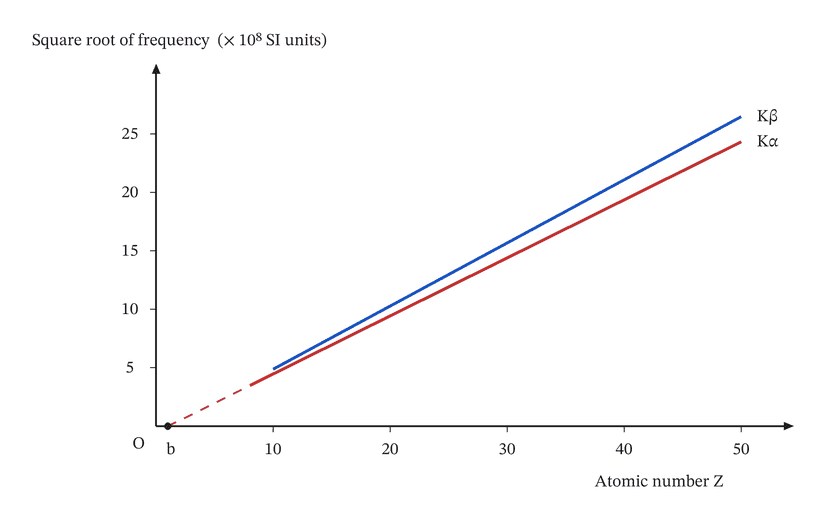
Step 3 — Explain the law. The line is emitted when an electron falls from the L shell to a vacancy in the K shell. The one electron left in the K shell screens one unit of the nuclear charge, so the falling electron feels a charge of about . Bohr's formula then gives:
Taking the square root:
This is Moseley's law with and the constant
For copper () it gives , close to the measured line.
Step 4 — Explain its importance. Moseley's law is important because:
- It showed that the atomic number, not the atomic weight, decides an element's properties, so the periodic table is arranged by atomic number (this put argon before potassium and cobalt before nickel).
- It showed gaps in the table at and ; these elements (technetium, promethium, hafnium and rhenium) were later discovered.
- It fixed the number and order of the rare-earth elements, and it lets the elements in a sample be identified from their X-ray lines.
Therefore, Moseley's law, , says the square root of the frequency of a characteristic X-ray line is proportional to the atomic number; it explains the lines through Bohr's theory with screening and made the atomic number the basis of the periodic table.
- 363 marks
Question 36
Derive Duane and Hunt law.
Solve with AIWritten solution
Solution:
Concept: Duane and Hunt found that the continuous X-ray spectrum ends sharply at a shortest wavelength , which depends only on the accelerating voltage and not on the target material.
Step 1 — Show the observed spectra. The figure shows the intensity against wavelength for several accelerating voltages; each curve starts at its own , and decreases as the voltage increases.
Step 2 — Write the energy of an electron. An electron accelerated from rest through a potential difference gains kinetic energy:
Step 3 — Find the most energetic photon. At most an electron can give all of this energy to one photon. That photon has the maximum frequency :
Step 4 — Change to wavelength. We put into this equation:
Step 5 — Write the law. Since , and are constants:
With the values of the constants, , so with in volts:
Therefore, the Duane and Hunt law is : the minimum wavelength varies inversely as the accelerating voltage and is independent of the target material.
- 373 marks
Question 37
Explain the origin of characteristic X-ray spectrum.
Solve with AIWritten solution
Solution:
Concept: The inner-shell electrons of a heavy atom are very tightly bound (their binding energies are thousands of electronvolts, growing roughly as ), so a transition between inner shells gives out a photon in the X-ray region.
Step 1 — Create a vacancy. A fast electron from the cathode strikes a target atom and knocks out an electron from an inner shell, say the K shell. This is possible only if the electron's energy is greater than the binding energy of that shell (for molybdenum's K shell, about ).
Step 2 — Fill the vacancy. An electron from a higher shell (L, M, N, …) at once falls into the vacancy. The energy difference between the two shells is given out as a single X-ray photon:
Step 3 — Name the lines. The energy-level diagram shows the transitions. Falls into the K shell give the K series ( from L, from M, from N); falls into the L shell give the L series (, , …), and so on.
Step 4 — Explain why the lines are characteristic. The energy levels are different for each element, so the wavelengths of these lines are fixed by the target element (Moseley's law). The lines appear as sharp peaks on top of the continuous spectrum.
Therefore, the characteristic spectrum arises when the incident electrons knock out inner-shell electrons of the target atoms and electrons from outer shells fall into the vacancies, giving X-ray photons of definite energies that are characteristic of the target element.
- 385 marks
Question 38
What is meant by soft and hard X-rays? How can the intensity and penetrating power of X-rays be controlled?
Solve with AIWritten solution
Solution:
Concept: The energy of an X-ray photon is . Photons of higher frequency have more energy and pass through more matter.
Step 1 — Define hard X-rays. Hard X-rays have high frequency (short wavelength, roughly below ) and high energy, and so high penetrating power. They are produced when the tube runs at a high voltage.
Step 2 — Define soft X-rays. Soft X-rays have lower frequency (longer wavelength, roughly to ) and lower energy, and so low penetrating power. The boundary between the two kinds is not sharp.
Step 3 — Control the intensity. The intensity depends on the number of electrons striking the target each second. This number depends on the temperature of the filament, which is set by the filament current. Increasing the filament current (by lowering the resistance of the rheostat in the filament circuit) increases the intensity.
Step 4 — Control the penetrating power. The penetrating power depends on the energy of the electrons, that is, on the potential difference between the anode and the cathode. Increasing gives photons of higher frequency and shorter wavelength (), so the X-rays become harder and more penetrating.
Watch out: In a real tube, raising at a fixed current also raises the total X-ray output (roughly as , Kramers' rule), because each electron brings more energy and also turns a larger share of it into X-rays; the filament current is the control that sets the intensity without changing the penetrating power.
Therefore, hard X-rays are high-frequency, highly penetrating X-rays and soft X-rays are low-frequency, weakly penetrating X-rays; the intensity is controlled by the filament current and the penetrating power by the potential difference across the tube.
- 395 marks
Question 39
What are characteristic X-rays? How are they different from continuous X-rays? Give any one difference.
Solve with AIWritten solution
Solution:
Concept: The X-rays from a tube have two parts: a continuous spectrum produced by the braking of electrons, and sharp lines produced by electron jumps between the inner shells of the target atoms.
Step 1 — Define characteristic X-rays. Characteristic X-rays are X-rays of definite wavelengths, seen as sharp peaks on the continuous spectrum. They are produced when a fast electron knocks out an inner-shell electron (for example from the K shell) of a target atom and an electron from a higher shell falls into the vacancy, giving out a photon of energy .
Step 2 — Show the two parts of a spectrum. The figure shows the spectrum of a molybdenum target at 30 kV: the continuous spectrum starting at with the and lines on top of it.
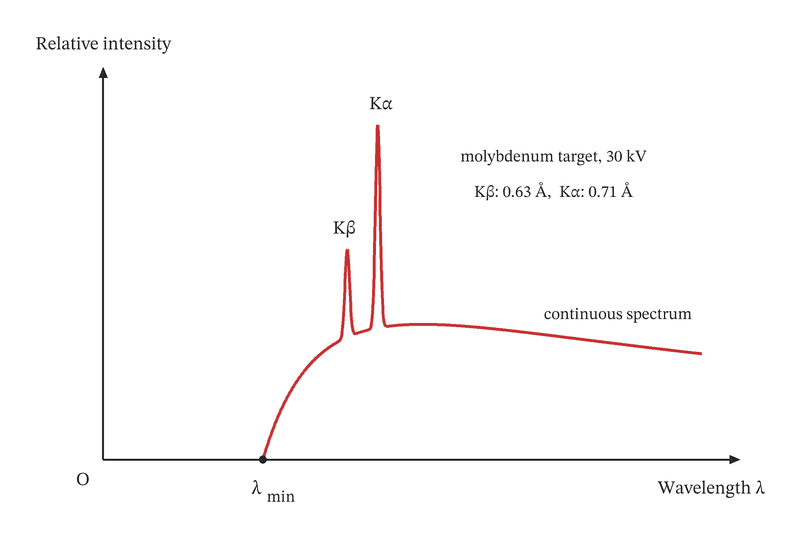
Step 3 — Explain how continuous X-rays differ. Continuous X-rays are produced when the electrons are slowed down in the electric fields of the target nuclei; each electron may lose any amount of energy, so all wavelengths above appear.
Step 4 — State the differences. The two kinds differ in these ways:
- The wavelengths of characteristic X-rays depend on the material (atomic number) of the target; the cut-off wavelength of continuous X-rays depends only on the tube voltage (), not on the target.
- Characteristic X-rays have only a few definite wavelengths (a line spectrum); continuous X-rays have all wavelengths above .
- Characteristic lines appear only when the tube voltage exceeds the excitation potential of the shell concerned (about for the K lines of molybdenum); continuous X-rays are produced at any voltage.
Therefore, characteristic X-rays are the sharp lines of definite wavelengths produced by electron transitions to vacancies in the inner shells; one difference is that their wavelengths depend on the target material, while the continuous X-rays depend on the potential difference applied to the tube.
- 405 marks
Question 40
Explain the production of X-rays by Coolidge tube with the help of a diagram. How are the intensity and the penetrating power of the X-rays controlled in this?
Solve with AIWritten solution
Solution:
Concept: In a Coolidge tube electrons are given out by a heated filament (thermionic emission), accelerated through a high potential difference in a very high vacuum and suddenly stopped by a heavy-metal target, which gives out X-rays.
Step 1 — Draw the tube. The labelled diagram of the Coolidge tube is shown below.
Step 2 — Describe the construction. The tube is a glass bulb evacuated to a very low pressure (about of mercury). The cathode is a tungsten filament F, heated by a low-voltage (LT) supply through a rheostat, and surrounded by a focusing cup S. The anode A is a thick copper rod; its end carries a target T of tungsten (or molybdenum), sloped at to the electron beam. Cooling fins (or circulating water or oil) on the anode carry the heat away. A high-voltage (HT) supply of tens of kilovolts keeps the anode positive with respect to the filament.
Step 3 — Explain the production of X-rays. The heated filament gives out electrons, and the focusing cup directs them into a narrow beam. The high potential difference accelerates them to very high speeds. When they strike the target they are suddenly stopped: about 1% of their kinetic energy is converted into X-rays, which leave the tube through a thin window, and about 99% becomes heat, which the copper anode conducts away.
Step 4 — Explain the control of intensity. The intensity depends on the number of electrons striking the target each second. Increasing the filament current (by lowering the rheostat's resistance) raises the filament temperature, more electrons are emitted, and the intensity of the X-rays increases.
Step 5 — Explain the control of penetrating power. The penetrating power depends on the energy of each electron. Increasing the potential difference between the anode and the cathode gives photons of higher frequency and shorter wavelength (), so the X-rays become harder and more penetrating.
Therefore, in a Coolidge tube X-rays are produced when electrons from a heated filament, accelerated by a high voltage, are suddenly stopped by a tungsten target; the intensity is controlled by the filament current and the penetrating power by the anode-cathode potential difference.
- 415 marks
Question 41
In Coolidge X-ray tube (Modern X-ray tube), how will you vary:
(i) the intensity of emitted X-rays and
(ii) the penetrating power of emitted X-rays?
Solve with AIWritten solution
Solution:
Concept: The intensity of an X-ray beam is the X-ray energy falling on unit area in unit time; it depends mainly on how many electrons strike the target each second. The quality of X-rays means their penetrating power; it depends on the energy of each photon, that is, on the accelerating voltage.
Step 1 — Recall the controls on the tube. In the Coolidge tube shown below, the filament F is heated by a low-voltage (LT) circuit containing a rheostat, and a high-voltage (HT) supply is connected between the filament and the anode A.
Step 2 — Answer part (i). The number of electrons emitted by the filament each second depends on its temperature. To increase the intensity, we increase the filament current by lowering the resistance of the rheostat; the filament becomes hotter, more electrons strike the target each second, and more X-ray photons are produced. Lowering the filament current reduces the intensity.
Step 3 — Answer part (ii). The energy of each electron reaching the target is . To increase the penetrating power, we increase the potential difference of the HT supply; the X-ray photons then have higher frequency and shorter wavelength, , so the X-rays become harder. Lowering makes them softer.
Watch out: In a real tube, raising at a fixed current also raises the total X-ray output (roughly as , Kramers' rule), because each electron brings more energy and also turns a larger share of it into X-rays; the filament current is the control that sets the intensity without changing the penetrating power.
Therefore, (i) the intensity is varied by changing the filament current (the filament temperature), and (ii) the penetrating power is varied by changing the potential difference between the anode and the cathode.
- 425 marks
Question 42
(i) Draw a labelled graph showing variation of relative intensity of X-rays versus wavelength . Mark on the graph.
(ii) State how the value of can be varied?
Solve with AIWritten solution
Solution:
Concept: The X-ray spectrum from a tube is a continuous spectrum that starts sharply at a shortest wavelength , with sharp characteristic lines of the target on top of it.
Step 1 — Draw the graph for part (i). The figure shows the relative intensity against wavelength for a molybdenum target at 30 kV, with marked.
Step 2 — Describe the graph. The intensity is zero for wavelengths shorter than . The continuous spectrum rises steeply from , reaches a maximum and then falls slowly. The sharp peaks and are the characteristic lines of the target. For 30 kV:
Step 3 — Answer part (ii). By the Duane and Hunt law:
So is varied by changing the accelerating potential across the tube: raising shortens (doubling to halves it to about ), and lowering lengthens it. Changing the filament current or the target material does not change .
Therefore, (i) the graph rises sharply from zero at to a maximum, with sharp characteristic peaks on it, and (ii) is varied by changing the potential difference across the tube, since .
- 433 marks
Question 43
If the potential difference across the tube is V and the current A, find
(a) the number of electrons crossing the tube per second and
(b) the kinetic energy gained by an electron traversing the tube without collision.
- 443 marks
Question 44
Calculate the energy in electron volt and velocity of electron beam giving rise to X-ray of wavelength 1 Å?
- 453 marks
Question 45
The accelerating potential of an X-ray machine is 66000 V. Calculate
(i) the frequency of the most energetic X-rays produced and
(ii) the shortest wavelength present in the X-rays.
- 463 marks
Question 46
X-rays of wavelength 0.5 Å are incident upon molybdenum target. If the absorption limit for molybdenum is at a wavelength of 0.618 Å, find the kinetic energy of the electrons released.
- 473 marks
Question 47
The rate at which heat is produced in an X-ray tube is 300 W. If the accelerating potential difference applied to the tube is 30 kV, find the current in the circuit assuming that only a very small percentage of the kinetic energy of electron is converted into X-rays.
- 483 marks
Question 48
The energy of the line of characteristic X-ray line emitted by calcium is 4.10 keV and manganese is 6.52 keV. What is the time taken by the photons from calcium and manganese to travel a distance of 1.5 km?
- 493 marks
Question 49
An X-ray tube is operated at a tube potential of 40000 V. Calculate
(i) kinetic energy of an electron emitted by the filament when it reaches the target/anode.
(ii) Wavelengths of all the X-rays emitted by the X-ray tube.
- 503 marks
Question 50
Find the minimum wavelength of the emitted X-rays when an X-ray tube is operating at 50 kV.
What Class 12 Physics Ch 25 covers
The sections of the chapter, in the order the book takes them. Every question above comes from one of these.
- 01Production of X-Rays
- 02Intensity, Quality and Properties of X-Rays
- 03Continuous X-Ray Spectrum and Duane-Hunt Relation
- 04Characteristic X-Ray Spectrum
- 05Moseley's Law
More ways to study this chapter
The same chapter asked three other ways. Practise it, revise it, and see what the board has set on Ch 25 before.
- Competency-Based Questions (CBQ)Case study questions: a situation, and the part of the chapter that answers it.40questionsOpen
- Previous Year QuestionsQuestions that have actually appeared in board papers, each tagged with its year.4questionsOpen
- Practice QuestionsExtra questions per chapter, for when one attempt at a method is not enough.69questionsOpen
Ch 25 in past ISC papers
The same chapter as the board has actually asked it. These are worded differently from the textbook exercise, which is the point of reading them.
- 11 mark
Board paper question 1
State Moseley's law.
Solve with AIWritten solution
Solution:
Key idea: Each element gives characteristic X-ray lines (K, L, …) whose frequencies depend on its atomic number . Moseley found a simple law linking the two.
Step 1 — State the law in words.
The square root of the frequency of a given characteristic X-ray line (for example the line) of an element is directly proportional to , where is the atomic number of the element.
Step 2 — Write it as an equation.
Here and are constants for that line ( for the line).
Therefore, Moseley's law: the square root of the frequency of a characteristic X-ray line is directly proportional to (Z − b), that is √ν = a(Z − b), where Z is the atomic number and a, b are constants.
- 22 marks
Board paper question 2
Using the constants given on page 8 of this Paper, find the minimum wavelength of the emitted X rays, when an X ray tube is operated at .
Solve with AIWritten solution
Solution:
Key idea: The shortest wavelength (cut-off wavelength) of X-rays is emitted when an electron accelerated through the tube voltage gives all its kinetic energy to a single X-ray photon (the Duane–Hunt law).
Step 1 — Write the data with the paper's constants.
We use , and , with the tube voltage in volts.
Step 2 — Find the energy gained by each electron.
Each electron of charge falls through the potential difference , so it gains energy .
Step 3 — Rearrange for the minimum wavelength.
We make the subject of the Duane–Hunt relation.
Step 4 — Substitute the values.
We put in and the electron energy from Step 2.
The exact value with these constants is , about .
Therefore, the minimum wavelength of the emitted X-rays is about 2.48 × 10⁻¹¹ m (0.25 Å).
- 32 marks
Board paper question 3
State the effect of the following changes on the X-rays emitted by Coolidge X-ray tube:
(i) High voltage between cathode and anode is increased.
(ii) Filament temperature is increased.
Solve with AIWritten solution
Solution:
Key idea: In a Coolidge tube the high voltage decides the energy of the electrons striking the target, and so the quality (penetrating power) of the X-rays. The filament temperature decides how many electrons are emitted, and so the intensity of the X-rays.
Step 1 — Part (i): find the effect on the energy of the X-rays.
A higher voltage gives each electron more kinetic energy . The minimum wavelength falls, because , and the X-ray photons have more energy on average.
Step 2 — Part (i): state the result.
The X-rays become harder (more penetrating), so their quality improves. In the ISC treatment the number of X-ray photons is set by the tube current, so the intensity is taken as unchanged.
Step 3 — Part (ii): find the effect on the number of electrons.
A hotter filament emits more electrons per second by thermionic emission, so the tube current increases.
Step 4 — Part (ii): state the result.
More electrons strike the target each second, so more X-ray photons are produced and the intensity of the X-rays increases. The voltage is unchanged, so the minimum wavelength and the penetrating power (quality) stay the same.
Note: In practice the total X-ray power also rises when the voltage is raised (roughly as the square of the voltage, Kramers' rule), because each electron brings more energy and also turns a larger share of it into X-rays.
Therefore, (i) increasing the high voltage makes the X-rays more penetrating (harder, shorter minimum wavelength); (ii) increasing the filament temperature increases the intensity of the X-rays without changing their quality.
- 42 marks
Board paper question 4
(i) Find maximum frequency of X-rays produced by an X-ray tube operating at a tube potential of .
(ii) State any one difference between characteristic X-rays and continuous X-rays.
Solve with AIWritten solution
Solution:
Key idea: An electron accelerated through a potential difference gains energy . The highest-frequency X-ray photon is produced when all of this energy goes into one photon, so .
Step 1 — Part (i): write the data with the paper's constants.
We use and , with the tube potential in volts.
Step 2 — Part (i): find the maximum frequency.
We rearrange for and substitute.
Step 3 — Part (ii): give one difference.
Continuous X-rays contain all wavelengths above a minimum wavelength . That minimum depends only on the tube voltage, not on the target. Characteristic X-rays appear as sharp lines at a few definite wavelengths that depend only on the element of the target (they come from electron jumps between inner shells of the target atoms), not on the voltage.
Therefore, (i) the maximum frequency of the X-rays is 1.6 × 10¹⁹ Hz; (ii) continuous X-rays have all wavelengths above a cut-off set by the tube voltage, whereas characteristic X-rays have a few sharp wavelengths that depend on the target element.
Class 12 Physics Ch 25 questions students ask
How many questions are there in Class 12 Physics Ch 25?
50 questions. Every one is solved step by step on this page.
Are these Class 12 Physics solutions free?
Yes. Every question and its full working is free to read, with no account needed.
Can I download the Class 12 Physics Ch 25 solutions as a PDF?
There is no PDF to download. Every solution is on this page instead, which means it is searchable, always the current syllabus, and readable on a phone. Use your browser's print option if you want it on paper.