
Opening your dashboard
Class 12 Physics Chapter 25 X-Rays: Practice Questions
69 questions on Chapter 25, each worked through on its own page with the AI tutor. Class 12 Physics, ICSE 2026-27.
69 questions
1–4 marks · Mixed difficulty
- 11 mark
Question 1
In a Coolidge X-ray tube, the heated filament sits inside a small metal cup (the focusing cup) that is kept at the same potential as the filament. The main job of this cup is to
- 21 mark
Question 2
In a Coolidge tube, the tungsten target is set into the sloping face of a thick copper rod (the anode), whose outer end carries cooling fins or is cooled by water or oil. The main job of the copper is to
- 31 mark
Question 3
A Coolidge tube is pumped out to a very low pressure (about of mercury). The main reason for this high vacuum is
- 43 marks
Question 4
In an X-ray tube, the filament and the target are apart and a steady is applied between them. The tube current is . (Hypothetical data.) Treat the electric field between the filament and the target as uniform, take each electron to leave the filament from rest, and ignore relativity. Take and . Find
(i) the speed with which an electron reaches the target,
(ii) the time an electron takes to cross the gap, and
(iii) the number of electrons that are crossing the gap at any one instant.
- 53 marks
Question 5
A crystallography X-ray tube runs at with a tube current of . Take of the energy of the electron beam to become heat in the anode, and take all of this heat to be carried away by cooling water flowing through the anode. The water leaves warmer than it enters. (Hypothetical data.) The specific heat capacity of water is , and of water has a volume of litre. Find
(i) the power delivered to the target by the electron beam,
(ii) the power that leaves the tube as X-rays, and
(iii) the mass of water that must flow through the anode each second, and this flow in litres per minute.
- 63 marks
Question 6
In an X-ray tube, the electron beam strikes the sloping target face over a strip long, measured along the face (the focal strip). The X-ray beam that is used leaves straight down, at right angles to the electron beam, and the target face makes an angle with this downward direction, as shown in the figure. (Hypothetical data.)
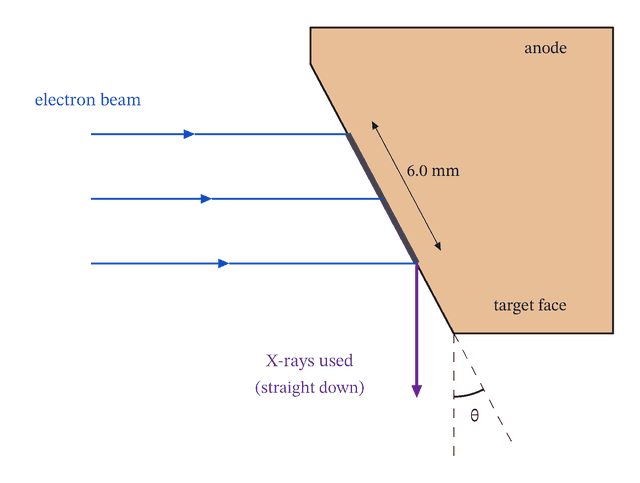
Seen along the X-ray beam (from the patient's side), the strip looks shorter: its apparent length is its projection on a line at right angles to the X-ray beam.
(i) Find the apparent length of the strip when and when .
(ii) Explain why a long focal strip that looks short from the patient's side is useful.
- 72 marks
Question 7
In the early X-ray tubes, the tube contained a little gas, and the electrons came from ionisation of this gas by the high voltage. In Coolidge's tube (1913) the gas is removed and the electrons come from a heated tungsten filament. Give two advantages of Coolidge's arrangement.
- 82 marks
Question 8
A dental X-ray unit is set to and a tube current of for an exposure lasting . (Hypothetical data.) Take . Find
(i) the number of electrons that strike the target during the exposure, and
(ii) the total energy they deliver to the target.
- 91 mark
Question 9
A radiographer finds that an X-ray image of a hand taken at and a tube current of is too faint, although the penetrating power of the X-rays is just right. (Hypothetical data.) Which change should the radiographer make?
- 103 marks
Question 10
An X-ray tube can be run at three settings: P at and ; Q at and ; R at and . (Hypothetical data.) Using the rules of this chapter,
(i) arrange the settings in order of the intensity of the X-rays, greatest first,
(ii) arrange them in order of the penetrating power of the X-rays, greatest first, and
(iii) find the shortest wavelength produced at the setting with the greatest penetrating power.
Take , and .
- 113 marks
Question 11
X-rays ionise the air they pass through. On average, about of energy is used up for each ion pair formed in air, and the energy needed to ionise one oxygen or nitrogen molecule is only about to . An X-ray photon of wavelength is completely absorbed in air.
(i) Find the energy of the photon in joules and in electronvolts.
(ii) Estimate the number of ion pairs it produces.
(iii) Explain why a photon of green light () cannot ionise air molecules.
Take , and .
- 121 mark
Question 12
A positively charged gold-leaf electroscope stands in air. When a beam of X-rays is passed through the air close to its cap, the leaves slowly collapse. The best explanation is that the X-rays
- 131 mark
Question 13
For the X-rays from a particular diagnostic tube, every of lead cuts the intensity of the beam to half of its value. (Hypothetical data.) A lead sheet thick is placed across the beam. The fraction of the intensity that passes through the sheet is
- 143 marks
Question 14
During a dental X-ray exposure, the radiographer can stand either or from the target of the X-ray tube. Treat the target as a point source and neglect absorption in air. (Hypothetical data.)
(i) By what factor is the intensity of the X-rays reaching the radiographer smaller when standing at ?
(ii) An exposure of is used while the radiographer stands at . Compare the X-ray energy reaching each square centimetre of the radiographer's body with that for an exposure of while standing at .
(iii) State the three basic ways of reducing the radiation dose a worker receives.
- 151 mark
Question 15
On an X-ray image of a hand, the bones appear white while the flesh appears dark grey. This is mainly because
- 163 marks
Question 16
A mammography unit (for breast imaging) is run at a peak voltage of , while a chest X-ray unit is run at . (Hypothetical data.)
(i) Find the shortest wavelength produced by each unit.
(ii) Find the ratio of the largest photon energy of the chest unit to that of the mammography unit.
(iii) Which unit gives the harder X-rays, and why is the softer beam chosen for imaging breast tissue?
Take , and .
- 172 marks
Question 17
(i) Why are protective aprons and screens in an X-ray room made with lead rather than with aluminium of the same thickness?
(ii) Which property of X-rays makes unnecessary exposure harmful to the body?
- 181 mark
Question 18
The figure shows the continuous X-ray spectra A and B given out by the same tube, run with the same tube current. Spectrum A was taken at a tube voltage of .
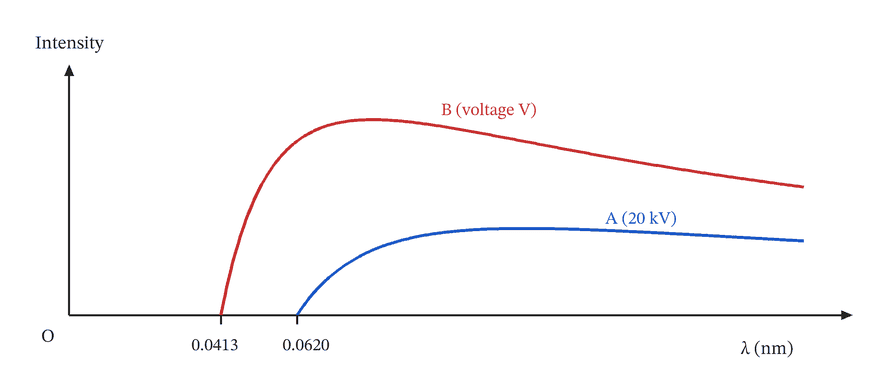
The tube voltage used for spectrum B is
- 191 mark
Question 19
An X-ray tube runs from a steady d.c. supply, so every electron reaches the target with the same kinetic energy . Yet the continuous X-rays have all wavelengths above . The reason is that
- 203 marks
Question 20
An X-ray tube runs at a steady . One electron, as it reaches the target, gives out a single X-ray photon of wavelength in its first braking event. Ignore relativity. Take , , and . Find
(i) the energy of the photon in keV,
(ii) the kinetic energy the electron still has just after giving out the photon, and
(iii) the speed of the electron just after giving out the photon.
- 211 mark
Question 21
For an X-ray tube, a graph of the maximum frequency of the X-rays against the tube voltage is a straight line through the origin. Taking and , the slope of this line is
- 223 marks
Question 22
Two X-ray tubes are run at the same steady voltage of . Tube 1 has a molybdenum target () and a tube current of ; tube 2 has a tungsten target () and a tube current of . (Hypothetical data.)
(i) Find the short-wavelength limit of the continuous spectrum of each tube.
(ii) Which tube gives the more intense X-rays? Give the reason using the rule of this chapter.
(iii) Explain why changing the target metal does not change .
Take , and .
- 233 marks
Question 23
The high voltage of a simple X-ray unit is full-wave rectified but not smoothed, so the tube voltage rises and falls as shown in the figure, with a peak value of . (Hypothetical data.)
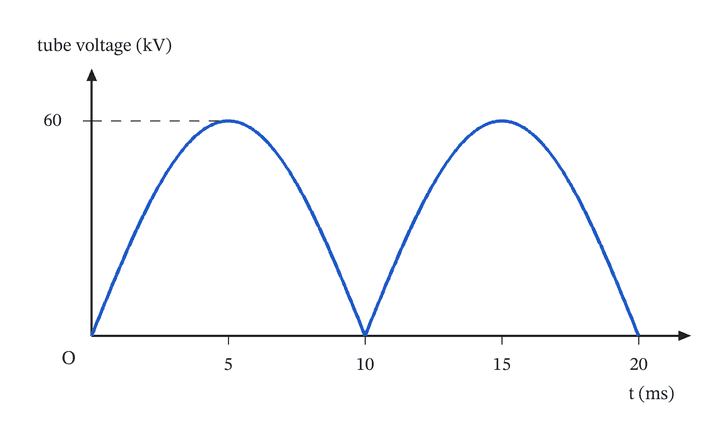
(i) Find the shortest wavelength present in the X-rays.
(ii) Find the least tube voltage at which photons of wavelength can be produced.
(iii) For what fraction of each hump can such photons be produced?
Take , and .
- 241 mark
Question 24
An X-ray tube runs at a steady . Taking , and , which of these wavelengths can NOT be present in the continuous X-rays it gives out?
- 251 mark
Question 25
In a copper atom, is needed to remove an electron from the K shell, and a copper photon has an energy of . The voltage across an X-ray tube with a copper target is raised slowly from . The K-series lines of copper first appear when the tube voltage reaches about
- 264 marks
Question 26
The figure shows three inner energy levels of a molybdenum atom, with one value for each shell: K at , L at and M at . The energy of a free electron at rest is taken as zero, and the closely spaced sub-levels of the real L and M shells are ignored. Take .

(a) Find the photon energies of the and lines.
(b) Find the wavelengths of these two lines.
(c) What is the least voltage at which an X-ray tube with a molybdenum target can give these lines?
(d) Which of the two lines is more intense, and why?
- 271 mark
Question 27
A target gives out two characteristic lines, and . Compared with its line, its line has
- 282 marks
Question 28
In a copper atom, is needed to remove an electron from the K shell, and the copper line has a wavelength of . Take , and take the energy of a free electron at rest as zero.
(a) Find the energy of a photon.
(b) Hence find the energy of the L level of copper.
- 291 mark
Question 29
(Hypothetical data.) An X-ray tube with a molybdenum target runs at a steady with a tube current of . Its spectrum shows the molybdenum line at . The tube current is now raised to by heating the filament more, while the voltage stays at . What happens to the line?
- 303 marks
Question 30
For crystal studies a beam of nearly one wavelength is wanted, but a copper target gives both photons () and photons (). A thin nickel foil is placed in the beam. In nickel, is needed to remove a K electron. Photons with more than this energy can eject K electrons from nickel and are strongly absorbed by the foil; photons with less energy are absorbed much more weakly. Take .
(a) Find the wavelengths of the copper and lines, and the wavelength of a photon of energy .
(b) Explain which line the nickel foil removes from the beam and which it lets through.
(c) Explain why a thin foil of copper itself would not do this job.
- 311 mark
Question 31
A tube filled with hydrogen gas is bombarded with fast electrons, but it never gives out characteristic X-ray lines. The energy needed to remove the electron from a hydrogen atom in its normal state is ; take . The reason is that
- 322 marks
Question 32
Copper metal, copper(II) oxide and copper sulfate are each tested in an X-ray analyser. All three give photons of practically the same energy, , even though copper is bonded quite differently in them.
(a) Explain why the chemical form makes almost no difference to the line.
(b) Explain why this makes characteristic X-rays useful for finding which elements a sample contains.
- 333 marks
Question 33
(Hypothetical data.) An X-ray analyser is pointed at an old iron tool fixed with metal rivets. Its X-rays excite the atoms of the tool, and the detector records four characteristic lines, at , , and . The table gives the measured K-line energies of some metals. Take .
Metal (keV) (keV) Chromium 5.41 5.95 Iron 6.40 7.06 Nickel 7.48 8.26 Copper 8.05 8.90 Zinc 8.64 9.57 (a) Which metals does the tool contain? Give your reasons.
(b) Find the wavelength of the line of each metal found.
- 344 marks
Question 34
(Hypothetical data.) The inner energy levels of an element are K at , L at and M at , taking one level for each shell and the energy of a free electron at rest as zero. Take .
(a) Draw an energy-level diagram, roughly to scale, and show on it the transitions that give the , and lines.
(b) Find the photon energy of each of the three lines.
(c) Arrange the three lines in order of increasing wavelength, and find the wavelength of the longest one.
(d) Show that the energy of a photon equals the sum of the energies of a photon and an photon, and explain what this means for an atom with a vacancy in its K shell.
- 352 marks
Question 35
(Hypothetical data.) A crystal-study instrument uses copper X-rays, whose photons each carry . Its detector absorbs X-ray energy at a rate of . Take .
(a) Find the energy of one photon in joules.
(b) How many photons reach the detector each second?
- 363 marks
Question 36
In a medical X-ray tube, an electron accelerated through strikes a tungsten atom in the target and knocks an electron out of its K shell. In tungsten, is needed to remove a K electron and to remove an L electron. Take .
(a) At most, how much kinetic energy is left to be shared between the incoming electron and the electron knocked out?
(b) An L electron now falls into the K vacancy. Find the energy and wavelength of the photon given out, and name the line.
(c) This photon carries less than the used to make the vacancy. Where is the rest of that energy?
- 372 marks
Question 37
The yellow light of a sodium lamp, of wavelength , comes from a fall of the outermost electron of sodium. The copper X-ray line has a wavelength of . Take .
(a) Find the energy of each photon, and the ratio of the X-ray photon's energy to the sodium photon's energy.
(b) Use your answer to explain why X-ray lines come from the inner shells of an atom and not from its outer electrons.
- 381 mark
Question 38
For lines, Moseley's law is , where is the frequency of the line, the atomic number and a constant. Sodium () and scandium () both give lines. The frequency of scandium is how many times that of sodium?
- 391 mark
Question 39
Treat the fall that gives a photon as the jump in a hydrogen-like atom whose nuclear charge is reduced to by the electron left in the K shell. The photon energy is then . The photon energy of zinc () predicted in this way is about
- 401 mark
Question 40
The measured photon energies of three elements are: niobium (), ; molybdenum (), ; ruthenium, . When these lines were first measured, no element was known between molybdenum and ruthenium. By Moseley's law, , like , rises by equal steps from each element to the next. The data show that
- 411 mark
Question 41
For lines, Moseley's law is , where . Take the Rydberg constant and . The value and SI unit of are
- 423 marks
Question 42
Cobalt has a larger atomic mass () than nickel (), so a table ordered by mass would put nickel first. Their measured photon energies are for cobalt and for nickel. For lines, Moseley's law is . Take , , and .
(a) Find the atomic numbers of cobalt and nickel.
(b) Which of the two comes first in the periodic table, and what does this show?
- 431 mark
Question 43
For the lines of the elements, Moseley's law is . If the frequency itself, rather than , is plotted against the atomic number , the result is
- 444 marks
Question 44
For lines, Moseley's law is , with . Take , , and .
(a) Show that the frequencies of two neighbouring elements, with atomic numbers and , differ by .
(b) Use this to find, in eV, the difference between the photon energies of copper () and zinc (). Compare it with the measured energies, and .
(c) Find the same difference, by Moseley's law, for the elements with and . What does the comparison tell you about the steps in and in from one element to the next?
- 453 marks
Question 45
Hafnium () was discovered in 1923, when its X-ray spectrum was found in zirconium minerals. The strongest lines of its neighbours, lutetium () and tantalum (), have photon energies of and . Take .
(a) Using Moseley's law , with the same and for all three elements, show that for hafnium is the average of for lutetium and tantalum.
(b) Predict the energy of this line for hafnium.
(c) Find its wavelength.
- 461 mark
Question 46
The rare-earth elements are so alike chemically that, before Moseley's work, chemists could not agree how many of them existed. Moseley's law settled the question because
- 472 marks
Question 47
On a Moseley graph of against the atomic number , the points for the lines and the points for the lines of many elements each lie on a straight line, and the line lies above the line at every .
(a) Explain why the line lies above the line.
(b) Explain why each set of points lies on a straight line.
- 483 marks
Question 48
An iron atom has . Compare two cases.
(a) An iron ion that has lost all but one electron, , is hydrogen-like. Bohr's theory gives the photon energy for its jump as . Find this energy in keV.
(b) In a neutral iron atom with one electron knocked out of its K shell, the photon comes from the same kind of fall, and Moseley's law gives . Find this energy, and compare it with the measured iron energy, .
(c) Explain why the falling electron in the neutral atom behaves as if the nuclear charge were only about .
- 491 mark
Question 49
What is XU?
- 502 marks
Question 50
How will you control the intensity and quality of X-rays?
- 511 mark
Question 51
The continuous X-rays are called “bremsstrahlung.” Why?
- 521 mark
Question 52
Between cathode rays and X-rays which has greater velocity?
- 531 mark
Question 53
What should be done to increase the intensity of X-rays produced by a Coolidge tube?
- 541 mark
Question 54
On what factor does the minimum wavelength of the continuous X-ray spectrum depend?
- 551 mark
Question 55
How will you increase the penetrating power of X-rays produced in an X-ray tube?
- 561 mark
Question 56
What is the relation between the maximum frequency for the X-rays produced by an X-ray tube operating at a certain voltage ?
- 572 marks
Question 57
Explain briefly why there is a maximum frequency for the X-rays produced in an X-ray tube operating at a certain voltage.
- 582 marks
Question 58
Show graphically the continuous spectrum of X-rays, labelling the axes and marking .
- 592 marks
Question 59
Why is the structure (nature) of crystals studied by X-rays?
- 601 mark
Question 60
What is the difference between soft and hard X-rays?
- 611 mark
Question 61
A metal block is exposed to beams of X-ray of different wavelengths. X-rays of which wavelength penetrate the most?
- 621 mark
Question 62
Given below is a list of electromagnetic spectrum and its mode of production. Which one does not match?
- 631 mark
Question 63
Characteristic X-rays are produced due to
- 641 mark
Question 64
A beam of 35.0 keV electrons strike a molybdenum target generating the X-rays. What is the cut off wavelength?
- 651 mark
Question 65
Which one of the following statements is wrong in the context of X-rays generated from an X-ray tube?
- 661 mark
Question 66
The minimum wavelength of X-rays emitted by X-ray tube is 0.4125 Å. The accelerating voltage is
- 671 mark
Question 67
The energy of the e.m. waves is of the order of 15 keV. To which part of the spectrum does it belong?
- 681 mark
Question 68
Electrons with de Broglie wavelength fall on the target in an X-ray tube. The cut-off wavelength of the emitted X-rays is
- 691 mark
Question 69
An X-ray tube is operated at 1.24 million volt. The shortest wavelength of the produced photon will be