
Question 415 marksMedium
In Coolidge X-ray tube (Modern X-ray tube), how will you vary:
(i) the intensity of emitted X-rays and
(ii) the penetrating power of emitted X-rays?
Confirming your payment
Sign up now and get 250 free tokens.
X-Rays · Question 41 of 50
In Coolidge X-ray tube (Modern X-ray tube), how will you vary:
(i) the intensity of emitted X-rays and
(ii) the penetrating power of emitted X-rays?
Solution:
Concept: The intensity of an X-ray beam is the X-ray energy falling on unit area in unit time; it depends mainly on how many electrons strike the target each second. The quality of X-rays means their penetrating power; it depends on the energy of each photon, that is, on the accelerating voltage.
Step 1 — Recall the controls on the tube. In the Coolidge tube shown below, the filament F is heated by a low-voltage (LT) circuit containing a rheostat, and a high-voltage (HT) supply is connected between the filament and the anode A.
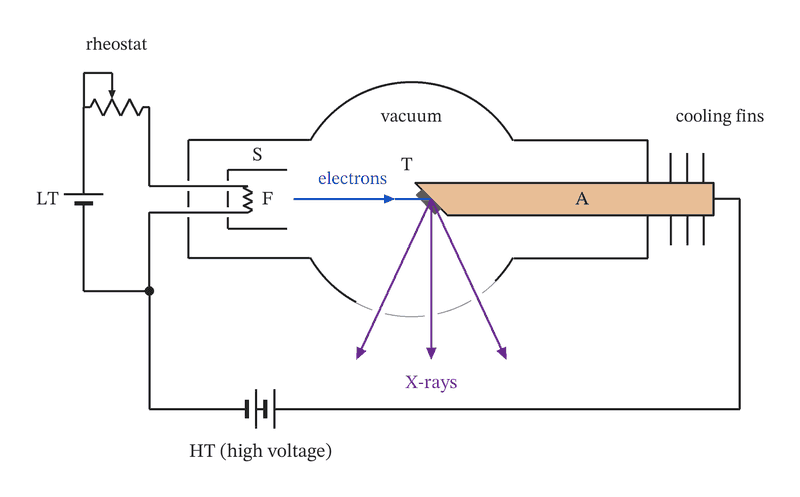
Step 2 — Answer part (i). The number of electrons emitted by the filament each second depends on its temperature. To increase the intensity, we increase the filament current by lowering the resistance of the rheostat; the filament becomes hotter, more electrons strike the target each second, and more X-ray photons are produced. Lowering the filament current reduces the intensity.
Step 3 — Answer part (ii). The energy of each electron reaching the target is . To increase the penetrating power, we increase the potential difference of the HT supply; the X-ray photons then have higher frequency and shorter wavelength, , so the X-rays become harder. Lowering makes them softer.
Watch out: In a real tube, raising at a fixed current also raises the total X-ray output (roughly as , Kramers' rule), because each electron brings more energy and also turns a larger share of it into X-rays; the filament current is the control that sets the intensity without changing the penetrating power.
Therefore, (i) the intensity is varied by changing the filament current (the filament temperature), and (ii) the penetrating power is varied by changing the potential difference between the anode and the cathode.