
Question 405 marksMedium
Explain the production of X-rays by Coolidge tube with the help of a diagram. How are the intensity and the penetrating power of the X-rays controlled in this?
Confirming your payment
Sign up now and get 250 free tokens.
X-Rays · Question 40 of 50
Explain the production of X-rays by Coolidge tube with the help of a diagram. How are the intensity and the penetrating power of the X-rays controlled in this?
Solution:
Concept: In a Coolidge tube electrons are given out by a heated filament (thermionic emission), accelerated through a high potential difference in a very high vacuum and suddenly stopped by a heavy-metal target, which gives out X-rays.
Step 1 — Draw the tube. The labelled diagram of the Coolidge tube is shown below.
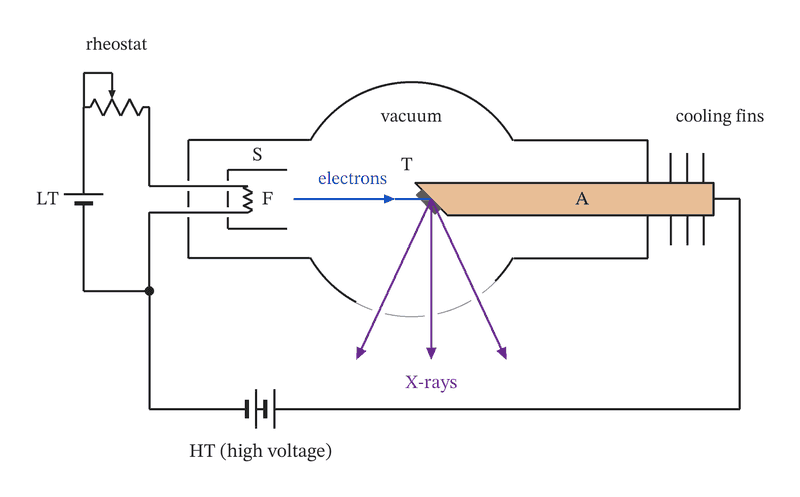
Step 2 — Describe the construction. The tube is a glass bulb evacuated to a very low pressure (about of mercury). The cathode is a tungsten filament F, heated by a low-voltage (LT) supply through a rheostat, and surrounded by a focusing cup S. The anode A is a thick copper rod; its end carries a target T of tungsten (or molybdenum), sloped at to the electron beam. Cooling fins (or circulating water or oil) on the anode carry the heat away. A high-voltage (HT) supply of tens of kilovolts keeps the anode positive with respect to the filament.
Step 3 — Explain the production of X-rays. The heated filament gives out electrons, and the focusing cup directs them into a narrow beam. The high potential difference accelerates them to very high speeds. When they strike the target they are suddenly stopped: about 1% of their kinetic energy is converted into X-rays, which leave the tube through a thin window, and about 99% becomes heat, which the copper anode conducts away.
Step 4 — Explain the control of intensity. The intensity depends on the number of electrons striking the target each second. Increasing the filament current (by lowering the rheostat's resistance) raises the filament temperature, more electrons are emitted, and the intensity of the X-rays increases.
Step 5 — Explain the control of penetrating power. The penetrating power depends on the energy of each electron. Increasing the potential difference between the anode and the cathode gives photons of higher frequency and shorter wavelength (), so the X-rays become harder and more penetrating.
Therefore, in a Coolidge tube X-rays are produced when electrons from a heated filament, accelerated by a high voltage, are suddenly stopped by a tungsten target; the intensity is controlled by the filament current and the penetrating power by the anode-cathode potential difference.