
Question 395 marksMedium
What are characteristic X-rays? How are they different from continuous X-rays? Give any one difference.
Confirming your payment
Sign up now and get 250 free tokens.
X-Rays · Question 39 of 50
What are characteristic X-rays? How are they different from continuous X-rays? Give any one difference.
Solution:
Concept: The X-rays from a tube have two parts: a continuous spectrum produced by the braking of electrons, and sharp lines produced by electron jumps between the inner shells of the target atoms.
Step 1 — Define characteristic X-rays. Characteristic X-rays are X-rays of definite wavelengths, seen as sharp peaks on the continuous spectrum. They are produced when a fast electron knocks out an inner-shell electron (for example from the K shell) of a target atom and an electron from a higher shell falls into the vacancy, giving out a photon of energy .
Step 2 — Show the two parts of a spectrum. The figure shows the spectrum of a molybdenum target at 30 kV: the continuous spectrum starting at with the and lines on top of it.
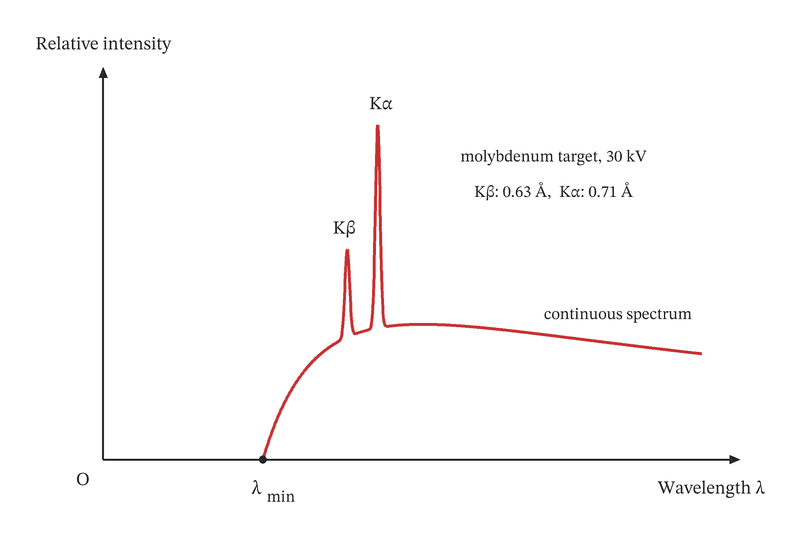
Step 3 — Explain how continuous X-rays differ. Continuous X-rays are produced when the electrons are slowed down in the electric fields of the target nuclei; each electron may lose any amount of energy, so all wavelengths above appear.
Step 4 — State the differences. The two kinds differ in these ways:
Therefore, characteristic X-rays are the sharp lines of definite wavelengths produced by electron transitions to vacancies in the inner shells; one difference is that their wavelengths depend on the target material, while the continuous X-rays depend on the potential difference applied to the tube.