
Opening your dashboard
Class 12 Physics Chapter 25 X-Rays: Competency-Based Questions (CBQ)
40 questions on Chapter 25, each worked through on its own page with the AI tutor. Class 12 Physics, ICSE 2026-27.
40 questions
1–4 marks · Mixed difficulty
- 14 marks
Question 1
Competency: Application
A CT scanner's X-ray tube has a rotating anode: a disc that spins at revolutions per second, while the electron beam strikes a fixed focal spot on a circular focal track near the edge of the disc, as shown in the figure. In one scan the tube runs at with a tube current of for . Take of the energy of the electron beam to become heat in the disc. The disc has a mass of and an average specific heat capacity of , and it loses no heat during the scan. The focal spot is long, measured along the track. (Hypothetical data.)
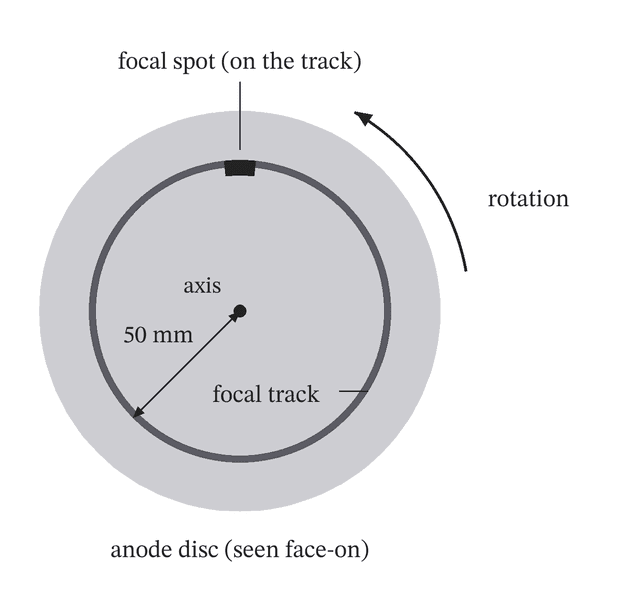
(a) Find the energy delivered to the target by the electron beam during the scan, and the heat produced in the disc.
(b) Find the rise in the temperature of the disc during the scan.
(c) Find the length of the focal track, and the time for which any one point of the track is under the electron beam in each revolution. Hence explain why a rotating anode can take this heavy load.
- 21 mark
Question 2
Competency: Analysis & Evaluation
Some older portable dental X-ray units apply the alternating high voltage from a transformer directly across the X-ray tube, with no rectifier. The tube is then said to be "self-rectified".
Assertion (A): While its target is cool, such a tube produces X-rays only during the half-cycles in which the target is positive with respect to the filament.
Reason (R): Only the hot filament gives out electrons, so electrons can cross the tube only from the filament to the target.
- 34 marks
Question 3
Competency: Application
A hospital X-ray tube has two focal spots: a fine focus wide and a broad focus wide. Because the focal spot is not a point, the shadow of the edge E of a bone is not perfectly sharp: X-rays from the two ends of the spot pass E along different straight lines, so the edge of the shadow is blurred over a strip of width on the detector, as shown in the figure. The focal spot is above E, and the detector is below E. (Hypothetical data.)
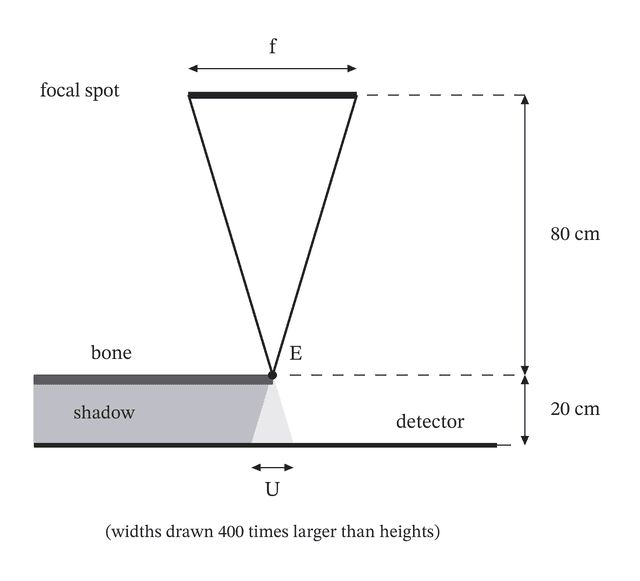
(a) Find for each focal spot.
(b) For one exposure the tube runs at and . Treating each focal spot as a square of the stated width, find the power delivered to each square millimetre of the target with each spot.
(c) Explain which focal spot should be used for this exposure, and what is given up by that choice.
- 41 mark
Question 4
Competency: Application
In the tube head of a dental X-ray unit, the X-ray tube and its high-voltage transformer are sealed together inside a metal case filled with oil. The case is lined with lead and has a small window where the X-ray beam comes out. The main job of the oil is to
- 51 mark
Question 5
Competency: Analysis & Evaluation
At an airport, a cabin-baggage scanner gives out X-rays only while a bag is passing through its tunnel, and none between bags.
Assertion (A): To stop the X-rays between bags, the scanner must switch off the current that heats the filament of its X-ray tube.
Reason (R): Electrons from the filament produce X-rays only when they have been accelerated through a high voltage before striking the target.
- 63 marks
Question 6
Competency: Application
A radiographer must X-ray the hand of a restless four-year-old child. The radiographer's usual setting for a child's hand is and for . In the child's hand can move about , which blurs the image. The radiographer decides to use an exposure time of only , while keeping the same brightness on the image (the same X-ray energy reaching each part of the detector) and the same contrast. Use the rule of this chapter that the intensity of the X-rays is proportional to the tube current. (Hypothetical data.)
(a) Find the product of the tube current and the exposure time (in mA s) for the usual setting, and the tube current needed for the shorter exposure.
(b) Taking the hand to move at a steady speed, find the blur caused by its movement during the shorter exposure.
(c) Explain why the radiographer changes the tube current and not the tube voltage.
- 71 mark
Question 7
Competency: Analysis & Evaluation
Mammography (breast imaging) uses soft X-rays from a tube run at about to . The window through which the X-rays leave the tube is made of a thin sheet of beryllium (atomic number ) instead of the glass used in most X-ray tubes. This is because
- 81 mark
Question 8
Competency: Analysis & Evaluation
The X-ray beam of a dental unit passes through a thin aluminium filter fixed across the window of the tube head before it reaches the patient.
Assertion (A): The filter raises the average penetrating power of the X-rays that reach the patient.
Reason (R): The filter makes the minimum wavelength of the beam shorter.
- 94 marks
Question 9
Competency: Analysis & Evaluation
During a heart procedure guided by moving X-ray images (fluoroscopy), a cardiologist stands from the place where the X-ray beam enters the patient. X-rays scattered by the patient's body reach the cardiologist. At these would give the cardiologist's body a radiation dose at a rate of per hour if no protection were worn. (The millisievert, mSv, measures how much harm a dose of radiation can do.) The cardiologist's lead apron lets through of this radiation. The X-ray beam is on for minutes in each procedure, and the cardiologist's yearly dose must stay under . Treat the patient as a point source of the scattered X-rays. (Hypothetical data.)
(a) Find the dose the cardiologist would receive in one procedure without the apron, and the dose received with it.
(b) How many procedures can the cardiologist carry out in a year, wearing the apron, without going over the yearly limit?
(c) During of the minutes the cardiologist need not be close to the patient, and so steps back to . Find the new dose per procedure (wearing the apron), and the percentage by which this lowers the dose.
- 101 mark
Question 10
Competency: Analysis & Evaluation
A student notices that hospital X-ray images are always shadow pictures, never images focused by a lens as in a camera.
Assertion (A): An ordinary glass lens cannot bring X-rays to a focus in the way that it focuses visible light.
Reason (R): X-rays carry no electric charge, so they are not deflected by electric or magnetic fields.
- 113 marks
Question 11
Competency: Analysis & Evaluation
Once a year a hospital physicist checks the voltage settings of an X-ray unit. The tube voltage rises and falls slightly, and its highest value, set on a dial in kilovolts peak (kVp), fixes the shortest wavelength of the continuous X-rays. The physicist records the spectrum with an X-ray spectrometer and reads from it. The hospital accepts a setting if the true peak voltage is within of the dial value. The readings are given in the table. (Hypothetical data.)
Dial setting Measured Take , and .
(a) Find the true peak voltage at the setting, and say whether the setting is accepted.
(b) Do the same for the setting.
(c) For the setting, find the value of that should be read if the dial is exactly right, and the range of readings of that can be accepted.
- 121 mark
Question 12
Competency: Analysis & Evaluation
A technician doubles the voltage across an X-ray tube, from to , keeping the tube current the same.
Assertion (A): At the shortest wavelength in the X-rays is half of what it was at , and the tube no longer gives out any X-rays with wavelengths longer than the old shortest wavelength.
Reason (R): The shortest wavelength is , so it is inversely proportional to the tube voltage.
- 131 mark
Question 13
Competency: Application
A dual-energy CT scanner takes two images at the same time with two X-ray tubes, one run at and the other at . Comparing the two images helps doctors tell different materials in the body apart. Take and . The highest frequency in the X-rays from the tube, and how it compares with the highest frequency from the tube, are
- 143 marks
Question 14
Competency: Analysis & Evaluation
An X-ray tube with a rhodium target, of the kind used in some mammography units and X-ray analysers, gives the spectrum shown in the figure. The continuous X-rays start at , and there are two sharp lines, at and . Removing an electron from the K shell of a rhodium atom needs . Take . (Hypothetical data.)
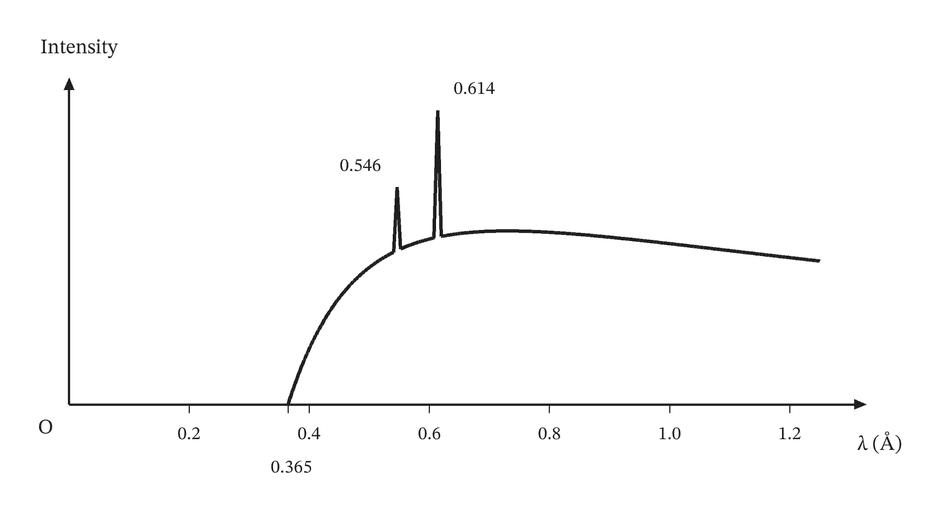
(a) Find the tube voltage.
(b) Find the photon energy of each sharp line, and say which line is and which is .
(c) The voltage is now lowered until the continuous X-rays start exactly at . Find this voltage, and explain why both sharp lines are then missing from the spectrum, even though photons of and of are still being produced.
- 151 mark
Question 15
Competency: Analysis & Evaluation
In a hospital laboratory, a solution of phosphorus-32 is handled behind a screen of perspex (acrylic plastic) about thick, rather than behind a sheet of lead. Phosphorus-32 gives out fast electrons (beta particles) with energies of up to about , and of perspex is enough to stop them. The main reason for choosing perspex is that
- 161 mark
Question 16
Competency: Analysis & Evaluation
A dental X-ray tube runs at a steady .
Assertion (A): A photon of energy is produced only when an electron gives up all of its kinetic energy in a single braking event.
Reason (R): About of the kinetic energy of the electrons that strike the target becomes heat.
- 173 marks
Question 17
Competency: Analysis & Evaluation
A safety inspector tests the paint on a child's toy with a handheld X-ray analyser, whose X-ray tube runs at . The X-rays knock inner electrons out of atoms in the paint, and the analyser records the characteristic X-rays these atoms give out. Its spectrum, shown in the figure, has peaks at and . Known lines: lead and ; arsenic and . Removing a K electron from a lead atom needs . Take . (Hypothetical data.)
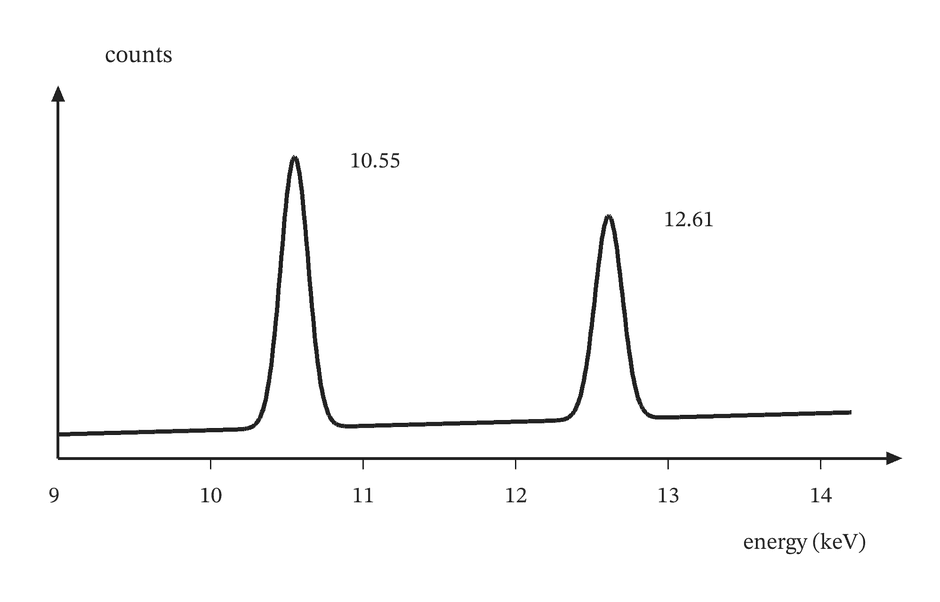
(a) Find the wavelengths of the lead X-rays and the arsenic X-rays, and explain why the peak at alone cannot tell lead from arsenic.
(b) Explain why the analyser shows lines of the L series of lead but none of its K series.
(c) Using the whole spectrum, decide whether the paint contains lead, arsenic or both.
- 181 mark
Question 18
Competency: Analysis & Evaluation
In PIXE (particle-induced X-ray emission), an old bronze coin is struck by a beam of protons with energies of about instead of by electrons. The protons knock electrons out of the inner shells of the atoms in the coin, which then give out characteristic X-rays. Compared with the copper line from the target of an X-ray tube, the copper line from the coin is
- 191 mark
Question 19
Competency: Analysis & Evaluation
A crystal-study X-ray tube with a copper target is first run at and then at , with the same tube current.
Assertion (A): The wavelength of the copper line is the same at both voltages.
Reason (R): The energy of a photon equals the difference between the energies of the L and K levels of a copper atom, and these levels do not depend on the tube voltage.
- 203 marks
Question 20
Competency: Analysis & Evaluation
A geology laboratory studies the crystal structure of rocks with an X-ray diffractometer. Its X-ray tube has a copper target, and it uses the copper line, whose photons each carry . With iron-rich rocks, the detector picks up a strong, even background of X-rays coming from the sample in all directions, which hides the weak diffraction peaks. In iron, is needed to remove a K electron, and the iron line has a photon energy of . A cobalt-target tube gives photons of (its photons, of , are removed by a filter). Take .
(a) Explain where the background comes from, and find the wavelength of the X-rays that make it up.
(b) Show that the cobalt tube avoids this problem, and find the wavelength of cobalt X-rays.
(c) The laboratory also considers an iron-target tube, whose and photons carry and . Would it need a filter to avoid the problem? Explain why an element's own characteristic lines can never knock K electrons out of that same element.
- 211 mark
Question 21
Competency: Application
In a scanning electron microscope, a beam of electrons accelerated through strikes a sample of tool steel that contains iron, chromium, molybdenum and tungsten. The microscope identifies the elements from the characteristic X-rays they give out. The energies needed to remove a K electron are: chromium , iron , molybdenum and tungsten . Which of these elements can give out K-series lines?
- 223 marks
Question 22
Competency: Analysis & Evaluation
An engineer writing software for an X-ray analyser tests a simple formula for the energies of characteristic lines, based on Bohr's theory with a screening number :
For the line, an electron falls from the M shell () into the K shell (). For copper (), the measured photon energy is .
(a) Taking , as for the line, find the photon energy the formula predicts for copper, and the percentage by which it differs from the measured value.
(b) Find the value of that makes the formula give the measured .
(c) Explain why the screening number for the line is larger than for the line.
- 231 mark
Question 23
Competency: Analysis & Evaluation
Copper occurs as two stable isotopes, copper-63 and copper-65, whose nuclei have the same number of protons but different numbers of neutrons. A physicist makes one X-ray target from pure copper-63 and another from pure copper-65.
Assertion (A): The two targets give lines of the same wavelength, as far as an ordinary X-ray spectrometer can tell.
Reason (R): By Moseley's law, the frequency of a characteristic line is fixed by the atomic number of the element, which is the same for all its isotopes.
- 241 mark
Question 24
Competency: Application
To measure the stresses locked inside steel machine parts, a materials laboratory needs X-rays with a wavelength of about . For lines, Moseley's law can be written as , with . Which target metal should its X-ray tube have?
- 253 marks
Question 25
Competency: Analysis & Evaluation
A tungsten-carbide drill tip is joined to its steel body with brass, an alloy of copper and zinc. A handheld X-ray analyser aimed at the joint records separate peaks at , , and , and one broad peak near . Known lines: copper and ; zinc and ; tungsten . The analyser cannot make K vacancies in tungsten (), so tungsten shows only its L lines. For the tungsten line, in which an electron falls from the M shell () to the L shell (), Moseley's law can be written as
The detector shows two lines as separate peaks only if their energies differ by more than . Take . (Hypothetical data.)
(a) Use Moseley's law to predict the energy and the wavelength of the tungsten line.
(b) Which recorded peak is the tungsten line? Which peaks come from copper and which from zinc?
(c) Explain why there is one broad peak near , and check whether the tungsten and zinc peaks can be told apart.
- 264 marks
Question 26
In a Duane–Hunt experiment, the short-wavelength limit of the continuous X-ray spectrum is measured at five tube voltages . (Hypothetical data.)
(kV) 20 25 32 40 50 (pm) 62.0 49.8 38.9 31.0 24.9 (i) Plot a graph of against and show that it is a straight line through the origin.
(ii) Use the slope of the line to find Planck's constant.
Take , and .
- 274 marks
Question 27
The measured photon energies of titanium () and zinc () are and . Take and .
(a) Find the frequency of each element, and its square root.
(b) Assuming Moseley's law, , find the constants and for lines.
(c) A metal sample gives a line of energy . Find the atomic number of the metal.
- 283 marks
Question 28
Show that the minimum wavelength of X-rays emitted from an X-ray tube under an accelerating voltage is Å.
- 293 marks
Question 29
Calculate the minimum applied potential required to produce X-rays of 1 Å wavelength.
- 303 marks
Question 30
The potential difference across an X-ray tube is V and a current of 5 mA flows through it. Find the maximum speed of the electrons striking the target. If only 0.15 percent of the incident energy is converted into X-radiations, find the rate of production of heat.
- 314 marks
Question 31
An X-ray tube is operated with an anode potential of 10 kV and an anode current of 15 mA. Calculate
(i) the number of electrons hitting the anode per second,
(ii) the rate of production of heat at the anode stating any assumptions made and
(iii) the frequency of the emitting X-ray quantum of maximum energy.
- 323 marks
Question 32
The wavelength of line emitted from molybdenum is 0.708 Å. Find the wavelength of the line of copper. Given, atomic number of molybdenum is 42 and that of copper is 29.
- 333 marks
Question 33
The wavelength of the characteristic X-ray line emitted by platinum is 1.321 Å. Another element whose atomic number is not known emits line of wavelength 4.174 Å. What is the atomic number of the unknown element? of platinum is 78. The constant for line.
- 343 marks
Question 34
The minimum wavelength emitted by an X-ray tube is 20 pm. What is the electric field between the cathode and the target if the distance between the two electrodes is 75 cm?
- 353 marks
Question 35
The maximum frequency of the X-rays obtained from an X-ray tube is Hz when the accelerating potential difference applied across ends is 62 kV. Find the value of the Planck’s constant.
- 363 marks
Question 36
Voltage applied between the cathode and anode of an X-ray tube is 18 kV. Calculate the minimum wavelength of the X-rays produced.
- 373 marks
Question 37
Find the maximum frequency of X-rays produced by an X-ray tube maintained at 66 kV.
- 381 mark
Question 38
Competency: Analysis & Evaluation
A teacher describes observations of the kind Roentgen made in 1895. A gas-discharge tube is wrapped completely in black paper and run in a darkened room.
- A screen coated with barium platinocyanide glows whenever the tube is running, even when the screen is about m away.
- A strong magnet held beside the path from the tube to the screen does not move the glowing patch on the screen.
- When a hand is held between the tube and the screen, dark shadows of the bones appear inside the fainter shadow of the hand.
Which conclusion do these three observations best support?
- 393 marks
Question 39
Competency: Application
Older colour television sets used a picture tube (a cathode-ray tube). Inside its vacuum, electrons from a heated cathode are accelerated through about kV. They strike a thin metal mask and the screen at the front of the tube, and the screen glows. The glass of the tube contains compounds of heavy elements such as barium, strontium and lead. A repair technician finds a faulty set in which the accelerating voltage has risen to kV. The technician says that the fault "only makes the screen image brighter, so it is harmless". (Hypothetical data.) Take .
(a) Explain why the cathode-ray tube gives out X-rays, although it was not built as an X-ray tube, and why its glass contains heavy elements.
(b) Find the shortest wavelength of these X-rays at kV and at kV.
(c) Use your answers to part (b) to evaluate the technician's statement.
- 404 marks
Question 40
Competency: Analysis & Evaluation
Each year a hospital physicist checks the X-ray beam of a radiography unit run at kV. Sheets of aluminium are placed one by one across the beam, and a detector behind them measures the intensity. The table gives it as a percentage of the intensity with no aluminium. The thickness of aluminium that halves the intensity is called the half-value thickness. The larger it is, the more penetrating (harder) the beam. The hospital's rule is that at kV the first half-value thickness must be at least mm. (Hypothetical data.)
Aluminium thickness (mm) Intensity (%) (a) Use the table to find the first half-value thickness, and the extra thickness of aluminium that halves the intensity again (the second half-value thickness).
(b) Use the data to explain why the second half-value thickness is larger than the first.
(c) Does the beam pass the hospital's rule? A trainee suggests that, if a beam ever fails the rule, doubling the tube current will make it more penetrating. Evaluate this suggestion.