
Competency: Analysis & Evaluation
A safety inspector tests the paint on a child's toy with a handheld X-ray analyser, whose X-ray tube runs at . The X-rays knock inner electrons out of atoms in the paint, and the analyser records the characteristic X-rays these atoms give out. Its spectrum, shown in the figure, has peaks at and . Known lines: lead and ; arsenic and . Removing a K electron from a lead atom needs . Take . (Hypothetical data.)
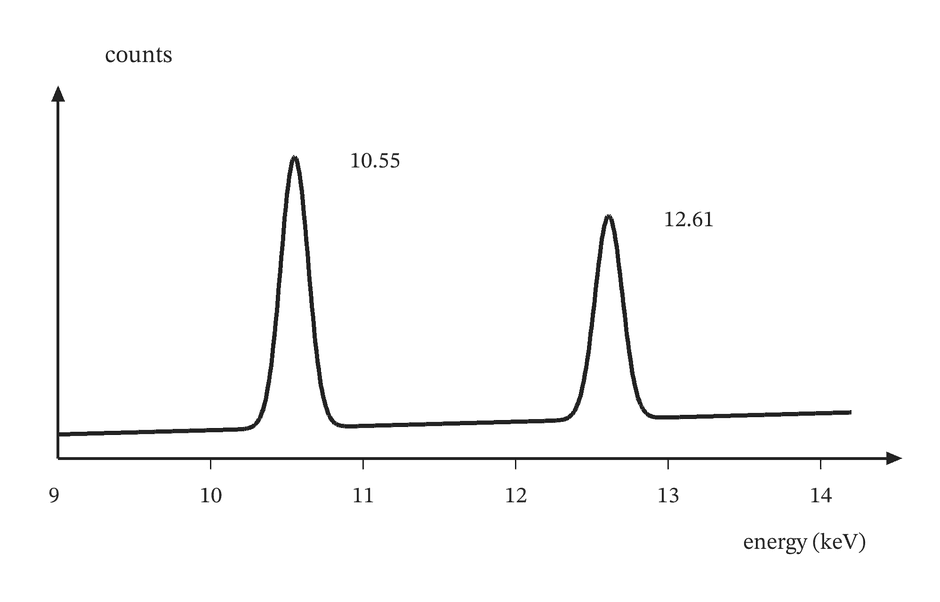
(a) Find the wavelengths of the lead X-rays and the arsenic X-rays, and explain why the peak at alone cannot tell lead from arsenic.
(b) Explain why the analyser shows lines of the L series of lead but none of its K series.
(c) Using the whole spectrum, decide whether the paint contains lead, arsenic or both.