
Question 373 marksMedium
Explain the origin of characteristic X-ray spectrum.
Confirming your payment
Sign up now and get 250 free tokens.
X-Rays · Question 37 of 50
Explain the origin of characteristic X-ray spectrum.
Solution:
Concept: The inner-shell electrons of a heavy atom are very tightly bound (their binding energies are thousands of electronvolts, growing roughly as ), so a transition between inner shells gives out a photon in the X-ray region.
Step 1 — Create a vacancy. A fast electron from the cathode strikes a target atom and knocks out an electron from an inner shell, say the K shell. This is possible only if the electron's energy is greater than the binding energy of that shell (for molybdenum's K shell, about ).
Step 2 — Fill the vacancy. An electron from a higher shell (L, M, N, …) at once falls into the vacancy. The energy difference between the two shells is given out as a single X-ray photon:
Step 3 — Name the lines. The energy-level diagram shows the transitions. Falls into the K shell give the K series ( from L, from M, from N); falls into the L shell give the L series (, , …), and so on.
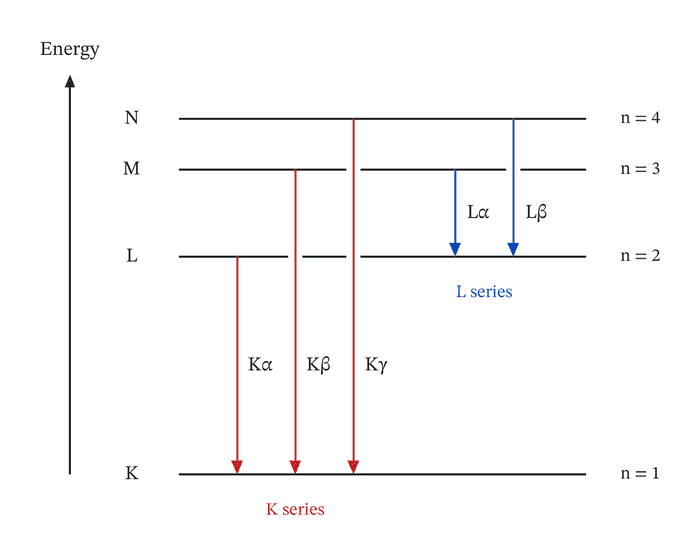
Step 4 — Explain why the lines are characteristic. The energy levels are different for each element, so the wavelengths of these lines are fixed by the target element (Moseley's law). The lines appear as sharp peaks on top of the continuous spectrum.
Therefore, the characteristic spectrum arises when the incident electrons knock out inner-shell electrons of the target atoms and electrons from outer shells fall into the vacancies, giving X-ray photons of definite energies that are characteristic of the target element.