
Opening your dashboard
Class 11 Physics Chapter 9: Work, Energy and Power Solutions
77 textbook questions with step-by-step answers, free to read, for ISC 2026-27.
Get talked through Ch 9, not just shown the answer
Reading a finished solution is not the same as being able to do it. The AI tutor takes one question at a time and works it with you, in your own words, until you can.
- Ask it out loud, in your own words
- It gives you the next step, not the answer
- Stuck on part (ii)? Start there
77 questions with solutions
1–5 marks · Mixed difficulty
The first 41 solutions are on this page. This chapter is a long one, so the rest open on their own page to keep this one quick to load.
- 11 mark
Question 1
A body moves a distance of 10 m along a straight line under the action of a 5 N force. If the work done is 25 J, then the angle between the force and direction of motion of the body is
Solve with AIAnswer
(A) 30°
(B) 45°
- Correct
(C) 60°
(D) 75°
Answer: (C) 60°
Concept: The work done by a constant force is , where is the angle between the force and the direction of motion.
Step 1 — Make the subject. We divide the work by and put in , and :
Step 2 — Find the angle. The angle whose cosine is 0.5 is
Step 3 — Check the other options. Each of the other angles gives a different amount of work with :
- (A) With 30°, , not 25 J.
- (B) With 45°, , not 25 J.
- (D) With 75°, , not 25 J.
Therefore, the angle between the force and the direction of motion is 60°.
- 21 mark
Question 2
The kinetic energy acquired by a mass after travelling a fixed distance from rest under the action of constant force is
Solve with AIAnswer
(A) directly proportional .
(B) inversely proportional to .
(C) directly proportional to .
- Correct
(D) independent of .
Answer: (D) independent of .
Concept: By the work–energy theorem, the kinetic energy gained by a body starting from rest equals the work done on it.
Step 1 — Find the work done. A constant force acts along the motion over the fixed distance , so the work done is
Step 2 — Find the kinetic energy. The body starts from rest, so all this work becomes kinetic energy:
Neither nor depends on the mass, so is the same for every mass. (A heavier body gains this energy with a smaller speed.)
Step 3 — Check the other options. Each of the other options describes a different quantity:
- (A) The momentum gained, , is the quantity that grows as , not the kinetic energy.
- (B) The final speed, , is the quantity that varies as .
- (C) Kinetic energy is proportional to only when the speed is fixed; here the distance and force are fixed instead.
Therefore, the kinetic energy acquired is independent of .
- 31 mark
Question 3
A light and a heavy body have equal momentum. Which one has greater K.E.?
Solve with AIAnswer
- Correct
(A) the light body
(B) both have equal K.E.
(C) the heavy body
(D) data given is incomplete
Answer: (A) the light body
Concept: Kinetic energy and momentum are linked by .
Step 1 — Compare the kinetic energies. The momentum is the same for both bodies, so
shows that : the smaller the mass, the larger the kinetic energy.
Step 2 — Check the other options. The relation above settles the comparison:
- (B) Equal kinetic energies would need equal masses, but one body is lighter.
- (C) The heavy body has the smaller kinetic energy, because is in the denominator.
- (D) The data are enough: equal momentum and different masses fix which body has more kinetic energy.
Therefore, the light body has the greater kinetic energy.
- 41 mark
Question 4
A light and heavy body have equal K.E. which has greater momentum?
Solve with AIAnswer
- Correct
(A) the heavy body
(B) the light body
(C) both have equal momentum
(D) data given incomplete
Answer: (A) the heavy body
Concept: Momentum and kinetic energy are linked by .
Step 1 — Compare the momenta. The kinetic energy is the same for both bodies, so
shows that : the larger the mass, the larger the momentum.
Step 2 — Check the other options. The relation above settles the comparison:
- (B) The light body has the smaller momentum, because grows with .
- (C) Equal momenta would need equal masses when the kinetic energies are equal.
- (D) The data are enough: equal kinetic energy and different masses fix which body has more momentum.
Therefore, the heavy body has the greater momentum.
- 51 mark
Question 5
If the unit of force and length be each increased by four times, then the unit of energy is increased by
Solve with AIAnswer
- Correct
(A) 16 times
(B) 8 times
(C) 2 times
(D) 4 times
Answer: (A) 16 times
Concept: Energy is measured by work, and work = force × distance, so the unit of energy is the unit of force multiplied by the unit of length.
Step 1 — Multiply the new units. The new unit of force is and the new unit of length is , so the new unit of energy is
Step 2 — Check the other options. Both units are multiplied by 4, and the factors multiply:
- (B) A factor of 8 would need one unit to grow 4 times and the other only 2 times.
- (C) A factor of 2 would mean energy grew as the square root of one unit; it grows as the product of the two units.
- (D) A factor of 4 counts the change in only one of the two units.
Therefore, the unit of energy is increased 16 times.
- 61 mark
Question 6
A particle of mass 0.1 kg is subjected to a force which is directly proportional to the distance . The work done by the force is directly proportional to
Solve with AIAnswer
(A)
(B)
(C)
- Correct
(D)
Answer: (D)
Concept: The work done by a varying force is , the area under the force–distance graph.
Step 1 — Write the force. The force is proportional to the distance, so , where is a constant.
Step 2 — Find the work done from to . We integrate the force over the distance, writing for the distance inside the integral so that it is not confused with the upper limit :
So . The mass of 0.1 kg does not affect this.
Step 3 — Check the other options. Each of the other powers would need a different law of force:
- (A) is how the force varies, not the work; a force that grew as gives work growing as .
- (B) would need a force proportional to .
- (C) would need a force proportional to .
Therefore, the work done is directly proportional to .
- 71 mark
Question 7
Two bodies of masses and are moving with equal K.E. The ratio of their linear momentum is
Solve with AIAnswer
(A) 4:1
(B) 1:1
- Correct
(C) 1:2
(D) 1:4
Answer: (C) 1:2
Concept: For equal kinetic energy , momentum , so .
Step 1 — Write the ratio of the momenta. We divide the two momenta; the factor cancels:
Step 2 — Check the other options. The ratio goes as the square root of the mass ratio:
- (A) 4 : 1 is the ratio of the masses taken heavier to lighter; the lighter body has the smaller momentum.
- (B) Equal momenta would need equal masses when the kinetic energies are equal.
- (D) 1 : 4 is the ratio of the masses themselves; the square root has been left out.
Therefore, the ratio of their linear momenta is 1 : 2.
- 81 mark
Question 8
1 kg body explodes into three fragments. The ratio of their masses is 1:1:3. The fragments of same mass move perpendicular to each other with speed 30 m/s. The speed of heavier part is
Solve with AIAnswer
(A) m/s
- Correct
(B) m/s
(C) m/s
(D) m/s
Answer: (B) m/s
Concept: In an explosion only internal forces act, so the total momentum is conserved. Take the body to be at rest before it explodes; then the momenta of the three fragments must add up to zero.
Step 1 — Find the masses. The mass of 1 kg is shared in the ratio 1 : 1 : 3, that is, into 5 equal parts of 0.2 kg:
and the second light fragment also has .
Step 2 — Find the momentum of each light fragment. Each light fragment moves at 30 m/s:
and is also , at right angles to .
Step 3 — Find the momentum of the heavy fragment. The heavy fragment must cancel the resultant of and , so it moves opposite to that resultant with a momentum equal to it in size:
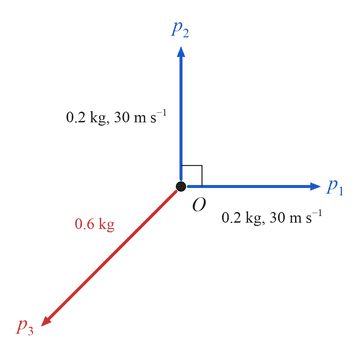
Step 4 — Find its speed. We divide its momentum by its mass:
This is about .
Step 5 — Check the other options. Each of the other speeds comes from a slip:
- (A) This divides by instead of multiplying: it would need the two equal momenta to have a resultant of only .
- (C) This would be the speed if the heavy fragment were only 0.3 kg, one and a half times each light fragment, instead of 0.6 kg.
- (D) This would be the speed if the third fragment had the same mass as each of the others; it is three times heavier, so its speed is a third of this.
Therefore, the heavier part moves with a speed of m/s.
- 91 mark
Question 9
A bomb of 12 kg explodes into two pieces of masses 4 kg and 8 kg. The velocity of 8 kg mass is 6 m/s. The kinetic energy of the other mass is
Solve with AIAnswer
(A) 48 J
(B) 32 J
(C) 24 J
- Correct
(D) 288 J
Answer: (D) 288 J
Concept: In an explosion only internal forces act, so the total momentum is conserved. The bomb is at rest before it explodes, so the two pieces move off with equal and opposite momenta.
Step 1 — Find the velocity of the 4 kg piece. Let it move with velocity . The total momentum after the explosion is zero:
The minus sign shows that it moves opposite to the 8 kg piece, at 12 m/s.
Step 2 — Find its kinetic energy. We use :
Step 3 — Check the other options. Each of the other values comes from a slip:
- (A) 48 is the size of the momentum of the 4 kg piece (, in kg m/s), not its kinetic energy.
- (B) 32 J would need the 4 kg piece to move at only 4 m/s; momentum conservation gives it 12 m/s.
- (C) 24 J is : the speed has not been squared.
Therefore, the kinetic energy of the 4 kg piece is 288 J.
- 101 mark
Question 10
A long spring is stretched by 2 cm, its potential energy is . If the spring is stretched by 10 cm, the potential energy stored in it will be
Solve with AIAnswer
(A)
(B)
(C)
- Correct
(D)
Answer: (D)
Concept: The potential energy of a spring stretched by is , so .
Step 1 — Write the ratio of the energies. The spring constant is the same, so it cancels:
Step 2 — Check the other options. Each of the other answers comes from a slip:
- (A) turns the ratio upside down; a bigger stretch stores more energy, not less.
- (B) turns the ratio upside down and also leaves out the square.
- (C) treats the energy as proportional to instead of .
Therefore, the potential energy stored becomes .
- 111 mark
Question 11
Two masses of 1 g and 9 g are moving with equal kinetic energies. The ratio of the magnitude of their respective linear momenta is
Solve with AIAnswer
(A) 1 : 9
(B) 9 : 1
- Correct
(C) 1 : 3
(D) 3 : 1
Answer: (C) 1 : 3
Concept: For equal kinetic energy , momentum , so .
Step 1 — Write the ratio of the momenta. We divide the two momenta; the factor cancels:
Step 2 — Check the other options. Each of the other ratios belongs to a different quantity:
- (A) 1 : 9 is the ratio of the masses; the square root has been left out.
- (B) 9 : 1 is the ratio of the masses turned upside down.
- (D) 3 : 1 is the ratio of their speeds, since varies as ; the momenta are in the opposite ratio.
Therefore, the ratio of their linear momenta is 1 : 3.
- 121 mark
Question 12
A stone is thrown at angle 45° to the horizontal with kinetic energy . The kinetic energy at the highest point is
Solve with AIAnswer
- Correct
(A)
(B)
(C)
(D) zero
Answer: (A)
Concept: For a projectile (air resistance neglected), the horizontal component of velocity stays constant, while the vertical component becomes zero at the highest point.
Step 1 — Find the speed at the highest point. Let the stone be thrown with speed . At the top only the horizontal component is left:
Step 2 — Find the kinetic energy there. We put this speed into :
Step 3 — Check the other options. Each of the other answers comes from a slip:
- (B) uses the factor by which the speed falls without squaring it.
- (C) would need the speed to stay the same; it falls because the vertical component is lost.
- (D) Zero would mean the stone stops at the top, which happens only for a stone thrown straight up.
Therefore, the kinetic energy at the highest point is .
- 131 mark
Question 13
Two identical balls A and B moving with velocities + 0.5 m/s and − 0.3 m/s respectively collide head-on elastically. The velocities of the ball A and B after collision will be respectively
Solve with AIAnswer
(A) + 0.5 m/s and + 0.3 m/s
- Correct
(B) − 0.3 m/s and + 0.5 m/s
(C) + 0.3 m/s and + 0.5 m/s
(D) − 0.5 m/s and + 0.3 m/s
Answer: (B) − 0.3 m/s and + 0.5 m/s
Concept: In a head-on elastic collision of two bodies of equal mass, the bodies exchange their velocities.
Step 1 — Exchange the velocities. Ball A takes B's velocity and ball B takes A's velocity:
Step 2 — Check momentum and kinetic energy. Let each ball have mass . The total momentum before the collision is
and after it the total is , again . The total kinetic energy is both before and after, because the same two speeds are present. Both are conserved, as an elastic collision needs.
Step 3 — Check the other options. Each of the other pairs breaks momentum conservation:
- (A) The total momentum would be , not .
- (C) The total momentum would again be , not .
- (D) The total momentum would be , which has the wrong direction.
Therefore, after the collision the velocities of A and B are −0.3 m/s and +0.5 m/s respectively.
- 141 mark
Question 14
Water is falling on the blades of turbine at a rate of 100 kg/s from a certain spring. If the height of the spring be 100 m, the power transferred to the turbine will be
Solve with AIAnswer
(A) 100 W
(B) 1 kW
(C) 10 kW
- Correct
(D) 100 kW
Answer: (D) 100 kW
Concept: Power is the energy delivered per second. Water of mass falling through a height gives up potential energy , so water falling at a rate delivers power .
Step 1 — Substitute the data. We take , with and :
This is 100 kW. With the power is , about 98 kW, and the nearest option is still 100 kW. (All the energy is taken to reach the turbine.)
Step 2 — Check the other options. Each of the other values leaves something out:
- (A) 100 W is a thousandth of the correct value; it would need only 0.1 kg of water to fall each second.
- (B) 1 kW is : the height has been left out.
- (C) 10 kW is : has been left out.
Therefore, the power transferred to the turbine is 100 kW.
- 151 mark
Question 15
Work done in time on a body of mass which is accelerated from rest to a speed in time as a function of time is given by
Solve with AIAnswer
(A)
(B)
(C)
- Correct
(D)
Answer: (D)
Concept: By the work–energy theorem, the work done on a body starting from rest equals the kinetic energy it has gained. A body accelerated uniformly from rest to speed in time has acceleration .
Step 1 — Find the speed at time . The body starts from rest with acceleration :
Step 2 — Find the work done up to time . The work done equals the kinetic energy at time :
Step 3 — Check the other options. Each of the other expressions does not even have the units of energy:
- (A) This equals , which has units of kg m; one factor of is missing.
- (B) This is twice option (A) and also has units of kg m, not joules.
- (C) This contains , so its units are kg² m² s⁻², not joules.
Therefore, the work done up to time is .
- 161 mark
Question 16
A body of mass accelerates uniformly from rest to in time . As a function of time , the instantaneous power delivered to the body is
Solve with AIAnswer
(A)
(B)
- Correct
(C)
(D)
Answer: (C)
Concept: The instantaneous power delivered by a force is , where is the speed at that instant.
Step 1 — Find the acceleration and the force. The body gains speed in time at a uniform rate:
Step 2 — Find the speed at time . The body starts from rest:
Step 3 — Multiply force and speed. The power at time is
Step 4 — Check the other options. Each of the other expressions has the wrong units for power:
- (A) This is at time , the momentum of the body (units kg m s⁻¹), not the power.
- (B) This has the units of energy (joules), not of power (watts): one factor is missing.
- (D) This equals , which has units of kg m, not watts.
Note: Option (A) is printed with in place of , a misprint, since no appears in the question; it is shown here with .
Therefore, the instantaneous power delivered to the body is .
- 171 mark
Question 17
A ball hits the floor and rebounds after inelastic collision. In this case,
(A) the momentum of the ball just after the collision is the same as that just before the collision.
(B) the mechanical energy of the ball remains the same in the collision.
(C) the total momentum of the ball and the Earth is conserved.
(D) the total energy of the ball and the Earth is conserved.
Solve with AIWritten solution
Solution:
Concept: Momentum is conserved for a system on which no external force acts. Total energy (counting heat and sound) is always conserved, but in an inelastic collision kinetic (mechanical) energy is not.
Step 1 — Judge statement (A). During the impact the floor pushes the ball upwards with a large force, which is an external force on the ball. The ball's momentum reverses direction (and, since the collision is inelastic, it also becomes smaller). So (A) is false.
Step 2 — Judge statement (B). In an inelastic collision part of the ball's kinetic energy becomes heat, sound and deformation, so the ball rebounds with a smaller speed and does not rise to its starting height. Its mechanical energy decreases, so (B) is false.
Step 3 — Judge statement (C). The force of the floor on the ball and the force of the ball on the floor (the Earth) are equal and opposite internal forces of the ball–Earth system. The Earth gains exactly the momentum the ball loses, so the total momentum of the ball and the Earth is conserved. (C) is true.
Step 4 — Judge statement (D). The kinetic energy lost by the ball is not destroyed: it becomes heat in the ball and the floor and sound in the air round them (counting the air as part of the Earth). So the total energy of the ball and the Earth is conserved. (D) is also true.
Note: The book's key gives only the momentum statement (C), but statement (D) is also correct once the heat and sound are counted, so this question has two correct options.
Therefore, statements (C) and (D) are both correct: the total momentum of the ball and the Earth is conserved, and so is their total energy (with heat and sound included).
- 181 mark
Question 18
What is the work done by the centripetal force?
Solve with AIWritten solution
Solution:
Concept: Work is zero when the force is at right angles to the displacement.
Step 1 — Find the angle. The centripetal force on a body moving in a circle acts along the radius, towards the centre, while each small displacement is along the tangent. The angle between them is 90°.
Step 2 — Find the work. Since , the centripetal force does no work at any point; it changes only the direction of the velocity, not the speed.
Therefore, the work done by the centripetal force is zero.
- 191 mark
Question 19
What is the potential energy associated with a non-conservative force?
Solve with AIWritten solution
Solution:
Concept: The potential energy of a body at a point is defined through the work done by a force when the body moves between a reference point and that point. This definition works only when that work depends on the two end positions alone, which is true for conservative forces such as gravity and the spring force.
Step 1 — Look at a non-conservative force. For a non-conservative force such as friction, the work done between two points depends on the path followed, and round a closed path it is not zero.
Step 2 — See why no potential energy can be defined. Because the work between two points changes with the path, no single value of potential energy can be given to each position. The work done against friction is not stored for later use; it is lost as heat.
Note: An answer of "zero" is often given. Strictly, potential energy is not defined at all for a non-conservative force, which is different from its having the value zero.
Therefore, no potential energy can be associated with a non-conservative force: potential energy is defined only for conservative forces.
- 201 mark
Question 20
When a porter carries a load on a horizontal road, he is doing work against a force. Name that force.
Solve with AIWritten solution
Solution:
Concept: Work is done against a force only when the motion has a component opposite to that force.
Step 1 — Rule out gravity. The load moves horizontally while gravity acts vertically downwards. The angle between them is 90°, so the porter does no work against gravity on the load.
Step 2 — Name the opposing force. The forces that oppose the horizontal motion of the porter and the load are frictional forces, such as the resistance of the air. The porter does work against these forces.
Note: The grip of the road on the porter's feet (static friction) is what pushes the porter forward; that force does not oppose the motion.
Therefore, the porter does work against the force of friction.
- 211 mark
Question 21
In a tug of war, one team is slowly giving way to the other. What work is being done and by whom?
Solve with AIWritten solution
Solution:
Concept: Work is positive when the force acts along the displacement and negative when it acts against it.
Step 1 — Look at the winning team. The winning team pulls the rope (and the losing team) towards itself, and the losing team moves in that direction. The force and displacement are in the same direction, so the winning team does positive work on the losing team.
Step 2 — Look at the losing team. The losing team pulls the other way, against the displacement, so it does negative work.
Therefore, the winning team does (positive) work on the losing team, while the work done by the losing team is negative.
- 221 mark
Question 22
A moving car is suddenly stopped. What happens to its K.E.?
Solve with AIWritten solution
Solution:
Concept: Energy is never destroyed; it only changes from one form to another (law of conservation of energy).
Step 1 — Find the forces that stop the car. When the brakes are applied, the brake pads rub against the discs or drums, and the tyres grip (or skid on) the road. These frictional forces act against the motion and do negative work on the car until it stops.
Step 2 — Follow the energy in a braking stop. The work done against friction changes the kinetic energy of the car into other forms. When the wheels keep rolling, most of it becomes heat in the brakes; if the wheels lock and skid, much of it becomes heat in the tyres and the road. A small part becomes sound, such as the screech of the tyres. (In electric and hybrid cars, regenerative braking turns part of the kinetic energy into electrical energy stored in the battery.)
Step 3 — Follow the energy in a crash. If the car is stopped suddenly by hitting something, much of its kinetic energy is used in crushing (deforming) the car and the obstacle, and this too ends up mostly as heat, with some sound. A tiny part sets the nearby air and dust moving.
Therefore, the kinetic energy of the car is not destroyed: it is converted mainly into heat (in the brakes, tyres and road, or in the crushed parts in a crash), with a small part into sound and into the motion of the nearby air and dust.
- 231 mark
Question 23
When a ball is thrown up, the magnitude of its (i) momentum and (ii) kinetic energy decreases and then increases. Does this violate the laws of conservation of (i) linear momentum and (ii) energy?
Solve with AIWritten solution
Solution:
Concept: The conservation laws apply to the total momentum and the total energy of a whole isolated system, not to one part of it.
Step 1 — Momentum. The gravitational pulls between the ball and the Earth are internal forces of the ball–Earth system. As the ball's momentum changes, the Earth's momentum changes by an equal and opposite amount, so the total momentum of the ball, the Earth (and the air molecules) is conserved.
Step 2 — Energy. As the ball rises, its kinetic energy decreases but its potential energy increases by the same amount; as it falls, the potential energy changes back into kinetic energy. The total energy stays the same.
Therefore, no: the momentum of the ball, the Earth and the air remains conserved, and when the kinetic energy decreases the potential energy increases, so the total energy remains conserved.
- 241 mark
Question 24
Two ball bearings of mass , each moving in opposite directions with equal speeds, collide head-on with each other. Predict the outcome of the collision, assuming it to be perfectly elastic.
Solve with AIWritten solution
Solution:
Concept: In a head-on elastic collision of two equal masses, the bodies exchange their velocities.
Step 1 — Write the velocities before the collision. Take one direction as positive: the first bearing has velocity and the second has .
Step 2 — Exchange them. After the collision the first bearing has velocity and the second has : each bounces back with its original speed. Total momentum is zero before and after, and the total kinetic energy, , is unchanged.
Therefore, the two ball bearings rebound from each other, each moving back with the same speed .
- 251 mark
Question 25
The casing of a rocket in flight burns up due to friction. At whose expense is the heat energy required for burning obtained? The rocket or the atmosphere?
Solve with AIWritten solution
Solution:
Concept: The heat produced by friction comes from the energy of the body that does work against the friction.
Step 1 — Find who does the work. The rocket does work against the air's friction as it moves.
Step 2 — Find where the energy comes from. This work, which appears as heat, is taken from the rocket's own mechanical energy (supplied by its fuel).
Therefore, the heat energy is obtained from the rocket.
- 261 mark
Question 26
If is the mass of a body and is its kinetic energy, then what is its linear momentum?
Solve with AIWritten solution
Solution:
Concept: Kinetic energy and momentum , where is the speed of the body.
Step 1 — Write the kinetic energy in terms of the momentum. Since , the speed is . We put this speed into the formula for kinetic energy:
Step 2 — Make the subject. We multiply both sides by and take the positive square root, because the magnitude of momentum is positive:
Therefore, the linear momentum is .
- 271 mark
Question 27
The P.E. of a body at a height is . What will be its K.E. when it falls freely to the ground?
Solve with AIWritten solution
Solution:
Concept: When only gravity acts (air resistance neglected), mechanical energy is conserved: the potential energy lost equals the kinetic energy gained.
Step 1 — Write the energy at the starting point. The body starts from rest at height , so its kinetic energy there is zero and its total mechanical energy is .
Step 2 — Write the energy at the ground. Taking the ground as the zero of potential energy, the potential energy just before the body reaches the ground is zero. Let its kinetic energy there be . Conservation of mechanical energy gives
All the potential energy lost on the way down has become kinetic energy.
Therefore, its kinetic energy on reaching the ground is .
- 281 mark
Question 28
When a spring is stretched, is the work done by the stretching force positive or negative?
Solve with AIWritten solution
Solution:
Concept: The work done by a constant force is . It is positive when the force acts in the same direction as the displacement (an angle of 0°).
Step 1 — Find the direction of the force. To stretch the spring, the stretching force pulls the free end of the spring outwards, away from the fixed end.
Step 2 — Compare it with the displacement. The free end also moves outwards, so the force and the displacement are in the same direction and the angle between them is 0°:
This is a positive quantity.
Note: The spring's own restoring force pulls inwards, against the stretch, so the work done by the spring itself is negative.
Therefore, the work done by the stretching force is positive.
- 291 mark
Question 29
Is the work done by the applied force positive or negative, when a heavy body is lowered to the ground?
Solve with AIWritten solution
Solution:
Concept: The work done by a constant force is . It is negative when the force acts opposite to the displacement (an angle of 180°).
Step 1 — Find the direction of the applied force. To lower the heavy body gently, without letting it fall freely, the hand or rope must hold it back, so the applied force acts upwards.
Step 2 — Compare it with the displacement. The body moves downwards, so the angle between the applied force and the displacement is 180°:
This is a negative quantity.
Note: Gravity acts downwards, along the displacement, so the work done by gravity on the body is positive.
Therefore, the work done by the applied force is negative.
- 301 mark
Question 30
By what factor is the velocity of a vehicle increased so that its kinetic energy may increase by a factor of 4?
Solve with AIWritten solution
Solution:
Concept: Kinetic energy , so for a body of fixed mass .
Step 1 — Write the ratio of the kinetic energies. Let the speed change from to while the kinetic energy changes from to . The mass is the same, so cancels:
Step 2 — Put in the factor of 4. The kinetic energy becomes 4 times as large, so
Therefore, the velocity should be doubled (increased by a factor of 2).
- 311 mark
Question 31
The momentum of a body is doubled. What is the percentage increase in its kinetic energy?
Solve with AIWritten solution
Solution:
Concept: For a body of fixed mass, , so .
Step 1 — Find the new kinetic energy. When the momentum is doubled (the velocity is doubled), the kinetic energy becomes times, .
Step 2 — Find the percentage increase. We divide the increase by the original value:
Therefore, the kinetic energy increases by 300%.
- 321 mark
Question 32
Where is the energy of a vertically projected body maximum?
Solve with AIWritten solution
Solution:
Concept: For a body moving only under gravity (air resistance neglected), the total mechanical energy, kinetic plus potential, is conserved.
Step 1 — Apply the conservation law. As the body rises, kinetic energy changes into potential energy, and as it falls the change is reversed; their sum stays fixed.
Step 2 — Note how each part varies. The kinetic energy is greatest at the point of projection and the potential energy is greatest at the highest point, but their total is the same everywhere.
Therefore, the total energy is the same at all points of the path, because energy is conserved (the kinetic energy alone is greatest at the bottom, the potential energy at the top).
- 331 mark
Question 33
Two bodies of masses and are moving with equal kinetic energies. What is the ratio of their linear momentum?
Solve with AIWritten solution
Solution:
Concept: Momentum and kinetic energy are linked by , so for equal kinetic energy .
Step 1 — Write each momentum. Both bodies have the same kinetic energy , with masses and :
Step 2 — Divide the two momenta. The factor cancels, leaving the square root of the mass ratio:
The lighter body has half the momentum of the heavier one.
Therefore, the ratio of their linear momenta is 1 : 2.
- 341 mark
Question 34
Is it possible to increase the kinetic energy without the application of external force?
Solve with AIWritten solution
Solution:
Concept: By the work–energy theorem, kinetic energy changes when work is done on the parts of a system, and internal forces between the parts can do work.
Step 1 — Give an example. When a bomb explodes, the forces between its parts are internal, yet they do work and push the fragments apart. The fragments, at rest before, now move, so the kinetic energy has increased; it comes from the chemical energy of the explosive.
Therefore, yes: the work done by internal forces can increase the kinetic energy, as for the fragments of an exploding bomb.
- 351 mark
Question 35
K.E. of a particle is increased by 300%. Find the percentage increase in momentum?
Solve with AIWritten solution
Solution:
Concept: For a fixed mass, , so .
Step 1 — Find the new kinetic energy. An increase of 300% adds to :
Step 2 — Find the new momentum. The momentum grows by the factor , so .
Step 3 — Find the percentage increase. We divide the change in momentum by the original momentum:
Therefore, the momentum increases by 100%.
- 361 mark
Question 36
Assume that the Earth revolves around the Sun in a perfectly circular orbit. Does the Sun do any work on the Earth?
Solve with AIWritten solution
Solution:
Concept: A force does no work when it is at right angles to the displacement.
Step 1 — Find the angle. On a circular orbit, the Sun's gravitational pull on the Earth is along the radius, while the Earth's displacement at each instant is along the tangent. The angle between them is 90°.
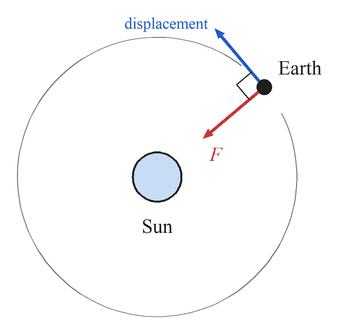
Step 2 — Find the work. Since , the work done is zero at every point of the orbit.
Therefore, no: the Sun does no work on the Earth, because its gravitational force is perpendicular to the Earth's displacement.
- 372 marks
Question 37
Why do we say that the work done by a coolie carrying a suitcase along a horizontal road is zero?
Solve with AIWritten solution
Solution:
Concept: The work done by a force is , where is the angle between the force and the displacement. A force at right angles to the displacement does no work.
Step 1 — Find the force the coolie applies. To hold the suitcase on the head while walking at a steady speed, the coolie pushes it vertically upwards with a force equal to its weight .
Step 2 — Find the displacement. The suitcase moves horizontally along the road, a distance .
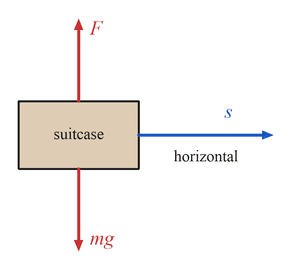
Step 3 — Calculate the work. The force is vertical and the displacement is horizontal, so :
Note: The coolie still gets tired: the coolie's muscles use up chemical energy to hold the load and to walk, even though no work is done on the suitcase in the physics sense.
Therefore, the work done by the coolie on the suitcase is zero, because the upward force the coolie applies is perpendicular to the horizontal displacement.
- 382 marks
Question 38
Why do we prefer to use work–energy concept to solve the dynamics of a mechanical system instead of Newton's laws?
Solve with AIWritten solution
Solution:
Concept: The work–energy theorem says that the net work done on a body equals the change in its kinetic energy. Work and energy are scalars, while Newton's second law, , deals with vectors at every instant.
Step 1 — Scalars are easier to handle. With Newton's laws we must resolve forces and accelerations into components and keep track of their directions. Work and energy are scalars, so they are simply added, and problems are solved more easily.
Step 2 — Only the end states are needed. The work–energy approach links the speeds at the start and end of the motion directly. We do not need the acceleration or the time at each instant, which makes it especially useful when the force changes from point to point or the path is curved.
Therefore, we prefer the work–energy concept because work and energy are scalars, so problems can be solved more easily than with vector equations, and only the initial and final states are needed.
- 392 marks
Question 39
Force and displacement are vectors. But work is scalar, why?
Solve with AIWritten solution
Solution:
Concept: Work is defined as the scalar (dot) product of force and displacement, ; in terms of magnitudes, .
Step 1 — Look at the definition. The dot product of two vectors multiplies their magnitudes and the cosine of the angle between them. The result is a single number with no direction.
Step 2 — Interpret it. Work measures how much energy is transferred, and energy has a size but no direction. The same amount of work is done whichever way the force and displacement point, as long as the angle between them is the same.
Therefore, work is a scalar because it is the scalar (dot) product of the two vectors force and displacement, , which has magnitude only and no specific direction.
- 402 marks
Question 40
Define work and energy. How are they related?
Solve with AIWritten solution
Solution:
Concept: Work describes the transfer of energy by a force; energy is the store from which work can be done.
Step 1 — Define work. Work is said to be done when a force acting on a body moves it through some distance. It is the product of the force and the component of the displacement along the force:
Its SI unit is the joule (J): 1 J of work is done when a force of 1 N moves its point of application through 1 m along the force.
Step 2 — Define energy. The energy of a body is its capacity (ability) to do work. Its SI unit is also the joule.
Step 3 — State the relation. When work is done on a body, its energy changes by the same amount. For example, the net work done on a body equals the change in its kinetic energy (the work–energy theorem):
Therefore, work is the product of force and the displacement along it, energy is the capacity to do work, and the two are related because the work done on a body equals the change in its energy (both are measured in joules).
- 412 marks
Question 41
If the force applied on body is varying, then how will you find the work done by the force?
Solve with AIWritten solution
Solution:
Concept: Over a very small displacement , even a varying force is nearly constant, so the small amount of work is . Adding all these small amounts gives the total work, which equals the area under the force–displacement graph.
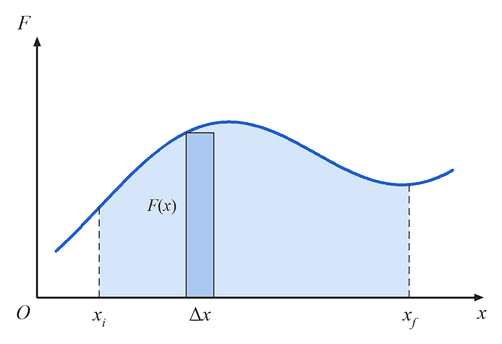
Step 1 — Split the displacement into small parts. Let the force act along the -axis while the body moves from to . Divide this displacement into many small parts, each of width .
Step 2 — Find the work in one small part. Over one small part the force hardly changes, so the work done is
This is the area of the thin strip in the figure.
Step 3 — Add the parts. The total work is the sum of all the strips. When is made very small, the sum becomes an integral:
Step 4 — Read it from the graph. The integral is the area enclosed between the – curve, the -axis and the lines and .
Therefore, the work done by a varying force is , which equals the area under the force–displacement graph between the initial and final positions.
- 422 marks
Question 42
Is it possible that the work done by a force is negative? Give an example.
- 432 marks
Question 43
When we lift a body, we apply force. Don't you think that the body gains kinetic energy with height? Explain.
- 442 marks
Question 44
Distinguish between a conservative force and a non-conservative force.
- 452 marks
Question 45
Is frictional force a conservative force or a non-conservative force? Why it is called so?
- 462 marks
Question 46
While calculating work done by a varying force, why do we calculate the work for small displacements ?
- 472 marks
Question 47
When can you say that a body has potential energy?
- 482 marks
Question 48
What is the P.E. of a mass kept at the centre of the Earth?
- 492 marks
Question 49
Show that the P.E. of a compressed spring is .
- 502 marks
Question 50
State the law of conservation of mechanical energy.
- 512 marks
Question 51
Define power. Give its S.I. unit.
- 522 marks
Question 52
What is the purpose of defining power?
- 532 marks
Question 53
Which conservation law is applicable to a body moving under non-conservative force?
- 542 marks
Question 54
Can kinetic energy be negative? Explain.
- 552 marks
Question 55
Can the average power be equal to the instantaneous power?
- 562 marks
Question 56
Can you exert force on a body without doing work? Give one example for a body at rest and another one for a body in motion.
- 572 marks
Question 57
“For one person the kinetic energy of a body is zero whereas for another person it is not zero”. Is it possible? Explain.
- 582 marks
Question 58
What is elastic collision? What are the conditions for a collision to be called as elastic collision?
- 592 marks
Question 59
In inelastic collision, momentum is conserved, but kinetic energy is not conserved, why?
- 602 marks
Question 60
Explain the energy transformations in a pole vault event.
- 612 marks
Question 61
A ball is dropped from the top of a building by a person. Another person observes its motion from the bottom. Will they agree on the values of the ball's potential energy and its change in P.E.?
- 622 marks
Question 62
A small cake of wet cement thrown at a corner in a wall remains glued to the wall. What happens to its initial energy?
- 632 marks
Question 63
A bob of a pendulum released from 30° to the vertical hits another bob of the same mass at rest on a table as shown. How high does the bob rise after the collision? Neglect the size of the bobs and assume the collision to be elastic.

- 642 marks
Question 64
Comet moves around the Sun in highly elliptical orbits. The gravitational force on the comet due to the Sun is not normal to the comet's velocity in general. Yet the work done by the gravitational force over every complete orbit of the comet is zero. Why?
- 652 marks
Question 65
Chemical, gravitational and nuclear energies are nothing but potential energies for different types of forces in nature. Explain this statement clearly with examples.
- 662 marks
Question 66
What is the minimum amount of energy released in the annihilation of an electron–positron pair?
- 672 marks
Question 67
What is kilowatt hour?
- 682 marks
Question 68
Work done during the motion of a body on a closed loop is zero for every force in nature. Is it true?
- 693 marks
Question 69
Define work, power and energy. Obtain an expression for work done by a constant force. How will you determine the work done by a constant force by graphical method?
- 703 marks
Question 70
Derive an expression for the work done by a varying force. Explain how the work done by a varying force can be determined by graphical method.
- 713 marks
Question 71
Show that force is the negative gradient of potential energy. Define spring constant. Derive an expression for the elastic potential energy of an extended spring.
- 723 marks
Question 72
Explain the different forms of energy and their transformations. Write down the Einstein's mass–energy relation. Give an example for conversion of energy into mass.
- 733 marks
Question 73
Explain collision in two dimensions. What is perfectly inelastic collision and derive the equation for perfectly inelastic collision in two dimensions?
- 745 marks
Question 74
(a) Give examples for positive work, negative work and zero work.
(b) Distinguish between conservative force and non-conservative force with examples.
(c) State and explain work–energy theorem.
- 755 marks
Question 75
(a) Define K.E. and P.E. Derive an expression for K.E. and P.E.
(b) State and prove the law of conservation of energy.
- 765 marks
Question 76
Derive the equations for the final velocities of two bodies undergoing a head-on elastic collision in one dimension. Hence show that for two bodies of equal mass, they nearly exchange their velocities after collision.
- 775 marks
Question 77
(a) Define instantaneous power. Define S.I. unit of power. Obtain the relation connecting power and velocity.
(b) Distinguish between elastic collision and inelastic collision.
(c) Show that during perfectly inelastic collision, there is a heavy loss of kinetic energy.
What Class 11 Physics Ch 9 covers
The sections of the chapter, in the order the book takes them. Every question above comes from one of these.
- 01Work Done by a Constant Force
- 02Work Done by a Varying Force
- 03Conservative and Non-Conservative Forces
- 04Kinetic Energy and the Work-Energy Theorem
- 05Potential Energy and Potential Energy of a Spring
- 06Conservation of Mechanical Energy
More ways to study this chapter
The same chapter asked three other ways. Practise it, revise it, and see what the board has set on Ch 9 before.
Class 11 Physics Ch 9 questions students ask
How many questions are there in Class 11 Physics Ch 9?
77 questions. Every one is solved step by step on this page.
Are these Class 11 Physics solutions free?
Yes. Every question and its full working is free to read, with no account needed.
Can I download the Class 11 Physics Ch 9 solutions as a PDF?
There is no PDF to download. Every solution is on this page instead, which means it is searchable, always the current syllabus, and readable on a phone. Use your browser's print option if you want it on paper.