
Question 703 marksMedium
Derive an expression for the work done by a varying force. Explain how the work done by a varying force can be determined by graphical method.
Confirming your payment
Sign up now and get 250 free tokens.
Work, Energy and Power · Question 70 of 77
Derive an expression for the work done by a varying force. Explain how the work done by a varying force can be determined by graphical method.
Solution:
Concept: Over a very small displacement a varying force can be treated as constant. Adding up the work for all the small displacements gives the total work as an integral, which is the area under the force–displacement graph.
Step 1 — Set up the problem. Let a force , whose value changes with position, act along the -axis on a body that moves along the axis from position to position .
Step 2 — Find the work over a small displacement. Divide the displacement into a large number of small displacements . Over each one the force is nearly constant, so the small amount of work done is
Step 3 — Add the small amounts of work. The total work is the sum of all these small amounts:
As is made smaller and smaller (), the sum becomes exact and turns into an integral:
Step 4 — Use the graphical method. Plot against . Each term is the area of a thin strip of height and width . Adding all the strips from to gives the area enclosed by the curve, the -axis and the ordinates at and .
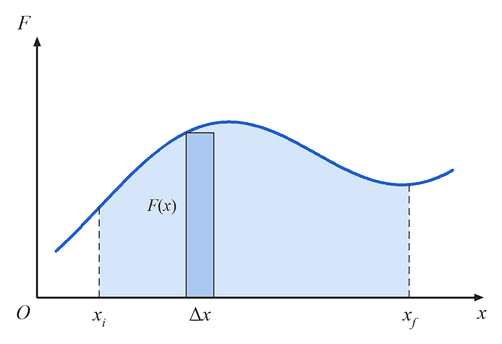
Watch out: Where the force is negative (the curve lies below the -axis), the area is counted as negative work.
Therefore, the work done by a varying force is , and graphically it equals the area under the force–displacement curve between and .