
Question 693 marksMedium
Define work, power and energy. Obtain an expression for work done by a constant force. How will you determine the work done by a constant force by graphical method?
Confirming your payment
Sign up now and get 250 free tokens.
Work, Energy and Power · Question 69 of 77
Define work, power and energy. Obtain an expression for work done by a constant force. How will you determine the work done by a constant force by graphical method?
Solution:
Concept: Only the component of a force along the displacement does work. For a constant force this gives , which is the area under the force–displacement graph.
Step 1 — Define the three quantities. Each definition is followed by its SI unit:
Step 2 — Resolve the force. Let a constant force act on a block at an angle to its displacement . We resolve into along the displacement and at right angles to it.
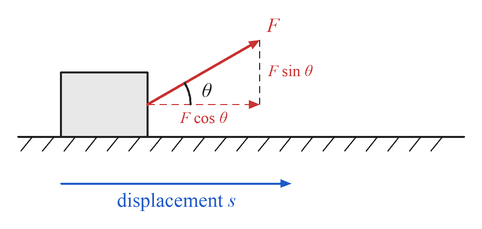
Step 3 — Find the work. The block does not move in the direction of , so that component does no work. The work is done only by , over the distance :
In vector form this is the scalar product . Work is positive for , zero for and negative for .
Step 4 — Use the graphical method. Take the force along the -axis and plot it against the position . A constant force gives a straight line parallel to the -axis. As the body moves from to , the work done is the force times the distance moved:
This product is the height times the width of the rectangle between the line, the -axis and the ordinates at and , so the work equals the area of that rectangle.

Therefore, the work done by a constant force is , the scalar product (in joules), energy is the capacity to do work (in joules) and power is the rate of doing work (in watts); graphically, the work done by a constant force equals the area of the rectangle under its force–displacement graph.