
Question 713 marksMedium
Show that force is the negative gradient of potential energy. Define spring constant. Derive an expression for the elastic potential energy of an extended spring.
Confirming your payment
Sign up now and get 250 free tokens.
Work, Energy and Power · Question 71 of 77
Show that force is the negative gradient of potential energy. Define spring constant. Derive an expression for the elastic potential energy of an extended spring.
Solution:
Concept: For a conservative force, the change in potential energy equals the negative of the work done by the force. A spring obeys Hooke's law, , where is the spring constant.
Step 1 — Relate force and potential energy. Let a conservative force act on a body that moves a small distance along the force's line. The force does work , and the potential energy falls by the same amount:
So the force is the negative gradient of the potential energy: it acts in the direction in which the potential energy decreases. For example, a body at height has , and the rule gives:
This is the weight, acting downwards (the minus sign shows it points towards decreasing ).
Step 2 — Define the spring constant. By Hooke's law, when a spring is stretched or compressed by , it exerts a restoring force
The constant is the spring constant (force constant): the restoring force per unit extension. Its SI unit is . A stiff spring has a large .
Step 3 — Find the work done in stretching the spring. Fix one end and pull the other slowly. When the extension is , we must apply a force outwards to balance the restoring force. For a further small extension the work done is . Stretching from to needs
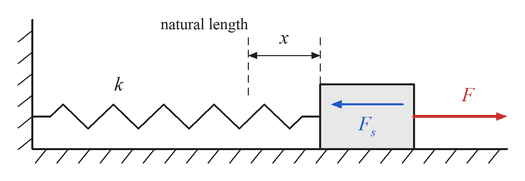
Step 4 — Read the same result from the graph. The applied force rises in a straight line from to , so the work is the area of the triangle under the graph, .

Step 5 — Identify the potential energy. This work is stored in the stretched spring as elastic potential energy, . As a check, , which is exactly the spring force.
Therefore, ; the spring constant is the restoring force per unit extension (in ); and the elastic potential energy of a spring extended by is .