
Question 745 marksMedium
(a) Give examples for positive work, negative work and zero work.
(b) Distinguish between conservative force and non-conservative force with examples.
(c) State and explain work–energy theorem.
Confirming your payment
Sign up now and get 250 free tokens.
Work, Energy and Power · Question 74 of 77
(a) Give examples for positive work, negative work and zero work.
(b) Distinguish between conservative force and non-conservative force with examples.
(c) State and explain work–energy theorem.
Solution:
Concept: Work is positive, zero or negative according as the angle between the force and the displacement is less than, equal to or more than 90°. The net work done on a body changes its kinetic energy.
Step 1 — Give examples of positive, negative and zero work for part (a). The sign comes from :
Step 2 — Distinguish the two kinds of force for part (b). The table compares them point by point.
| Conservative force | Non-conservative force |
|---|---|
| Work between two points does not depend on the path | Work depends on the path followed |
| Work round a closed path is zero | Work round a closed path is not zero |
| Work is stored as potential energy and can be fully recovered | Work is not stored; with friction it becomes mostly heat |
| Mechanical energy is conserved | Mechanical energy is not conserved |
| Examples: gravity, spring force, electrostatic force | Examples: friction, air resistance, viscous drag |
Step 3 — State the work–energy theorem for part (c). The work done by the net force on a body is equal to the change in its kinetic energy:
Step 4 — Prove it for a constant force. Let a constant net force act on a body of mass and move it a distance along the force, so that its speed changes from to . Its acceleration is , and the third equation of motion gives
We multiply both sides by :
Here is the work done by the force, so this work equals the gain in kinetic energy.
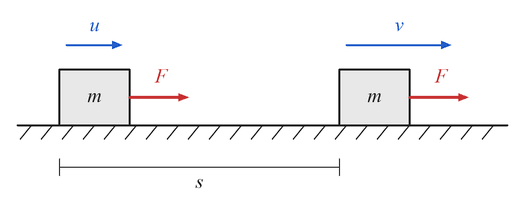
Step 5 — Prove it for a varying force. For a force that varies, Newton's second law gives . By the chain rule the acceleration can be written in terms of position:
So , and . We add up the work as the body moves from (speed ) to (speed ), writing for the speed inside the integral so that it is not confused with the upper limit :
Step 6 — Explain its meaning. If the net work is positive, the kinetic energy increases (the body speeds up); if it is negative, the kinetic energy decreases; if it is zero, the speed does not change.
Therefore, (a) lifting a load, friction on a sliding body and a centripetal force are examples of positive, negative and zero work; (b) conservative forces do path-independent work that is zero round a closed path, while non-conservative forces do not; (c) the work done by the net force on a body equals the change in its kinetic energy.